Showing posts with label Time. Show all posts

25.11.15

Embracing death as a joy of life

On my recent visit to Israel I had the honor of escorting my dad through some of his last days in life. I’d shared my thoughts and insights with my family, as part of our daily updates. The first one below was written early one morning following a few days of traveling and social encounters. About a week after my return to Canada my dad embraced the hold of death and passed away seven days later, Saturday, November 21 2015. My eulogy below was written in response to our last conversation.
I am grateful to have family and friends supporting us in this process of growth.
- - - - - - - - - - - - - - - - - - - - - - - - - - - - - - - - - - - -
Each of us carries an invisible load of baggage. This includes what I think of the other and what I think people think of me. My conversation with Gali, my niece, raises the notion that some issues might not require discussion. Tamar, my sister in-law, knows in advance what would offend her. We face a daily effort of dismantling this baggage of landmines and firebombs.

In one early moment of the Sterns’ visit to Vancouver last year, I waived a threatening finger in front of Yohanan. His response made me wonder what exactly happened there. My parents’ stay with us, transformed into a realization, that we can all enjoy it. With my raised finger I’ve exclaimed “If you don’t trust my good intentions and Yardena’s good intentions, we have no communication.” Yohanan jumped from his spot at the other side of the table. He then charged into the bedroom. A few seconds later we could hear him screaming at the tenant in Israel to pay his rent.

I am fascinated by our use of the comic in relating to life. Laughter relieves our breath and introduces a healthy dose of oxygen to our brain. In embarrassment and hardships it seems like laughter gives me a break. Instead of sliding into depression, laughter allows me to remove the tough issue from its threatening context. It doesn't always succeed. But a small story from my acquaintance with Gerstman, one of Yeheskely Clothing's suppliers, keeps inspiring me to employ laughter and insist on it.

Yoav, the designer I used to work with, was Gerstman's tenant for a few years. He's told me that they'd always had pleasant conversations. Some of them even included stories from the landlord's past as a Holocaust survivor. The man, bearing a smile on his face, was always happy to share amusing anecdotes. In one of Yoav's encounters with Gerstman the gentleman had confided: "So, in the concentration camps have I stopped laughing? Of course I had laughed." This was enough for me.

Yohanan Stern has been collecting clown figurines for years in a variety of forms: paintings, dolls and other creations. Some of them are sad, some are smiling. They all, in my view celebrate the light hearted side of our personality; the part that helps a healthy perspective of life. The sad clown might be mumbling "What's the point in being pessimistic; life's hard enough." The happy one is saying "Every situation entails a glimmer of bliss; the joy of life stems from that." You can notice the two clowns manifested in my dad. Occasionally I cringe embarrassedly from his fooling around. In the rest of time I tell myself that I am the same.

So where is Yardena in all of this? Let's not talk about Yardena. Taking care of Yohanan is currently top priority. She chunks a couple of pain killers in the morning and the day is settled. Never mind that their influence is receding. Just make sure they are Extra Strength. My effort in finding out how I might be the same gives me a headache. There you are, I made it! Now I can relax. We agreed that with all the difficulties we have a history and present of cooperation. In all of us, the good intentions overcome our frustrations. True, I know how to be turned off by Yohanan. And the point is that I am the one who is turned off. The other side in the story is not guilty of my being turned off but, alas, he is part of it.

So here is an idea for a scientific research in sociology: our life is built upon reducing our amount of turn off from people, especially those closest to us. Once I have already told mom that my success in life results "thanks to you as well as in spite of you." And then, doesn't Meni turn me off? Sharon? Erez? Ah,… Erez doesn't turn me off. And Yardena understands immediately. At the same time she is dead wrong. Erez doesn't turn me off because we hardly speak to each other. Yardena counts the ‘hardly’. YarOn counts the ‘speak’. Sharon comforts us in saying "that's OK." And Meni? He stopped reading in the first paragraph. And that too is OK.

This update has no immediate concrete implications. It is an intermediate summary in my line of impressions from what's up in the family. I am trying to bring to light some thoughts in hope that they allow a small window into space and a breath of fresh air. In the tough and serious situation we are all experiencing, the suffocating feeling of hopelessness might sabotage the delightful effort we are all involved in. My aspiration is that these words manage to amuse the moment a bit, until the next day.
- - - - - - - - - - - - - - - - - - - - - - - - - - - - - - - - - - - -
Yohanan,

Indeed we ate the last of the humus on your last day. Like some kind of a Hanukah miracle where you were the sacrifice. And we will continue to make humus and bake pitot (pita bread) and think of Nablus Gate, the falafel that we had to bring from the adjacent stall and the coffee that the guy poured from the boil. Much of what I could know about you came to me indirectly. Like a side observation. Something I had said off hand turned out months later to be significant to you.

Your lust for life has always entailed a measure of frightened, somewhat childish concern. As my ability to express my impression in words improved, your desire to give and nurture overcame any insult. I am grateful for the opportunity to learn something out of this. Looking from within, our life feels almost boring. Why even my effort to extract family stories for your fiftieth anniversary confronted a variety of objections from its members.

But life goes on and the memory will play its part. Much of what I will hear about you will fill the void. “I am the strongest dad in the world,” I told the impressed boy one day. At the same breath I continued “and my dad is even stronger.” Every joke has a component of truth in it. I am grateful for the opportunity to continue the joke.


29.3.14

Drop Shadow - In The Making

I met Michael Shandrick at a design thinking event back in 2011. This whole series of documentation was inspired by a conversation I've had with him a short while ago. We were discussing processes. In response to his description of a script he was engaged in writing, I've asked him about the possibility of him posting the story. He seemed pretty intrigued by the idea. As we were exchanging more thoughts I've realized the same idea could apply to me. This is the fourth post following First StagesResurrection and Statement.
Just a minute or two before our walking tour of Vancouver in the Design Thinking unConference

As soon as I embark on the act of executing my thoughts, the process itself is a form of result. However, it is also an exploration. You could even see it as an adventure, where not all the answers are known. The creative process can be planned in detail yet reality imposes hurdles in many forms. Time and money are the most basic of them. Proper planning helps in balancing the many components that the process entails as it unfolds. However, people get sick, accidents happen, new ideas come up. You can't anticipate everything.
The beauty of a process exists in any of its stages.

'Drop Shadow' as a work of art is an analogy to this process. When I had started working on it, the plywood squares I was painting on, represented pixels of the digital world. Technically, I've placed them together as one surface and occasionally shuffled them to add a new layer of paint. That has generated a degree of arbitrariness to the composition. A pixel is like that. It is a sort of canvas that accommodates whatever info is directed in its way. When all the pixels together form an image that makes sense to us, communication exists.
Scale is a fascinating feature of space.

As my world expanded into the urban realm, my interest in reflecting that in my art inspired me to look at "my pixels" with a new sense of purpose. For me, a city is the most complex product of human society. Its most challenging complexity is the fact that we are one of its components - its most important one. Without the city our lives would be something else. Without us, it won't exist, or at least slowly degrade into oblivion (have a look at this).
Reflections happen with smooth surfaces, within computer programs and in your head.

In this process my camera and computer were used as painting accessories. Taking photos of the acrylic squares had allowed me to manipulate the image before continuing to add paint. The desktop monitor enabled an enhanced flexibility in viewing the work and experimenting. Planning and execution progressed very quickly following decisions made over a compelling variety of options. Plywood, as a building material, allowed me to cut existing pieces and further play with their layout.
The side of a building in construction where the concrete pouring "imperfections" are still evident. 

This layering of processes is what I find compelling in everything I do. Whether it is an idea or an object, a present reality or a vision for the future; when I look at them as raw material, my options of action are wide open. The story is the action that connects everything together. Each story sheds a light of its own on our existence.  Light and shadow play equal roles in our sense of space. If for no other reason, naming my project 'Drop Shadow' sounds almost inevitable.
- - - - - - - - - - - - - - - - - 
This post was actually posted on August 28 2014. I had meant to publish it on the date that appears here but simply lost  track of my list of drafted files. Interestingly, in Blogger you can control the publishing date to reflect your interests.

18.1.14

Smellicious: What is the control that you’re willing to let go of?


Utopia with the Design Nerds

Gathering around the theme of utopia, our group is meandering between seemingly nonsensical expressions of imaginary realities of the future. We have decided to take 2064 - fifty years from now - as our destination in time. For a few moments I was really about to just pack everything and leave. However, sticking with the guidelines of the Design Nerds, I made an effort to accommodate the process. It turned out to be an intriguing event with valuable points for thought. 

Utopian story proposes a vision that allows a moment of reflection. Among other ideas, we've come up with such: no one is required to work for a living; free transportation is available for all; animal-and-vegetation rights have been integrated into the social structures in human society. As our discussion had progressed our story has become a little more coherent just before we had to stand in front of the crowd.

Here is a short recap of our story as I remember it. I might have introduced some of my own interpretations in an effort to make sense of some issues. However, the credit goes to all who participated in the evening at the Hive. Over there the Design Nerds are responsible for inspiring valuable discussions that all aim at positive change to our life on earth.

Smellicious

The year is 2064. Global ecosystems have fallen out of balance in the late twenty teens. This collapse was followed by a wholesome voiding of economic structures. Without much notice, a quick change in humans’ sense of smell (olfaction) ensued. After millennia of loosing our olfactory communication skills, human society suddenly regained its connection to animals and plants. With new social realizations, vegetation and animal rights became central in policy making and enforcement through the judiciary system.


With a newly found use for odours of all kinds, animals and plants are now consulted in issues that until not long ago have been the sole manifestation of human interests and needs. Extraction of resources is directed by insights that are generated through quick smelling exchanges between humans, animals and machines. Fabrication of any new product, be it electronic devices or massive infrastructure developments is monitored through an elaborate network of sensors, plant material, animals and humans. Anything manufactured in the world maintains a capacity to retract so that it can be re-used or returned to nature without harm to its environment.


Atrocities of the past such as formal possession of pets, experiments conducted on animals, and much more, have come to an absolute end. The plant and animal world has been relieved from an immense source of hardship. These systemic human-centric abuses have been recognized as crimes against nature. However, no trace of stench related to memories of past oppressions could be detected coming out of non-human organisms' glands.

Paradise Lost

In a pretty short exchange among mostly unfamiliar people, some ideas shared around the table find a thread to weave a story. The process has been a hit and miss affair in my experience with the Design Nerds. When I had first seen the announcement for the Utopia evening I was intrigued. Although the experience challenged my patience, it was a worthwhile challenge. One member of another group has provided an interesting insight: for her, utopia is probably a reality that we've lost. The Utopian story can be seen as an effort to reclaim what could be right about our world. 

The gathering this week provided me with an opportunity to explore my own process of engagement. I keep coming back to a question that relates to my expectations from society and from myself. What is the control that you’re willing to let go of? If nothing else, I will check that out in the next session of the Design Nerds on January 25th, less than a week from now.


22.12.12

How do you get to 2013 from here?

Well, take a right where they're going to tear down the viaducts.
Go straight past where they're going to put in the hi-rize.
Take a left at what was going to be the new community center.
And keep going until you hit the place where they're thinking of building that cycle-in bank.
You can't miss it.
(Paraphrasing on Laurie Anderson’s Big Science - 1982)
The street grid here shows Kingsway between Victoria Dr. and Rupert St. in Vancouver, BC. The background image shows part of the planting around our sidewalk tree.

In the past year I've been involved in a variety of meetings and discussions relating to urban and other issues. My fascination with urban life gradually brought me to realize how much I enjoy dealing with the massive challenges that urban planning imposes. The coming year is going to be another step in my constant
 exploration, exposure, planning, building and connection with the subject matter I am so engaged in.

Best wishes for a graceful move from one year to another, from day to day, from one thought to the next. Some steps are bigger than others. All are important.

21.4.11

stepping-stones

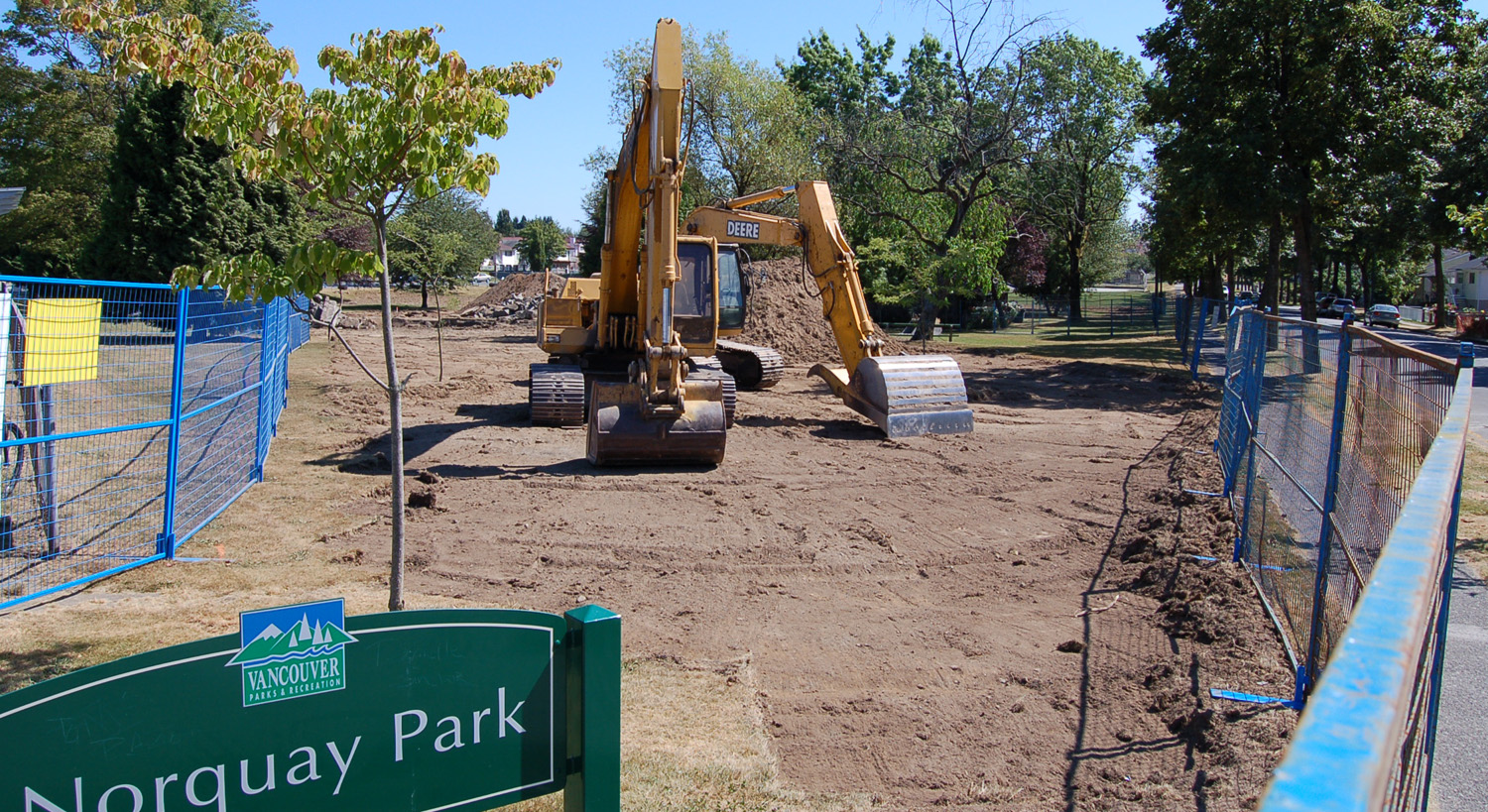
The block on Kingsway between Wales and Rhodes streets has light pedestrian traffic. As we are installing the last mosaic pieces in the two entries to the park the protective fence is still there. Norquay Park has been a construction zone since July of last year. The few people that pass by either slow down beside us or stop.
They are all curious as to when the park will be open again. They also notice the mosaic pieces and seem impressed with their beauty. Along the progress with installation we’ve gradually been able to get the sense of significance this project has in the upgraded park. The entry pieces have a good impact as gate decorations.

The history of Still Creek is one in many similar stories of urban industrialization, reflection and rehabilitation. Today the Vancouver part of the creek is still mostly hidden in underground pipes or behind chain link fences. From its designation as the most polluted stream in BC in the 1980s, much progress has been made and much more is required. Serious work has been taken to bring it back to a liveable natural element in urban space. The Norquay Park 2010 Clean Water Mosaic project is one stepping stone in a long educational journey.

Funding for our part of the journey came from the Vancouver Board of Parks and Recreation, the Vancouver Neighborhood Matching Fund and Collingwood Neighborhood House. The intention of this collaboration between budgetary resources is to facilitate community interaction. Participation in the building process of the park enhances the sense of ownership over the neighbourhood.

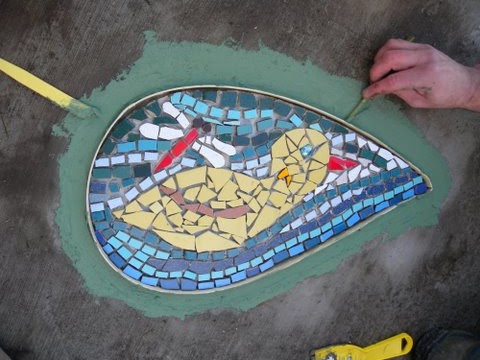
Members in the community were brought together to create a visual reminder for all to enjoy. Twenty pieces were created in this process and are now integrated in the concrete sections of the paths in the park. After entering either from its west or east entries you are welcome to explore the park and find the other mosaic pieces. All of them are a result of many hours shared by community members who participated in our workshops. It is our pleasure to thank them all, seniors, adults and youth for their contribution.

Installing our mosaics provided us with the opportunity to work closely with the architects and builders who were responsible for the function of the park. The result of their work is a fabulous space with a great sense of place.

The conclusion of this project brings me back to its starting point. In the research for mosaic making we met Liz Calvin and Bruce Walther. These two mosaic artists’ work can be seen in many places around and out of town. Without their generosity this project would have looked completely different. A sample of their collaboration can be seen in Downtown Vancouver where a set of eighteen pieces are placed.

Many more contacts were made throughout the process. Yoko and I are grateful to all who helped us get to this stage. Our own collaboration started with mutual interest in this experience and ends with excitement over the accomplishment. Just like the small pieces of a mosaic tile tell a story, the whole set of twenty expands this into space and time. This is a reflection on industrialization and rehabilitation.

19.3.11

are we there yet?

The park is slowly being completed. We’ve been away for the cold and wet winter. The forecast for excessive snow was mostly true for regions north of Vancouver. A few days after starting with the first piece though it did snow and from then on the weather kept playing between low temperatures and wet days.
A night walk in December. There wasn’t a lot of
snow this year but it was cold enough to prevent installation.
Yoko and I tried to stick to working together so that we learn from each other as much as possible. Until now it worked vey well. This week Yoko flied to Japan for a family visit. It is too early to conclude the degree of destruction following the earth quake a week ago. Nevertheless this is a moment in history that puts our lives into a grim perspective.
An aerial view of tsunami damage in the Tōhoku region.
From the first tile installed in October of last year we saw that the stained mortar band needs to be applied differently. If any of it rubs out onto the path surrounding the recess we are bound to spend more time and effort cleaning the mess. The solution is quite easy in theory: apply the paste carefully. In reality it was relatively easy but still challenging. A combination of cold weather, wet concrete path and crouching down to work were found to be a nice workout.
Into a one inch wide gap the mortar is applied in small amounts to
gradually create our desired band.
There is no way we can rush things even though we want to. As we move into spring more days are available to work on installation. The world around us is shaking in multiple directions. I think it’s a matter of re-imagining the excitement from last year that will help us shift gears. This is still a celebration of life.
Even with this impressive display of process the
grouting stage is still ahead of us.

26.11.10

always longer than you expect

The concrete was hard enough to step and jump on three days after it was poured. What you don’t see at that stage is the process of curing it goes though that takes about a month. Within that time it’s better not to lay our mosaic tiles in their recesses. Waiting for the concrete slab to cure allows adhesion with the mortar for the mosaic tiles to build up properly.

The plywood board is easily extracted from the recess.
An unwelcome puddle of water is exposed underneath.
By the time we could start it was already the end of October. A day or two of rain, and we need to wait. A few days of sunshine and it becomes colder. Proper setting of our mortar is sensitive to moisture and low temperatures. With the first tile we had started laying we realized that the opportunity was slipping away. The rest of the job will have to wait until spring.
A peanut buttery feel to the mix feels good
and is a suitable consistency.
Each tile will have a stained concrete band that is our choice for transition between the mosaic image and its surrounding gray paving. In order to achieve a clean line we need to fine tune our method of applying the stained concrete into the gap.
We surround the mosaic tile with a strip of masking taped cardboard
to leave room for the grout between the tile and the concrete band.
When we grout this piece we will also have a chance to see what other techniques we have to implement. This is a technically easy stage but it needs the same attention to details as we’ve invested in the process up to now. Grouting can drastically alter the appearance of a mosaic tile. If that happens we’d like it to be for the better. This is why I always tell people and try to remember myself: It always takes longer than you expect.

30.10.10

weather or not

Looking back at the process we went through I see that I can now afford to be a bit more personal. This month felt like a marathon. Giora and Irit, Anat's parents, my in-laws, were with us for two weeks on a visit from Israel. I was interested in reaching the final mosaic making session with as many of the tiles we needed finished. There was also an application package I was working on that needed to be sent. I had two weekends of this month dedicated to the Urban Design classes in SFU. In normal conditions this would have been busy but manageable. Even the weekend in Silverdale, near Seattle was a welcome break from routine.
Great sunny days on the weekend in Silverdale
At the end of that weekend we drove back to Vancouver to start the week. Anat's parents stayed in Washington for a few more days before joining us and leaving back to Israel. I had a few last touches on the mosaic pieces to make them ready for installation. The whole visit was turning into a great familial update with Inbal, our daughter, getting a lot of attention from her gramps.
Inbal enjoying the play, Saba enjoying his grand daughter
and the Richmond ice rink
On the first day of gramps enjoying the scenery of Mount Rainier, Irit broke her knee cap . This is one of those minor injuries that change your life in an instant and not for the better. In normal conditions she would have been operated in Washington and started rehabilitation. Being visitors in Canada with a flight back to Israel scheduled just a few days later introduced a whole set of considerations into the matter.
A short while before the accident as shot by Giora
As soon as Saba and Savta (Grandpa and Grandma) were back in Vancouver we started preparing for their flight to Israel. Rehabilitation is the most intensive component of treatment for this type of injury. An operation can be delayed for a few days without harm. Tickets needed to be changed, insurance issues were resolved and an operation had to be scheduled as soon as they landed in Israel.
Inspired by the occasion
At dinner of their last evening with us we raised glasses of wine for the admirable way Giora has managed the faxes, emails and phone calls. I complained that my desire to help wasn't fulfilled. To be honest, my in-law's independence allowed me to continue my daily activities with very little if any disruptions. No one wishes to enhance their lives with accidents and hardship. Still, whatever happens to you is part of your life. A day after landing in Israel Irit's knee cap was restructured. A day later she started walking again.
A short while before the concrete was poured
Our mosaics are waiting for a few days without rain to be laid and grouted. Vancouver weather is part of our life...

3.10.10

the best you can

Urban design might sound like a field that deals with inanimate components of the city: spaces, buildings, roads and other built environments. One of the reasons I've joined the certificate program in SFU is my perception of the urban as an extension of the human, physically and socially. I'm happy to find the SFU Urban Design program delivering an approach that runs along a similar line.
The plywood board is later taken away and leaves a recess
where the tile will be installed
The mosaic workshops are wrapping up to their final days of fabricating pieces. Soon we will start installing them in Norquay Park. Most of the concrete that will house our tiles has recently been poured. Each mosaic piece, as an inanimate illustration of water related creatures, is also a reflection of a person or people who created it. We've had school kids, teenagers, adults and seniors participating in this project. I've had the fortune of following some of them go through an inspiring creative process.
The story behind each tile is personal as well as artistic
There are many ways to work on the things you are currently busy with. There is only one way that I can consider to be right: doing the best you can. This is a decision that is inherently an attitude. As soon as you reach that decision, your work is pretty easy. From there you can only improve.
Some of the more compelling results come from challenges
like this somewhat messy start
Guiding people to embrace this attitude is a challenge I wasn't fully aware of getting into before joining this project. I am now looking at our finished mosaics and can't wait to see them in place. Whether it was an hour that some spent with us or a few months that others labored, each brought a piece of their own life into this. The story of each tile starts with an image anyone can see and extends to the world of the people who created it.
Grouting will probably bring this tile
to an even better expression of art.
Urban design deals with the built world and is concerned with us, living its story.

28.8.10

commitment

My perception of the urban environment as a tool for the use of human society brought me to engage with this project. Eighteen water drop shaped pieces are planned for the pathways and two circular mosaic pieces will mark the entry to the park. The collaboration between planning parties is the driving force behind proper urban management. The result can turn into great living conditions.
How does this relate to making mosaics with the public? When we work on laying each small piece of broken ceramic onto the surface of our concrete base, a personal story unfolds. That story will be viewed by other people who visit the park. They will have a chance to go through a journey into their imagination while walking along the pathways. Already I've had the opportunity to notice the many interpretations some of our finished pieces excite.
The light gray areas mark the surfaces where the mosaic tiles
will be placed. Click the image to zoom in
and see the placements for the mosaic tiles.
The architects have a job to do in designing this park. The builders are in charge of putting it in place. When construction is done, it is the public that will be there to live with the results. Having members of the community participate in putting a piece of their lives into the park is a neat way of tying the ends. Our taxes go into paying for this development. Our hands are still there to be part of building it. It's like baking your own cake instead of buying it in the grocery store.
These forms will be sunk flush into the concrete surface.
The resulting recesses will house the mosaic tiles.
As simple as making mosaics can be, the fact that they are going to be part of public space requires a degree of coordination that I find intriguing. Each party has a role to perform. By working together the process promotes an opportunity to make the most out of collaboration. Having a community arts project as part of this maintains a balance between the professional and the personal.
making sense of it all.

13.8.10

community-art

When we will look at the process we are going through these days in twenty years, what we will see is a result. The beauty of a fine process is that it can be seen in a result you enjoy looking at many years later. Our ingredients for this are planning, right team and leadership. From how things look up to now we are on the right track.
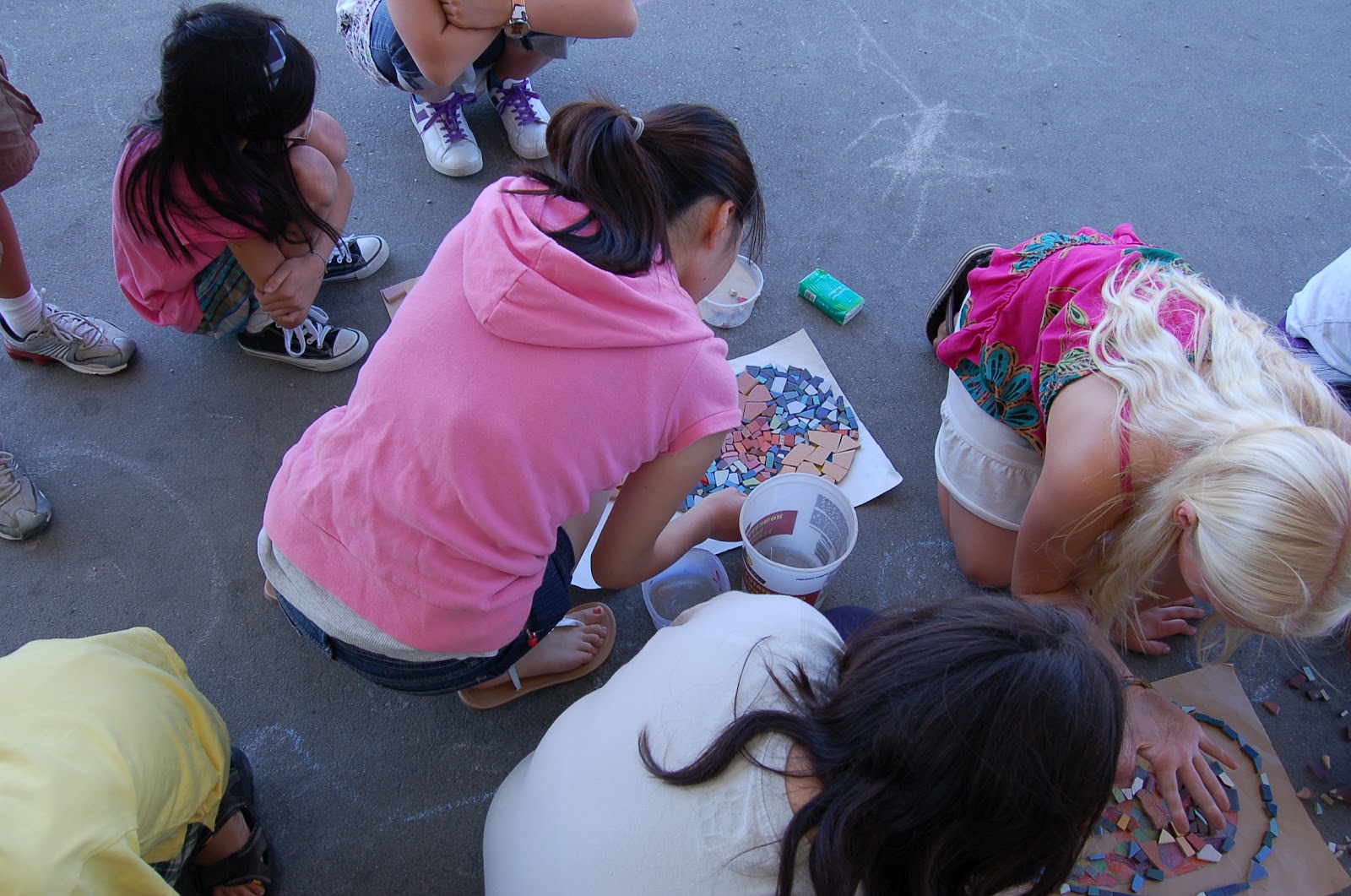
This week the two first mosaic pieces were completed. Finishing a high quality 1 square foot tile requires more than a two hour workshop session that we schedule weekly for our groups. Instead of waiting with each tile to be completed by the same person who started it, we moved some of them between groups to add pieces to the partially laid surface. This helped in two fronts: finishing tiles quickly without haste and generating a true sense of communal collaboration. 
We got to a point where one of our biggest challenges is people getting excited and engaged. Usually they just put too little mortar on a tile or lay them so that nothing seems to resemble the intended image. Add genuine interest and you can end up with a bunch of small disasters that no one knows exactly what to do with. This is where leadership comes in handy. We have great leaders helping us in guiding youth in one group. The group of adults seems to understand the need to consult our guidance. Our own leadership is then a matter of balancing between keeping a sense of interest in the work and sensitivity to each person contributing their time and energy to this project.
The demolition of the park that started a short while ago is now transitioning into pockets of construction. By the end of this month we might even see some concrete paths being poured. In those paths we will have recesses to accommodate our tiles. Although there's still a lot of work ahead of us, completion feels very close. 

2.8.10

learning is one thing. implementing is another.


Facilitating a Matching Fund workshop is a constant process of learning. Whoever joins us for an hour or a few sessions has unique skills, expectations and interests. For us that means we need to be many things to many people. How to do this changes from day to day. 
Yoko on the left with
the Renfrew Community Center youth group
Yoko and I are working as a team since we met less than two months ago. I'm really happy with how well we get along. Each of us learns from the other and we both manage to review our process and make decisions following each discussion. Whatever we go through in a workshop generates insights into the steps ahead. This is how we find ways of transferring our knowledge and experience to our audience.
Placing tile fragments on paper is a quick way
to feel the process of mosaic creation
The differences between kids and adults are noticeable in terms of ability to concentrate, understanding of language and amount of energy. What I've noticed as similarities is a generality that I'm taking as fact and nothing more. It is an impression that is followed by change that brings me at the end of a process to re-assess my own perception: Most of our visitors start with hardly any ability to imagine what they'd like to create. Through our guidance and leadership a gradual change is taking place in front of our eyes.
One person creates a design. Another lays tiles.
Some of our results are thoroughly collaborative
We need that change to happen if we want to generate results that reflect our capabilities. There is no question in our own ability to produce mosaic tiles that people can appreciate. The challenge is in helping our audience succeed in making similar, high quality results we would like to see in the renovated Norquay Park. In itself, this aspiration raises questions over issues relating to art, quality, and authority. It also raises questions over how far we can go within the structure of the Matching Fund.
From a crude freestyle laying start,
we moved on to fine details and attentive focus
To judge by where we are at in this collaboration, we have gone very far. We intend to continue improving on that.

16.7.10

mind off; hands on. community building

You can be done with laying tiles for a small mosaic in a short one hour and a half session. When it comes to working with the community this is what most people want on the one hand. On the other, the promise to have them learn is greatly compromised this way.
The hands-on approach allows for a fulfilling experience. The trick is to turn this into a rhythmic succession of learning waves. People can then both make something with their own hands and gain pieces of knowledge through their hands. The opportunity starts with a simple "I don't know how to draw". You never know immediately what makes people say that but with patience and persistence I usually find out that the person had something else on their mind. It could be the task that wasn't to their liking or simply a way to get some attention.
It's hard to predict exactly how a broken tiles mosaic will look like. The hammer strokes randomly produce pieces that are then placed on the design in a process similar to solving a puzzle. Playing with tiles before drawing a design on paper, helps in envisioning a style. This can later on be reproduced with realistic expectations. It would be interesting to see how the image above translates into a mosaic with the broken tiles system.
The same can be said about this drawing. Two variants are the main influence upon the quality of the final piece: the skill level of your audience and each of the participants' degree of engagement.
The sense of ownership that evolves through the process is present within the group no matter what age they are. The real benefit though of this project is getting people to interact in a way that is both fun and educational. A city needs this type of community building to really serve its purpose.