Showing posts with label Mosaic. Show all posts

22.3.14

The making of Drop Shadow - Artist Staement

Among the layers of creation, a statement is the artist's way of articulating the outcome for the viewer. Whether this explains the work or adds mystery, is a matter of choice. I find it intriguing to provide a statement that is both. The previous two posts (First StagesResurrection) mainly dealt with the timeline of working on 'Drop Shadow'. Apart from beauty, I want my work to provoke thought and nurture discussion. Open minded communication with my audience can generate new ideas and insights. The following is my statement for the show in July.
Our built environment is a result of generations of growth and interaction. In this body of work I'm reflecting on components of life and setting them in a pattern that supports new directions. We all come together on an individual journey and find the commons we need. The city is a body with endless faces. The way from which you look at it can change how you feel about and in it.
'Drop Shadow' is a process in which I contemplate the move between stages, the changes in time and scale, the balance between resource and allocation. From a young age I've been intrigued by the constant development of tools available to us. When I started using Photoshop I very quickly developed a variety of processes that allowed me to generate the features we needed for my team's projects. Then a tool called drop-shadow was introduced that in a single click created most of what my process had involved.
The city is our most complex tool and changing it seems to be on a larger scale than we can imagine. Within the arbitrary motions of fitting components together, a sense of order evolves. This sense of order is a source of both strength and weakness in all of us, individuals and societies. The need for change repeatedly shows itself. The effort to change is many times bigger than what we've thought or even hoped it would be.
'Drop Shadow' is merely a work of art. My work on creating it involves traditional arts materials such as acrylics and pencils. However, computer and various hand tools were a significant contribution to the results at hand. In 2003 its various components were constructed in a certain way. Revisiting them more than a decade later has allowed me to relate the small scale of revitalizing their existence to my current state of engagement with urban design. The effort of tweaking an established body of work involves finding the right balance between existing conditions and the boundaries of my imagination; between past, present and future.
My search is in how to turn this effort into play.

15.3.14

The making of Drop Shadow - Resurrection

My previous post (Drop Shadow - First Stages) ended with me leaving my art stored since 2005 for a few years.
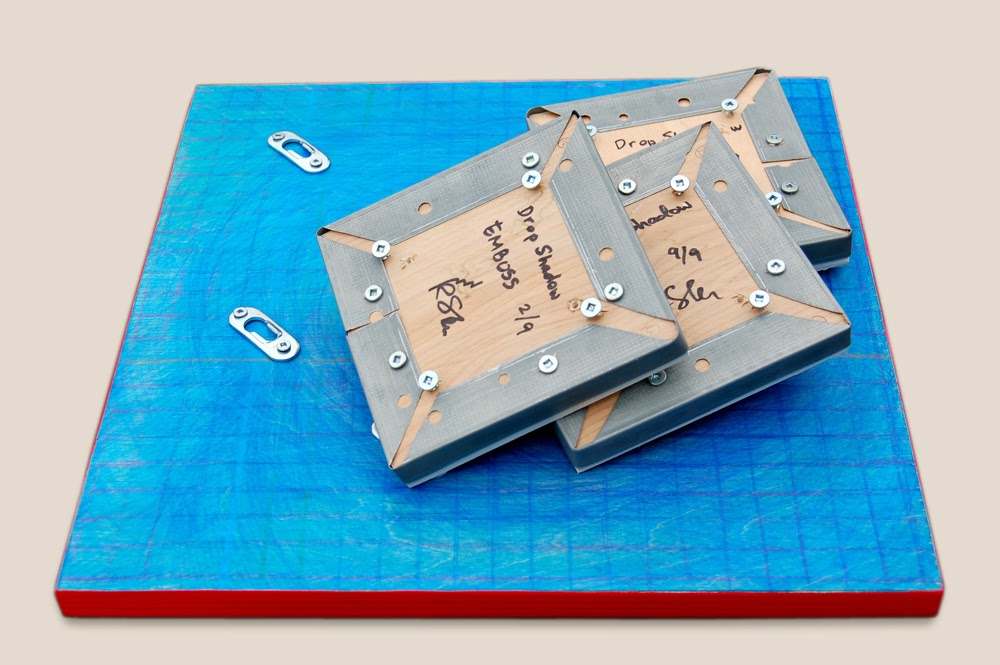
Then, in 2010 came my parents' 70th birthdays. It seemed like a great opportunity to take a look at what I've had and make something new out of it. This time, a square plywood board was selected to be the background and support for the whole composition. To make the small squares truly interactive, simple elements of hardware were employed. Making sure to work with an accurate template, I've installed screws at the back of each square so that one can insert each piece in any of the nine spots on the background board. I'm not sure my parents play with combinations of the various possibilities but they sure can, and that was my intention.
A little later I tried a down scaled version for a friend's wedding. Instead of a stained background I took a bunch of color pencils and worked on visually relating the pieces. Instead of nine squares floating above the surface I've selected three from the existing acrylics on plywood pieces.
Pressing the pencils on the background boards, there is a physical connection that forms between me and the surface. I enjoy the transparency of pencils where you can gradually add strokes and the color becomes more pronounced and still the color beneath shows itself. By contrast, acrylics tend to just cover the layer beneath. The difference between media supports my narrative of urban change: the effort of tweaking an established infrastructure involves finding the right balance between existing conditions and the boundaries of our imagination; between past, present and future.
My current state of the process is nearly ready with six pieces. They all use plywood boards as backgrounds and pencils in various degrees of application. There is a wide range of styles between them and still they seem to form a coherent family of objects. I am intrigued by how they will look when I'm done. Notice in the small works the similar pieces in blue. As my use of tools allows me to plan and anticipate the process, what I'm showing here is an approximately what they will be. On this, I will expand a bit later.

30.9.12

PKN - Norquay Mosaics in 20 slides at 20 seconds each

My first Pecha Kucha talk was delivered twice: in November 2010 I was the last in a line of speakers at the first ever Coquitlam BC PKN; in September 2012 the first ever Richmond BC PKN was held at the Cultural Center there and I was the eighth among ten. The Norquay Park Clean Water Mosaic was a Vancouver Neighborhood Matching Fund  project. This talk describes in 20 slides the issues related to the creative process we, Yoko Tomita and I facilitated in the Renfrew-Collingwood community back in 2010. Here it is in its revised and updated version: 
Halfway into a mosaic making session I’m delivering an enthusiastic speech about the fascinating process of telling a story through careful one by one laying of pieces onto the cement base. As part of my routine I ask one of the kids I am working with, “what is the story in your tile?”

“Whatever”, he responds in a typical juvenile bored expression.
“How do you spell whatever?” I ask him, still with the same breathless enthusiasm.
He starts with “aam, W. H. A…” and finally retreats to “whatever”.


At the time my daughter was six years old. I must have been influenced by the games I was playing with her. “How do you say it; How do you spell it” and so on.


Making mosaics was new to me. I haven’t really realized what I got myself into by joining this Neighborhood Matching Fund project. Working with the community is a challenge. In most cases it was fun.


Yoko Tomita is a community artist in the Vancouver East side. She is the one who actually prepared me to working with youth: they would say “Yoko, I’m bored” she warned me. “Hey, this is child labor…”. And they actually did.


For many of the artists out there community arts is a treacherous way of making a living. For me it was an opportunity to engage in design for urban space. 


My first encounter with design and production of large scale objects was in 2001, about a year before moving from Israel to Canada. I had an exhibition of eight lighting objects at the foyer of the Pavilion for Performing Arts in Tel Aviv.


For the mosaic project I had the fortune of meeting Bruce Walther and Liz Calvin, two professional and generous artists who have their mosaics installed in various locations around the lower mainland and even further away.


Our challenge was not only bored kids but many people’s low expectations that in many cases leads to lagging engagement. This drawing was made by a woman who initially said she could not draw. “Oh”, I said to her. “Can you draw a straight line?”; “Can you draw a circle?” “Looks like a drawing to me”.


No matter what skill level, it was a pleasant surprise to see people's creative process evolving as this pretty example shows.


The youth leader who started this one, occasionally asked for advice or direction. I would point to a simple pattern and half an hour later she’d come up with even better creations.


It wasn't always easy. No matter how patient Yoko would be, with the boy who started this, he would lose interest as soon as his design was covered by the broken tiles we worked with. But we needed more detail, we wanted to push the limits.


When I took the drawing home and played a bit with PhotoShop I wasn’t sure how the boy would react to someone else taking over his design. Miraculously, he loved it and continued working with a new sense of purpose.


It was always heartbreaking for people to realize that this was not the end. The woman who showed this to us thought it was perfect. We were looking for more detail. For us the task was simple: the gaps had to be even; every piece made a difference. Notice the chunky red border at the top and the yellow border around the dolphin.


One day she approached me just a few pieces before her mosaic was complete.  With the little English this woman had she managed to say, “It’s not beautiful”. “Ah,” I reassured her, “Whatever you manage to do is perfect. From there you can only improve.” 


The mosaic process was almost over when demolition of the old park started and we moved on to dealing with the landscape architect and contractors. It was mostly a friendly exchange of information. We were just a tiny component of the whole production but the coordination required some back and forthing that exposed a few challenges.


Even at the planning stage, the mosaics were supposed to go into the floor of the water spray feature. When the health authorities said that mosaics are not allowed in or near the water, I encouraged my colleagues with the realization that now the whole park could benefit from the art. The red dots show where the mosaics were proposed; the green marks show where they were eventually installed.


In the cold spring of 2011 we finally installed the pieces that were waiting in my basement throughout the winter. You need to wait for the concrete structure to cure before you can install the mosaics in the recesses that were made for them. During the winter it was too cold for the mortar to efficiently attach the tiles in place.

I think the achievement with the credit plate was managing to fit in all of the info we were expected to. But it was also the fact that we got a stone carved element with the absurdly low budget we had. The stone carver who made it for us was absolutely generous and committed when we explained the context of our project.

For me, Community Arts is not about art; it’s not about community. It’s about our connection. For this I’d like to thank you for reading this far and making it happen. To read even more, go to the Mosaic page of this blog.

1.4.11

engagement

I was halfway through a mosaic laying workshop discussing the fascinating aspects of creating a story through one by one laying of tiles on the concrete surface. As part of my routine I turned to one of the kids and asked him: “what’s the story in your tile?” His response illustrated exactly what Yoko had described as the challenge of working with youth: “whatever…” he said with the most lifeless look on his face.
They’re bored; they’re all over the place; they always want to do something other than what you were committed to deliver. “How do you spell whatever?!” I asked him with surprising breathless enthusiasm. In retrospect I couldn’t really explain where my outburst came from. His response was “aahm, doubleyoo, ‘H’, ‘A’…, whatever…”. So I had to conclude with “Good Job! I almost got you there!”.

Putting this experience in writing reminds me that face to face communications lives in a different universe than that of letters and text. In the written space, texting, typing or messaging have a life of their own. Whoever the recipient might be, my words arrive at the other side without facial expressions and no sounds. I can send an innocent “What’s up?” to my sister and hear the explosions from the other side of the world in a matter of minutes. Or never hear from her ever again.

Sometimes every breath we take is loaded with food for interpretations. When I was a teenager I had realized that no matter what I do or say there is always someone who will be upset. My conclusion was to do whatever felt right to me. If any explanations will be needed afterwards, so be it. You have to trust your own intentions.

Communications can be an adventure. There are people who prefer to avoid confrontation. I can envy them for their choice of calm and composure. Most of the time my patience is that of an educator. Occasionally though I feel like it is that of a rebel: why should I wait till tomorrow for the action that could have been taken yesterday?! But people need their own time to join a "revolution". Put the wrong pressure and something will break. Fixing what went wrong then takes place instead of any sense of progress. Without prior intentions I become a rescue expedition to outer space.

The mosaic workshops were mostly grounded in and around community centers. No extraterrestrial adventures here. The boy who got the attention he needed continued to work on his tile with a new sense of commitment. Whatever he texted to his friends afterwards I have no idea…

24.7.10

leather based concrete

This week marked a shift in the process of creating mosaics with our community. Technically, we learned how to lay tiles in a way that is both simple and insightful. Socially, this method allows us to better engage with our public. It all started with what looked like a brief encounter with two local mosaic artists, Liz Calvin and Bruce Walther. They are both separately making mosaic pieces and have collaborated in a Downtown Vancouver project.


Concrete on mesh can be cut with sissors

Colored concrete is a world of exploration

Soon to be seen in Norquay Park, Vancouver BC

Both were friendly on the phone and provided valuable information that seemed quite a lot and sufficient for any good start of mosaic tile creation. This was a few weeks ago when Yoko and I were experimenting with methods to teach at our workshops. After quickly meeting with Bruce at the New Westminster Fraser Festival I went on to meet Liz in her studio.

My own joy of sharing information comes from practical realization that this is one of the stepping stones for our shared success as a society. What I've experienced in my meeting with Liz was something like a hurricane of generosity. Not only did she share information but she also provided us with tiles, materials and tools that are probably equal to doubling our budget for this part of the project. Not enough thanks can be expressed for such an attitude.

Meanwhile, in our workshops we gradually feel the growing interest among our visitors, who step into the room and around the tables with curiosity. They start with struggling to fit broken tiles side by side. As Yoko and I guide them through the process, their results begin to show nice little expressions of art. Some of them already show the glimmer of enthusiasm at the side of their eyes. They end their session with an eagerness do to more. I'm looking forward to the tiles we are about to create in the next little while.