Showing posts with label People. Show all posts

4.9.17

Small Matters Matter

At home, 65 centimeters exist between my eyes and the surface in front of me when I stand to pee. In most public washrooms, urinals are attached to a blank, boringly surfaced wall. That wall is typically  spaced about 35 cm away. Sometimes there is a framed picture, many times an ad, hung up to attract us, the pee-standing population. If there is some depth in the image, a slight sense of relief accompanies the process of relieving my bladder. In rare occasions there is a ledge at chest height that adds a welcome sense of space. In even rarer installations, there is a small window.
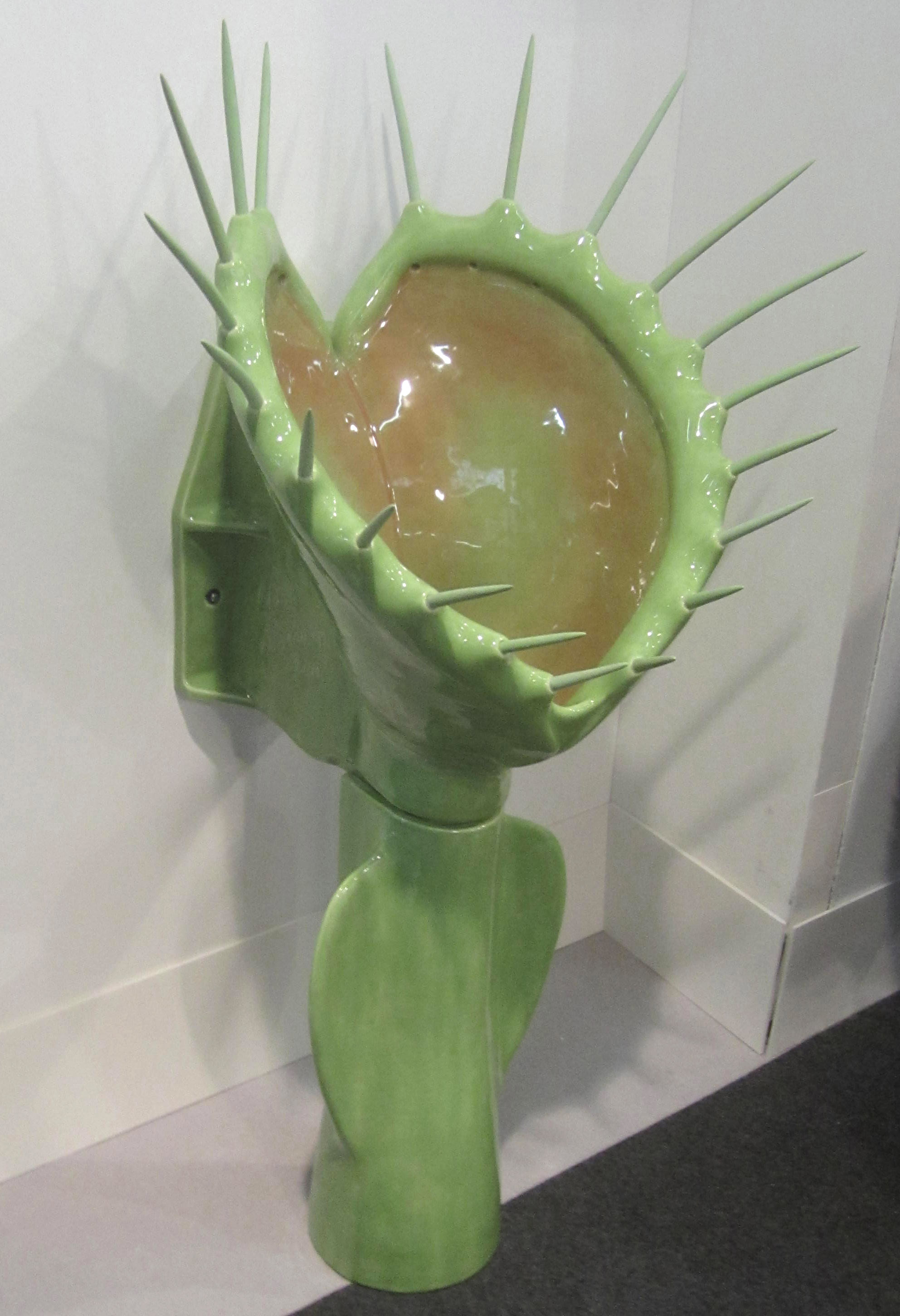
I've been enjoying the freedom of pee-standing forever, really. However, at times I simply get tired of the small accidents or even the occasional harmless splatter. As clean as I have always been, the stray drops that escape me accumulate in hidden gaps and get on my nerves. For a few years I managed to stick to pee-sitting. A seemingly small sacrifice for the sake of bathroom wellbeing. But temptations are not restricted to erotic avenues. One of my fantasies is to install a urinal at home.
However, the one I really want is just way too expensive, at least for the time being. So I stick my stick through the zipper and enjoy my musings in front of the blinded window in our humble bathroom. This morning for instance, I was wondering about the pattern of light that formed on one of the slats facing me. Light waves generate intriguing projections thanks to a variety of phenomena. When I thought of taking a picture of the light pattern, it occurred to me that until I set up the tripod and attach my camera on to it, the sun will move and the pattern might vanish with it. Still, which of the four cell-phones at our disposal would be best for the task? Why not try all? So yes. By the time I got to the fourth device, the projection changed.
Thankfully, none of the phones dropped into the toilet.


27.8.14

Fresh Roots Dig It

In our daughter's School's exploration of adding value to the educational experience, we've had a discussion with Fresh Roots.


On their website they say that they "transform underutilized spaces into thriving gathering places through urban agriculture. More than growing a garden, we grow community."


A quick visit to one of their locations in Vancouver allowed me to get an impression of what that transformation could look like.


In Norquay School, there is a nice play area, a few planting beds and vast gravel surfaces where kids roam in breaks and after school hours.


What my crappy phone-camera managed to capture is a compelling proposition for at least some of our school's yard.


Some of the photos are not that bad actually and of course that's not the point of teaming up with Fresh Roots.


Urban societies today are in a fascinating crossroads of defining many of their habits, including the act of farming their own produce.


Exposing kids to the possibilities at school age seems like a healthy way of keeping them connected to their source of life and hands on understanding of what sustainability could mean.


Farming is a labor intensive engagement. The friendly people at Fresh Roots may encourage more of us to reclaim the fun that is also part of it.


This Back Yard farming operation is located at the Vancouver Technical Secondary.

18.8.13

Talking about cars*

“So what is it about Vancouver that everyone’s talking about?”, my father's question from 2009 resonated in me as I was taking this picture. Downtown cities crammed with high-rises are a common sight in our world. Watching south from North Vancouver’s Waterfront Park you can definitely recognize it's Vancouver. However, to be honest, as a postcard image, it's just another big city. So what is it about Vancouver that everyone’s talking about? In my morning discussion with my wife we were talking about my future as urban designer. Am I actually contributing to our city's future?
One of my first incidents of planning for urban space was back in 2006. An invitation to participate in a public arts selection panel for the Steveston Community Center has introduced me to Doug Senft, one of three artists who had prepared a maquette for that eventHis Metal Cathedral from 1986 is a beautiful reflection on nature in and about the city. Still, our city is only as beautiful and meaningful as the people living in it and building it.
For our visit to the north shore we decided to take a walk starting from Lonsdale Quay and to let our steps lead us. Walking into the Waterfront Park, I was intrigued to see all these BMWs scattered around the lawn. My love affair with BMW started as a boy browsing through my grandmother’s National Geographic Magazine. Every month they used to have ads for BMW on one of the very first pages of each issue. I still admire what BMW are making but not so much as a drooling teenager anymore.
In 2009, after going to various places and experiencing some of Vancouver’s sights, my parents got over their flight inflicted back pains and jet lag. But it wasn’t until they had seen an acquaintance they’d known from a visit to Germany a few years earlier that the city made sense to them. Suddenly their whole visit turned into a story of success.

So what is it about a car club show that BMW lovers might talk about?

As Anat, Inbal and I were sitting on a bench enjoying the weather, the views and the hotdog, a passer by has asked me whether I was a BMW owner. Our first words drifted away from cars to let us learn that he had come from Acre. When he had realized our Israeli origins, our exchange shifted into an intriguing conversation. The whole visit to North Vancouver became a heart warming connection. Our city is only as beautiful and meaningful as the people living in it and caring for it.
- - - - - - - - - - - - - - - - - - - - - - - - - - - - - - - - - - - - - - - - - - - - - - - - - - - - - - - - - - -
* This is for Judi, whose recent remark about blogging was probably a good push for writing this one. Thank you.

20.4.13

Spellbound

“How do you spell whatever?!”
Prior to my interview with the selection panel for the West Richmond Community Center’s Art project five questions were sent to me for reference. They involved my ability to work with a variety of age groups, my process of developing collaborative processes and the challenges and opportunities I see in the proposed space. The questions seemed reasonable to me. They almost felt too easy. I knew I had to find a way to present the panel with "How do you spell whatever?"

This was my response to a youth from the community arts project in Vancouver I was involved in - Norquay Park 2010 Clean Water. When I had asked him what the story was in the tile he had been working on he answered in a single word: “Whatever”... In response to my "How do you spell whatever", he mumbled "Aam,... Double U, eighche, A, ... Whatever." From then on he seemed to be just a bit more engaged and interested. It was a moment that made me realize a point in community engagement: No one is there for you. As a facilitator my responsibility is to be with my audience. And at that exact moment I was totally with him. 

My entry into the City of Richmond’s public art platform started at around that time. Richmond’s public art planner, Eric Fiss, was coordinating a Pecha Kucha event. I had been looking for an opportunity to present the mosaic story and the waiting list for the Vancouver event looked hopelessly long. It still is. The Richmond event was cancelled that year but I stayed in touch with Eric and got onto the artists roster for public community arts. The way community arts projects are handled in Vancouver made me curious to see what things were like in Richmond.

The traffic to Richmond on the evening of my interview had been surprisingly light compared to previous experiences so I have arrived pretty early to City Hall. Eric seemed a bit concerned as if a possible encounter with the artist who was being interviewed before me might not be the best idea. For me it was no big deal. I found a spot to sit and prepare stuff for my turn. When the artist before me came out of the meeting room I handed her my card and introduced myself. I later found out that she, Jeanette Lee, was the one selected for this project.

Engagement in community arts is all about collaboration and the connections we make. When I stepped into the room where the panel had been waiting it was my first time to see them. However, our discussion seemed to pick up as if from some time in the past. The question from Norquay didn’t have to wait for too long to be mentioned. In my Pecha Kucha presentation it comes on the second slide. As I was preparing for the interview I had realized that my way of responding to the reference questions would be through a story. And the Norquay Mosaics story is still fresh as an illustration of my approach to dealing with community, be it kids, adults or seniors.

Community Arts is not about arts. It’s not even about community. It’s about our connections and what we make of them. Then our community is built. Then we make art.

So tell me now, what is your story, and how do you spell whatever?

21.3.13

See me and Julio down at the... PAC meeting

My first visit to a PAC meeting might be remembered by some for my proposal to call teachers by name… First name that is. I certainly remember the reaction of some to my proposal: vehement rejection.
When I was considering raising the issue it seemed to me almost like a non issue that maybe I shouldn't bother with. My vision of it was that people would just nod and say sure, why not. After all, we are in the 21st century.
It turns out I don’t know people that well. Do I know what PAC is? Is it Council or Committee... ? Well, it’s Council: “All parents/guardians of children in a school are members of the Parent Advisory Council” (from the School Board’s Handbook).
So here I am, almost three years as a parent of a child in school; still learning what this whole education system is all about; still trying to remember people’s names when I recognize their face. Anat and I try to alternate in attending PAC meetings so that the burden (and sometimes boredom) is shared.
Yes, you don’t have to be there to be a member. Before we know it, our daughter is eighteen and…, yeah, what century are we still in?

17.3.13

How are we doing, you may ask.


Fine tuning a message is like mixing colors to reach the perfect hue. The industry would always market the latest offering as the best ever. Then next year a new variant will show up, again, as the ultimate solution.
Strength Based Learning (SBL) is a fine title for an educational concept.
For me, an underlying tension exists between our intentions and the resulting messages we try to promote. My interaction with my daughter involves many expressions of behavior. Some of them are more pleasant than others. As she acquires the communication tools through exposure and practice, our interaction becomes more complex, challenging and rewarding. What is it in what we do that helps her in life and what might it be that undermines her progress? These questions are hard pressed to provide answers when dealing with other adults.
Many times I brought home exams marked at 97 points out of 100. My grandmother used to ask me “Why not a hundred?” She always did it with a smile that showed her content. But the message stayed: anything but perfect is not good enough. This search for balance between aspirations and reality is a life long endeavour. Everyone has a version of it that is made of infinite bits of beliefs and behaviours that make any of us what we are. Social interaction is a journey full of collaborations and confrontations. Throughout life I absorb ideas as well as reject others. In raising my kid I hope to expose her to experiences that lead her to socially healthy independence.
What is the state of social health in our world, our city, our neighbourhood? My daughter is an avid reader, so it seams we’ve done well so far. In the context of SBL we are commended as well as encouraged to go for more. But more might not necessarily mean more of the same. In the meeting with Faye Brownlie I found myself saying that our kids don’t need us that much. When adults try to discuss methods of promoting success of their kids I tend to cringe a bit. The intentions are all positive and worthy.
Children grow into their family and almost simultaneously out of it. We have a varying degree of control over their lives. My hope is to see my daughter confidently take control over her own life. She might share her perception of our efforts in the future. At the moment her ability and interest in doing so are limited.
Until we get her feedback if at all, we are busy mixing the colors in search of the perfect hue.

14.3.13

Strength Based Learning

In January this year Norquay School Principal Tricia Rooney shared with parents at the PAC meeting the concept of Strength Based Learning. On Tuesday, March 12, Faye Brownlie, a literacy and learning expert shared insights with a few parents and teachers at the school library. Teachers and Staff of Norquay Elementary in Vancouver have been introduced to Faye and the principles of Strength Based Learning by Tricia some time before. Faye Brownlie’s talk provided an intriguing window of thought into issues relating to the education of our children.

The focus of Strength Based Learning is in promoting the natural ability of anyone to succeed. For better or lesser reasons, our interest in promoting our kids’ success is always challenged. In society we then face a reality that not all of us are performing to the extent of our ability.
A child’s entry into adult world hinges on their ability to communicate in support of the society we all rely on. Play, learning and practice expose us as kids to a process that eventually becomes who and how strong we are. As adults we continue to play, learn and practice. As parents we hope to pass the better parts of our strength to our children.

Reading and writing are the core tools that enable us to connect in society. How to promote literacy in the early stages of life is where Strength Based Learning has a lot of insights to offer. Faye’s work around BC and elsewhere is an ongoing effort of keeping us connected to the simple truth that any of us is successful.
Norquay PAC shared the costs of inviting Faye to talk on this occasion. In appreciation to this and Tricia’s enthusiasm as an educator, I will continue to contemplate more at the topic and post new thoughts as they surface.

30.9.12

PKN - Norquay Mosaics in 20 slides at 20 seconds each

My first Pecha Kucha talk was delivered twice: in November 2010 I was the last in a line of speakers at the first ever Coquitlam BC PKN; in September 2012 the first ever Richmond BC PKN was held at the Cultural Center there and I was the eighth among ten. The Norquay Park Clean Water Mosaic was a Vancouver Neighborhood Matching Fund  project. This talk describes in 20 slides the issues related to the creative process we, Yoko Tomita and I facilitated in the Renfrew-Collingwood community back in 2010. Here it is in its revised and updated version: 
Halfway into a mosaic making session I’m delivering an enthusiastic speech about the fascinating process of telling a story through careful one by one laying of pieces onto the cement base. As part of my routine I ask one of the kids I am working with, “what is the story in your tile?”

“Whatever”, he responds in a typical juvenile bored expression.
“How do you spell whatever?” I ask him, still with the same breathless enthusiasm.
He starts with “aam, W. H. A…” and finally retreats to “whatever”.


At the time my daughter was six years old. I must have been influenced by the games I was playing with her. “How do you say it; How do you spell it” and so on.


Making mosaics was new to me. I haven’t really realized what I got myself into by joining this Neighborhood Matching Fund project. Working with the community is a challenge. In most cases it was fun.


Yoko Tomita is a community artist in the Vancouver East side. She is the one who actually prepared me to working with youth: they would say “Yoko, I’m bored” she warned me. “Hey, this is child labor…”. And they actually did.


For many of the artists out there community arts is a treacherous way of making a living. For me it was an opportunity to engage in design for urban space. 


My first encounter with design and production of large scale objects was in 2001, about a year before moving from Israel to Canada. I had an exhibition of eight lighting objects at the foyer of the Pavilion for Performing Arts in Tel Aviv.


For the mosaic project I had the fortune of meeting Bruce Walther and Liz Calvin, two professional and generous artists who have their mosaics installed in various locations around the lower mainland and even further away.


Our challenge was not only bored kids but many people’s low expectations that in many cases leads to lagging engagement. This drawing was made by a woman who initially said she could not draw. “Oh”, I said to her. “Can you draw a straight line?”; “Can you draw a circle?” “Looks like a drawing to me”.


No matter what skill level, it was a pleasant surprise to see people's creative process evolving as this pretty example shows.


The youth leader who started this one, occasionally asked for advice or direction. I would point to a simple pattern and half an hour later she’d come up with even better creations.


It wasn't always easy. No matter how patient Yoko would be, with the boy who started this, he would lose interest as soon as his design was covered by the broken tiles we worked with. But we needed more detail, we wanted to push the limits.


When I took the drawing home and played a bit with PhotoShop I wasn’t sure how the boy would react to someone else taking over his design. Miraculously, he loved it and continued working with a new sense of purpose.


It was always heartbreaking for people to realize that this was not the end. The woman who showed this to us thought it was perfect. We were looking for more detail. For us the task was simple: the gaps had to be even; every piece made a difference. Notice the chunky red border at the top and the yellow border around the dolphin.


One day she approached me just a few pieces before her mosaic was complete.  With the little English this woman had she managed to say, “It’s not beautiful”. “Ah,” I reassured her, “Whatever you manage to do is perfect. From there you can only improve.” 


The mosaic process was almost over when demolition of the old park started and we moved on to dealing with the landscape architect and contractors. It was mostly a friendly exchange of information. We were just a tiny component of the whole production but the coordination required some back and forthing that exposed a few challenges.


Even at the planning stage, the mosaics were supposed to go into the floor of the water spray feature. When the health authorities said that mosaics are not allowed in or near the water, I encouraged my colleagues with the realization that now the whole park could benefit from the art. The red dots show where the mosaics were proposed; the green marks show where they were eventually installed.


In the cold spring of 2011 we finally installed the pieces that were waiting in my basement throughout the winter. You need to wait for the concrete structure to cure before you can install the mosaics in the recesses that were made for them. During the winter it was too cold for the mortar to efficiently attach the tiles in place.

I think the achievement with the credit plate was managing to fit in all of the info we were expected to. But it was also the fact that we got a stone carved element with the absurdly low budget we had. The stone carver who made it for us was absolutely generous and committed when we explained the context of our project.

For me, Community Arts is not about art; it’s not about community. It’s about our connection. For this I’d like to thank you for reading this far and making it happen. To read even more, go to the Mosaic page of this blog.