Showing posts with label Create. Show all posts

29.3.14

Drop Shadow - In The Making

I met Michael Shandrick at a design thinking event back in 2011. This whole series of documentation was inspired by a conversation I've had with him a short while ago. We were discussing processes. In response to his description of a script he was engaged in writing, I've asked him about the possibility of him posting the story. He seemed pretty intrigued by the idea. As we were exchanging more thoughts I've realized the same idea could apply to me. This is the fourth post following First StagesResurrection and Statement.
Just a minute or two before our walking tour of Vancouver in the Design Thinking unConference

As soon as I embark on the act of executing my thoughts, the process itself is a form of result. However, it is also an exploration. You could even see it as an adventure, where not all the answers are known. The creative process can be planned in detail yet reality imposes hurdles in many forms. Time and money are the most basic of them. Proper planning helps in balancing the many components that the process entails as it unfolds. However, people get sick, accidents happen, new ideas come up. You can't anticipate everything.
The beauty of a process exists in any of its stages.

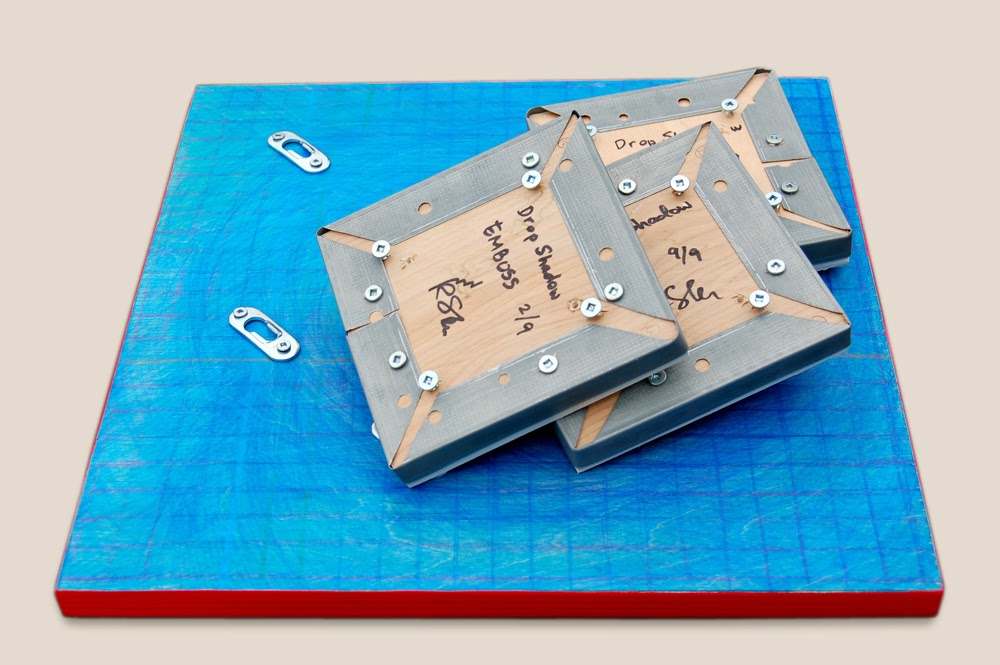
'Drop Shadow' as a work of art is an analogy to this process. When I had started working on it, the plywood squares I was painting on, represented pixels of the digital world. Technically, I've placed them together as one surface and occasionally shuffled them to add a new layer of paint. That has generated a degree of arbitrariness to the composition. A pixel is like that. It is a sort of canvas that accommodates whatever info is directed in its way. When all the pixels together form an image that makes sense to us, communication exists.
Scale is a fascinating feature of space.

As my world expanded into the urban realm, my interest in reflecting that in my art inspired me to look at "my pixels" with a new sense of purpose. For me, a city is the most complex product of human society. Its most challenging complexity is the fact that we are one of its components - its most important one. Without the city our lives would be something else. Without us, it won't exist, or at least slowly degrade into oblivion (have a look at this).
Reflections happen with smooth surfaces, within computer programs and in your head.

In this process my camera and computer were used as painting accessories. Taking photos of the acrylic squares had allowed me to manipulate the image before continuing to add paint. The desktop monitor enabled an enhanced flexibility in viewing the work and experimenting. Planning and execution progressed very quickly following decisions made over a compelling variety of options. Plywood, as a building material, allowed me to cut existing pieces and further play with their layout.
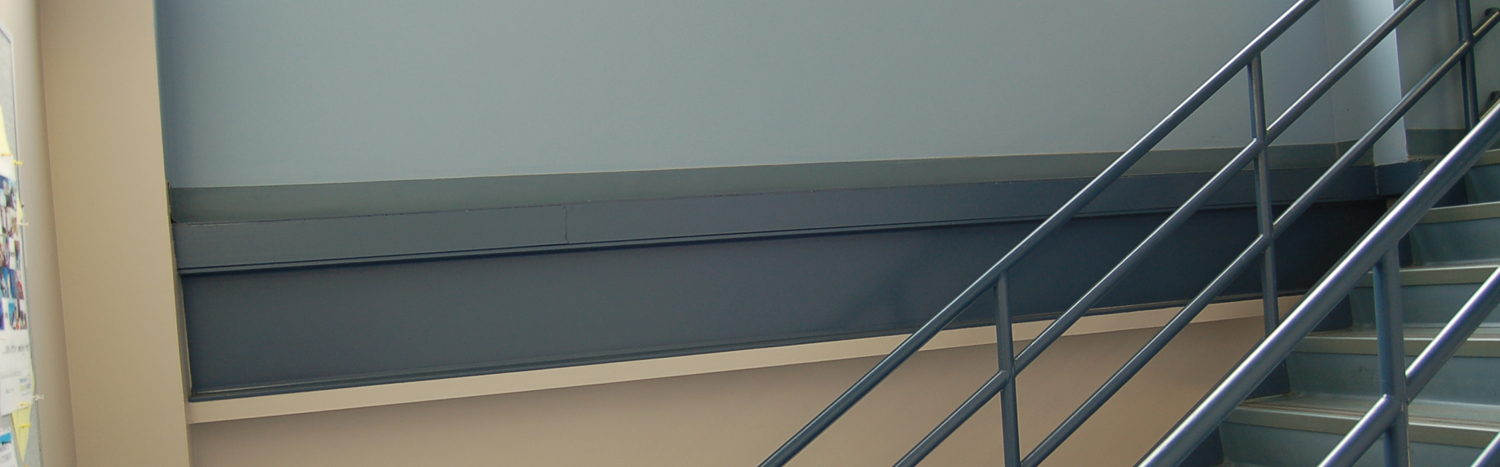
The side of a building in construction where the concrete pouring "imperfections" are still evident. 

This layering of processes is what I find compelling in everything I do. Whether it is an idea or an object, a present reality or a vision for the future; when I look at them as raw material, my options of action are wide open. The story is the action that connects everything together. Each story sheds a light of its own on our existence.  Light and shadow play equal roles in our sense of space. If for no other reason, naming my project 'Drop Shadow' sounds almost inevitable.
- - - - - - - - - - - - - - - - - 
This post was actually posted on August 28 2014. I had meant to publish it on the date that appears here but simply lost  track of my list of drafted files. Interestingly, in Blogger you can control the publishing date to reflect your interests.

22.3.14

The making of Drop Shadow - Artist Staement

Among the layers of creation, a statement is the artist's way of articulating the outcome for the viewer. Whether this explains the work or adds mystery, is a matter of choice. I find it intriguing to provide a statement that is both. The previous two posts (First StagesResurrection) mainly dealt with the timeline of working on 'Drop Shadow'. Apart from beauty, I want my work to provoke thought and nurture discussion. Open minded communication with my audience can generate new ideas and insights. The following is my statement for the show in July.
Our built environment is a result of generations of growth and interaction. In this body of work I'm reflecting on components of life and setting them in a pattern that supports new directions. We all come together on an individual journey and find the commons we need. The city is a body with endless faces. The way from which you look at it can change how you feel about and in it.
'Drop Shadow' is a process in which I contemplate the move between stages, the changes in time and scale, the balance between resource and allocation. From a young age I've been intrigued by the constant development of tools available to us. When I started using Photoshop I very quickly developed a variety of processes that allowed me to generate the features we needed for my team's projects. Then a tool called drop-shadow was introduced that in a single click created most of what my process had involved.
The city is our most complex tool and changing it seems to be on a larger scale than we can imagine. Within the arbitrary motions of fitting components together, a sense of order evolves. This sense of order is a source of both strength and weakness in all of us, individuals and societies. The need for change repeatedly shows itself. The effort to change is many times bigger than what we've thought or even hoped it would be.
'Drop Shadow' is merely a work of art. My work on creating it involves traditional arts materials such as acrylics and pencils. However, computer and various hand tools were a significant contribution to the results at hand. In 2003 its various components were constructed in a certain way. Revisiting them more than a decade later has allowed me to relate the small scale of revitalizing their existence to my current state of engagement with urban design. The effort of tweaking an established body of work involves finding the right balance between existing conditions and the boundaries of my imagination; between past, present and future.
My search is in how to turn this effort into play.

15.3.14

The making of Drop Shadow - Resurrection

My previous post (Drop Shadow - First Stages) ended with me leaving my art stored since 2005 for a few years.
Then, in 2010 came my parents' 70th birthdays. It seemed like a great opportunity to take a look at what I've had and make something new out of it. This time, a square plywood board was selected to be the background and support for the whole composition. To make the small squares truly interactive, simple elements of hardware were employed. Making sure to work with an accurate template, I've installed screws at the back of each square so that one can insert each piece in any of the nine spots on the background board. I'm not sure my parents play with combinations of the various possibilities but they sure can, and that was my intention.
A little later I tried a down scaled version for a friend's wedding. Instead of a stained background I took a bunch of color pencils and worked on visually relating the pieces. Instead of nine squares floating above the surface I've selected three from the existing acrylics on plywood pieces.
Pressing the pencils on the background boards, there is a physical connection that forms between me and the surface. I enjoy the transparency of pencils where you can gradually add strokes and the color becomes more pronounced and still the color beneath shows itself. By contrast, acrylics tend to just cover the layer beneath. The difference between media supports my narrative of urban change: the effort of tweaking an established infrastructure involves finding the right balance between existing conditions and the boundaries of our imagination; between past, present and future.
My current state of the process is nearly ready with six pieces. They all use plywood boards as backgrounds and pencils in various degrees of application. There is a wide range of styles between them and still they seem to form a coherent family of objects. I am intrigued by how they will look when I'm done. Notice in the small works the similar pieces in blue. As my use of tools allows me to plan and anticipate the process, what I'm showing here is an approximately what they will be. On this, I will expand a bit later.

8.3.14

The making of Drop Shadow - First Stages

In July of 2014, my acrylics will be displayed in Bean Around The World coffee shop on Main street in Vancouver. Following a process of restructuring and re-purposing a set of pieces that were stored in my basement, the show I call Drop Shadow will go through what might be considered a resurrection.
After moving from Israel to Canada in 2002 I decided to explore in more detail the process of painting and dealing with artistic expression. My first encounter with canvas and acrylics had happened just a year or so before. That explosion of color and emotions had stayed with my friends Yoav and Michal. In Canada, instead of canvas, plywood, which was readily available to me, was selected as my surface of choice. Another item from the past has been, in general terms, the three dimensional nature of the result. I am used to looking for the relationships between elements in space. Some of my previous dealings with acrylics involved found objects that I had attached to the surface as part of the composition.
Metal and wooden frames; wire and mesh hanging systems
My process has yielded two types of framing: metal and wood. The frames, being part of the composition, were used as the structure that holds the plywood pieces suspended in the air. Here too, I came up with two versions:  wires intersecting each other to form a 3 x 3 grid and a mesh stretched between the members of the frame.
Conceptually I considered the plywood pieces to be placed in any of the locations available within the composition and any orientation. Eventually they were attached rigidly to the mesh or grid from behind. I didn't worry with this too much but knew I would come back to that issue sometime later.
Ground floor in Cuppa Joe coffee shop (2003)
Eight items hung on the walls of Cuppa Joe on 4th Avenue West for the month of April 2003. A gallery in Gastown was next to host my art. Unfortunately it shut down just before my turn came up for display. In August of the same year one of my pieces was juried into a group show on Granville Island. After that I was already busy developing my ceramic designs so the art stayed mostly in storage until September 2004.
Wave participated in the juried show Painting On The Edge
When my ceramic pieces were displayed for sale in a gallery in Steveston, Tamaka, the owner invited me to have my acrylics there as well. She had called me to pick up my paintings after about a year of moving around the walls of the gallery without a buyer. A day after that call, a woman from Germany came by and paid Tamaka for one item to be shipped abroad. Suddenly I could use the term "sold internationally". However, I was focused more on my design interests and kept my art stored for another few years.
Daubs was the first to be sold.
In the next post I will go through the process of reviving Drop Shadow: Resurrection.

20.4.13

Spellbound

“How do you spell whatever?!”
Prior to my interview with the selection panel for the West Richmond Community Center’s Art project five questions were sent to me for reference. They involved my ability to work with a variety of age groups, my process of developing collaborative processes and the challenges and opportunities I see in the proposed space. The questions seemed reasonable to me. They almost felt too easy. I knew I had to find a way to present the panel with "How do you spell whatever?"

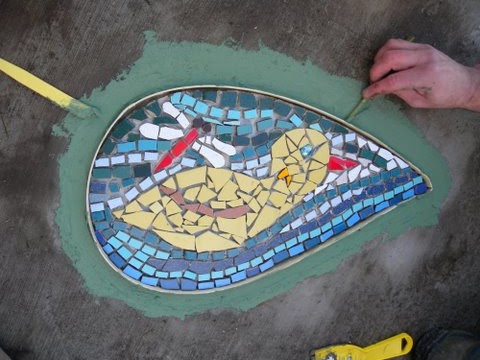
This was my response to a youth from the community arts project in Vancouver I was involved in - Norquay Park 2010 Clean Water. When I had asked him what the story was in the tile he had been working on he answered in a single word: “Whatever”... In response to my "How do you spell whatever", he mumbled "Aam,... Double U, eighche, A, ... Whatever." From then on he seemed to be just a bit more engaged and interested. It was a moment that made me realize a point in community engagement: No one is there for you. As a facilitator my responsibility is to be with my audience. And at that exact moment I was totally with him. 

My entry into the City of Richmond’s public art platform started at around that time. Richmond’s public art planner, Eric Fiss, was coordinating a Pecha Kucha event. I had been looking for an opportunity to present the mosaic story and the waiting list for the Vancouver event looked hopelessly long. It still is. The Richmond event was cancelled that year but I stayed in touch with Eric and got onto the artists roster for public community arts. The way community arts projects are handled in Vancouver made me curious to see what things were like in Richmond.

The traffic to Richmond on the evening of my interview had been surprisingly light compared to previous experiences so I have arrived pretty early to City Hall. Eric seemed a bit concerned as if a possible encounter with the artist who was being interviewed before me might not be the best idea. For me it was no big deal. I found a spot to sit and prepare stuff for my turn. When the artist before me came out of the meeting room I handed her my card and introduced myself. I later found out that she, Jeanette Lee, was the one selected for this project.

Engagement in community arts is all about collaboration and the connections we make. When I stepped into the room where the panel had been waiting it was my first time to see them. However, our discussion seemed to pick up as if from some time in the past. The question from Norquay didn’t have to wait for too long to be mentioned. In my Pecha Kucha presentation it comes on the second slide. As I was preparing for the interview I had realized that my way of responding to the reference questions would be through a story. And the Norquay Mosaics story is still fresh as an illustration of my approach to dealing with community, be it kids, adults or seniors.

Community Arts is not about arts. It’s not even about community. It’s about our connections and what we make of them. Then our community is built. Then we make art.

So tell me now, what is your story, and how do you spell whatever?

16.6.12

green streets traffic circle

My method of gardening relies on heavy digging. I have no patience for weeding on my knees. I started by building a few scrap plywood planters to experiment with structure in the traffic circle. Unfortunately these were turned over by mysterious hands and some were even removed. It's interesting to realize that people actually have interest in what's going on inside of a traffic circle.


So, from this I decided to concentrate on the existing conditions of the location. When this circle was assigned to me it had great mulch covering its soil, an established colony of irises and a few other plants in reasonable shape. It didn't seem to have too many weeds but who knows what weeds are anyway. Any plant matter that grows without me interested in it is doomed. Which more accurately means that I become doomed to constantly chase it whenever its leaves are sent out of the ground.


As a first step, the irises had to make room for other varieties. Their rhizome type root system is impressive. They're actually not that hard to pull. But I had to dig a bit before pulling so that it's not only the knife shaped leaves that come out. There's an interesting process going on in my head as I make my way from one cluster to the next. I decided to take it easy and start with what seemed to be a small task: removing irises from only one quarter of the circle. It worked well and didn't take too long. But it was still quite a workout. I was happy to have made the decision to take it easy ahead of time. But the next day I was there to work on another quarter. Immediately I became impatient to finish the whole area. Piles of irises with their root systems accumulated in the middle of the ground. 


The weather was great, a partly cloudy, typical Vancouver, mid June. The soil was soft and moist. Removing the "debris" from the circle required some hauling and now the place is ready to continue its transformation. The irises selected to stay are planted in two rows at the perimeter, close to the concrete edge. A young rose bush is waiting to be cultivated into a healthier accent and some pieces of bergenia were also spared from extinction (thank you Green Streets people for your help with the name).


Our sidewalk tree base is my gardening lab. This is where I plant all sorts of plants to see how well they grow. We bought a few 4" pots and as small as they are I have divided them before planting to increase their spread. As it seems, all have rooted well. In the next little while, some of them will be transported to the traffic circle and left to do their part of the deal.


15.4.12

hate-love


I have to confess I almost hate gardening. But the reason for that is the exact same reason why I almost love it. You toil away doing whatever you think is required to keep your yard or planter in shape. Then nature does its part and does it no matter if it fits your plans or not. When it doesn’t, I feel powerless and futile in my efforts. When it does…, hey! We are a team!
This is how it looked when i started. A variety of five plants.
So basically I admire the ability of plant matter to regenerate no matter what you think of it. We label dandelions ‘weeds’ and consider Morning Glory to be a menace. The inspiration one can take from these two examples is incredibly valuable: persistence and perseverance. If you think what you’re doing is right, never despair. Of course the human body matter’s mind doesn’t aspire to be considered a weed. But that’s not the point.
Small pot plants were cut into smaller parts.
I love the smell of soil. When I trim the hedge there is a fantastic feeling of freshness in the air. The act of gardening is mostly boring but the rewards exist. You just need to reach the right balance between Labor and Love.
From this angle things already look lovely.

15.7.11

the-official-opening

The park has been open to the public for about a month now. The upgrade seems to be a huge success based on the amount of people clamoring its features. Despite the coldish summer many even dare the sprinkles of the water spray area.
An official opening event is scheduled for Wednesday July 20th 4:30 pm. I'm curious to see what that will look like.

21.4.11

stepping-stones

The block on Kingsway between Wales and Rhodes streets has light pedestrian traffic. As we are installing the last mosaic pieces in the two entries to the park the protective fence is still there. Norquay Park has been a construction zone since July of last year. The few people that pass by either slow down beside us or stop.
They are all curious as to when the park will be open again. They also notice the mosaic pieces and seem impressed with their beauty. Along the progress with installation we’ve gradually been able to get the sense of significance this project has in the upgraded park. The entry pieces have a good impact as gate decorations.

The history of Still Creek is one in many similar stories of urban industrialization, reflection and rehabilitation. Today the Vancouver part of the creek is still mostly hidden in underground pipes or behind chain link fences. From its designation as the most polluted stream in BC in the 1980s, much progress has been made and much more is required. Serious work has been taken to bring it back to a liveable natural element in urban space. The Norquay Park 2010 Clean Water Mosaic project is one stepping stone in a long educational journey.

Funding for our part of the journey came from the Vancouver Board of Parks and Recreation, the Vancouver Neighborhood Matching Fund and Collingwood Neighborhood House. The intention of this collaboration between budgetary resources is to facilitate community interaction. Participation in the building process of the park enhances the sense of ownership over the neighbourhood.

Members in the community were brought together to create a visual reminder for all to enjoy. Twenty pieces were created in this process and are now integrated in the concrete sections of the paths in the park. After entering either from its west or east entries you are welcome to explore the park and find the other mosaic pieces. All of them are a result of many hours shared by community members who participated in our workshops. It is our pleasure to thank them all, seniors, adults and youth for their contribution.

Installing our mosaics provided us with the opportunity to work closely with the architects and builders who were responsible for the function of the park. The result of their work is a fabulous space with a great sense of place.

The conclusion of this project brings me back to its starting point. In the research for mosaic making we met Liz Calvin and Bruce Walther. These two mosaic artists’ work can be seen in many places around and out of town. Without their generosity this project would have looked completely different. A sample of their collaboration can be seen in Downtown Vancouver where a set of eighteen pieces are placed.

Many more contacts were made throughout the process. Yoko and I are grateful to all who helped us get to this stage. Our own collaboration started with mutual interest in this experience and ends with excitement over the accomplishment. Just like the small pieces of a mosaic tile tell a story, the whole set of twenty expands this into space and time. This is a reflection on industrialization and rehabilitation.

19.3.11

are we there yet?

The park is slowly being completed. We’ve been away for the cold and wet winter. The forecast for excessive snow was mostly true for regions north of Vancouver. A few days after starting with the first piece though it did snow and from then on the weather kept playing between low temperatures and wet days.
A night walk in December. There wasn’t a lot of
snow this year but it was cold enough to prevent installation.
Yoko and I tried to stick to working together so that we learn from each other as much as possible. Until now it worked vey well. This week Yoko flied to Japan for a family visit. It is too early to conclude the degree of destruction following the earth quake a week ago. Nevertheless this is a moment in history that puts our lives into a grim perspective.
An aerial view of tsunami damage in the Tōhoku region.
From the first tile installed in October of last year we saw that the stained mortar band needs to be applied differently. If any of it rubs out onto the path surrounding the recess we are bound to spend more time and effort cleaning the mess. The solution is quite easy in theory: apply the paste carefully. In reality it was relatively easy but still challenging. A combination of cold weather, wet concrete path and crouching down to work were found to be a nice workout.
Into a one inch wide gap the mortar is applied in small amounts to
gradually create our desired band.
There is no way we can rush things even though we want to. As we move into spring more days are available to work on installation. The world around us is shaking in multiple directions. I think it’s a matter of re-imagining the excitement from last year that will help us shift gears. This is still a celebration of life.
Even with this impressive display of process the
grouting stage is still ahead of us.

26.11.10

always longer than you expect

The concrete was hard enough to step and jump on three days after it was poured. What you don’t see at that stage is the process of curing it goes though that takes about a month. Within that time it’s better not to lay our mosaic tiles in their recesses. Waiting for the concrete slab to cure allows adhesion with the mortar for the mosaic tiles to build up properly.

The plywood board is easily extracted from the recess.
An unwelcome puddle of water is exposed underneath.
By the time we could start it was already the end of October. A day or two of rain, and we need to wait. A few days of sunshine and it becomes colder. Proper setting of our mortar is sensitive to moisture and low temperatures. With the first tile we had started laying we realized that the opportunity was slipping away. The rest of the job will have to wait until spring.
A peanut buttery feel to the mix feels good
and is a suitable consistency.
Each tile will have a stained concrete band that is our choice for transition between the mosaic image and its surrounding gray paving. In order to achieve a clean line we need to fine tune our method of applying the stained concrete into the gap.
We surround the mosaic tile with a strip of masking taped cardboard
to leave room for the grout between the tile and the concrete band.
When we grout this piece we will also have a chance to see what other techniques we have to implement. This is a technically easy stage but it needs the same attention to details as we’ve invested in the process up to now. Grouting can drastically alter the appearance of a mosaic tile. If that happens we’d like it to be for the better. This is why I always tell people and try to remember myself: It always takes longer than you expect.

30.10.10

weather or not

Looking back at the process we went through I see that I can now afford to be a bit more personal. This month felt like a marathon. Giora and Irit, Anat's parents, my in-laws, were with us for two weeks on a visit from Israel. I was interested in reaching the final mosaic making session with as many of the tiles we needed finished. There was also an application package I was working on that needed to be sent. I had two weekends of this month dedicated to the Urban Design classes in SFU. In normal conditions this would have been busy but manageable. Even the weekend in Silverdale, near Seattle was a welcome break from routine.
Great sunny days on the weekend in Silverdale
At the end of that weekend we drove back to Vancouver to start the week. Anat's parents stayed in Washington for a few more days before joining us and leaving back to Israel. I had a few last touches on the mosaic pieces to make them ready for installation. The whole visit was turning into a great familial update with Inbal, our daughter, getting a lot of attention from her gramps.
Inbal enjoying the play, Saba enjoying his grand daughter
and the Richmond ice rink
On the first day of gramps enjoying the scenery of Mount Rainier, Irit broke her knee cap . This is one of those minor injuries that change your life in an instant and not for the better. In normal conditions she would have been operated in Washington and started rehabilitation. Being visitors in Canada with a flight back to Israel scheduled just a few days later introduced a whole set of considerations into the matter.
A short while before the accident as shot by Giora
As soon as Saba and Savta (Grandpa and Grandma) were back in Vancouver we started preparing for their flight to Israel. Rehabilitation is the most intensive component of treatment for this type of injury. An operation can be delayed for a few days without harm. Tickets needed to be changed, insurance issues were resolved and an operation had to be scheduled as soon as they landed in Israel.
Inspired by the occasion
At dinner of their last evening with us we raised glasses of wine for the admirable way Giora has managed the faxes, emails and phone calls. I complained that my desire to help wasn't fulfilled. To be honest, my in-law's independence allowed me to continue my daily activities with very little if any disruptions. No one wishes to enhance their lives with accidents and hardship. Still, whatever happens to you is part of your life. A day after landing in Israel Irit's knee cap was restructured. A day later she started walking again.
A short while before the concrete was poured
Our mosaics are waiting for a few days without rain to be laid and grouted. Vancouver weather is part of our life...

3.10.10

the best you can

Urban design might sound like a field that deals with inanimate components of the city: spaces, buildings, roads and other built environments. One of the reasons I've joined the certificate program in SFU is my perception of the urban as an extension of the human, physically and socially. I'm happy to find the SFU Urban Design program delivering an approach that runs along a similar line.
The plywood board is later taken away and leaves a recess
where the tile will be installed
The mosaic workshops are wrapping up to their final days of fabricating pieces. Soon we will start installing them in Norquay Park. Most of the concrete that will house our tiles has recently been poured. Each mosaic piece, as an inanimate illustration of water related creatures, is also a reflection of a person or people who created it. We've had school kids, teenagers, adults and seniors participating in this project. I've had the fortune of following some of them go through an inspiring creative process.
The story behind each tile is personal as well as artistic
There are many ways to work on the things you are currently busy with. There is only one way that I can consider to be right: doing the best you can. This is a decision that is inherently an attitude. As soon as you reach that decision, your work is pretty easy. From there you can only improve.
Some of the more compelling results come from challenges
like this somewhat messy start
Guiding people to embrace this attitude is a challenge I wasn't fully aware of getting into before joining this project. I am now looking at our finished mosaics and can't wait to see them in place. Whether it was an hour that some spent with us or a few months that others labored, each brought a piece of their own life into this. The story of each tile starts with an image anyone can see and extends to the world of the people who created it.
Grouting will probably bring this tile
to an even better expression of art.
Urban design deals with the built world and is concerned with us, living its story.