Showing posts with label Grout. Show all posts

21.4.11

stepping-stones

The block on Kingsway between Wales and Rhodes streets has light pedestrian traffic. As we are installing the last mosaic pieces in the two entries to the park the protective fence is still there. Norquay Park has been a construction zone since July of last year. The few people that pass by either slow down beside us or stop.
They are all curious as to when the park will be open again. They also notice the mosaic pieces and seem impressed with their beauty. Along the progress with installation we’ve gradually been able to get the sense of significance this project has in the upgraded park. The entry pieces have a good impact as gate decorations.

The history of Still Creek is one in many similar stories of urban industrialization, reflection and rehabilitation. Today the Vancouver part of the creek is still mostly hidden in underground pipes or behind chain link fences. From its designation as the most polluted stream in BC in the 1980s, much progress has been made and much more is required. Serious work has been taken to bring it back to a liveable natural element in urban space. The Norquay Park 2010 Clean Water Mosaic project is one stepping stone in a long educational journey.

Funding for our part of the journey came from the Vancouver Board of Parks and Recreation, the Vancouver Neighborhood Matching Fund and Collingwood Neighborhood House. The intention of this collaboration between budgetary resources is to facilitate community interaction. Participation in the building process of the park enhances the sense of ownership over the neighbourhood.

Members in the community were brought together to create a visual reminder for all to enjoy. Twenty pieces were created in this process and are now integrated in the concrete sections of the paths in the park. After entering either from its west or east entries you are welcome to explore the park and find the other mosaic pieces. All of them are a result of many hours shared by community members who participated in our workshops. It is our pleasure to thank them all, seniors, adults and youth for their contribution.

Installing our mosaics provided us with the opportunity to work closely with the architects and builders who were responsible for the function of the park. The result of their work is a fabulous space with a great sense of place.

The conclusion of this project brings me back to its starting point. In the research for mosaic making we met Liz Calvin and Bruce Walther. These two mosaic artists’ work can be seen in many places around and out of town. Without their generosity this project would have looked completely different. A sample of their collaboration can be seen in Downtown Vancouver where a set of eighteen pieces are placed.

Many more contacts were made throughout the process. Yoko and I are grateful to all who helped us get to this stage. Our own collaboration started with mutual interest in this experience and ends with excitement over the accomplishment. Just like the small pieces of a mosaic tile tell a story, the whole set of twenty expands this into space and time. This is a reflection on industrialization and rehabilitation.

19.3.11

are we there yet?

The park is slowly being completed. We’ve been away for the cold and wet winter. The forecast for excessive snow was mostly true for regions north of Vancouver. A few days after starting with the first piece though it did snow and from then on the weather kept playing between low temperatures and wet days.
A night walk in December. There wasn’t a lot of
snow this year but it was cold enough to prevent installation.
Yoko and I tried to stick to working together so that we learn from each other as much as possible. Until now it worked vey well. This week Yoko flied to Japan for a family visit. It is too early to conclude the degree of destruction following the earth quake a week ago. Nevertheless this is a moment in history that puts our lives into a grim perspective.
An aerial view of tsunami damage in the Tōhoku region.
From the first tile installed in October of last year we saw that the stained mortar band needs to be applied differently. If any of it rubs out onto the path surrounding the recess we are bound to spend more time and effort cleaning the mess. The solution is quite easy in theory: apply the paste carefully. In reality it was relatively easy but still challenging. A combination of cold weather, wet concrete path and crouching down to work were found to be a nice workout.
Into a one inch wide gap the mortar is applied in small amounts to
gradually create our desired band.
There is no way we can rush things even though we want to. As we move into spring more days are available to work on installation. The world around us is shaking in multiple directions. I think it’s a matter of re-imagining the excitement from last year that will help us shift gears. This is still a celebration of life.
Even with this impressive display of process the
grouting stage is still ahead of us.

26.11.10

always longer than you expect

The concrete was hard enough to step and jump on three days after it was poured. What you don’t see at that stage is the process of curing it goes though that takes about a month. Within that time it’s better not to lay our mosaic tiles in their recesses. Waiting for the concrete slab to cure allows adhesion with the mortar for the mosaic tiles to build up properly.

The plywood board is easily extracted from the recess.
An unwelcome puddle of water is exposed underneath.
By the time we could start it was already the end of October. A day or two of rain, and we need to wait. A few days of sunshine and it becomes colder. Proper setting of our mortar is sensitive to moisture and low temperatures. With the first tile we had started laying we realized that the opportunity was slipping away. The rest of the job will have to wait until spring.
A peanut buttery feel to the mix feels good
and is a suitable consistency.
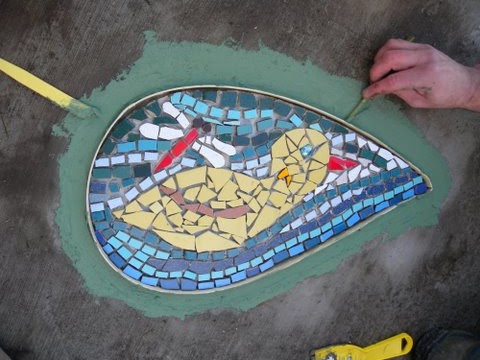
Each tile will have a stained concrete band that is our choice for transition between the mosaic image and its surrounding gray paving. In order to achieve a clean line we need to fine tune our method of applying the stained concrete into the gap.
We surround the mosaic tile with a strip of masking taped cardboard
to leave room for the grout between the tile and the concrete band.
When we grout this piece we will also have a chance to see what other techniques we have to implement. This is a technically easy stage but it needs the same attention to details as we’ve invested in the process up to now. Grouting can drastically alter the appearance of a mosaic tile. If that happens we’d like it to be for the better. This is why I always tell people and try to remember myself: It always takes longer than you expect.

24.7.10

leather based concrete

This week marked a shift in the process of creating mosaics with our community. Technically, we learned how to lay tiles in a way that is both simple and insightful. Socially, this method allows us to better engage with our public. It all started with what looked like a brief encounter with two local mosaic artists, Liz Calvin and Bruce Walther. They are both separately making mosaic pieces and have collaborated in a Downtown Vancouver project.


Concrete on mesh can be cut with sissors

Colored concrete is a world of exploration

Soon to be seen in Norquay Park, Vancouver BC

Both were friendly on the phone and provided valuable information that seemed quite a lot and sufficient for any good start of mosaic tile creation. This was a few weeks ago when Yoko and I were experimenting with methods to teach at our workshops. After quickly meeting with Bruce at the New Westminster Fraser Festival I went on to meet Liz in her studio.

My own joy of sharing information comes from practical realization that this is one of the stepping stones for our shared success as a society. What I've experienced in my meeting with Liz was something like a hurricane of generosity. Not only did she share information but she also provided us with tiles, materials and tools that are probably equal to doubling our budget for this part of the project. Not enough thanks can be expressed for such an attitude.

Meanwhile, in our workshops we gradually feel the growing interest among our visitors, who step into the room and around the tables with curiosity. They start with struggling to fit broken tiles side by side. As Yoko and I guide them through the process, their results begin to show nice little expressions of art. Some of them already show the glimmer of enthusiasm at the side of their eyes. They end their session with an eagerness do to more. I'm looking forward to the tiles we are about to create in the next little while.