Showing posts with label Interaction. Show all posts

24.4.15

The U-turn guy

As the car suddenly swerved towards me, I realized the guy driving it hadn't noticed me.

Cycling south on Shoken Street, a median separated road, between Salame Street and Glilot Way, used to be a typical morning commute for me. The street rises and descends in both directions. My apartment was located in the low rent but lively South of Tel Aviv. The ride was a seven kilometer stretch to the design school in the adjacent city of Holon.


There wasn't much time, neither a lot else to do but kick my way to safety. I lifted my left foot straight into the back right door of the car. This stabilized my violent change of direction. At the same time the driver got a clear signal that something wrong was happening.

His U-turn maneuver was a legal one. His neglect to notice me - the cyclist with the right of way - probably was not.


However, as soon as he heard the crashing sound of my shoe bending the metal of his car, his head turned and he saw me. He stopped. But I was still pedaling uphill, a few inches away from the right side of the car that had almost killed me. I was partly startled, partly happy everything was OK and mostly annoyed by the disruption.


When the man saw that I continued my ride, he accelerated beside me and cut me again to make me stop. At that moment the last thing I wanted was to be bothered with him. I changed course and kept going uphill, this time to the left of the car. But now he jumped out and latched onto my handlebar.


Driver: "You kicked my car!"

Cyclist: "You almost killed me..., what d'you want?"
"No, come with me. You kicked my car!"
"Nothing happened. Let go of my bike."
"No! You come with me first."
"You almost killed me. Nothing happened to your car. Let go of my bike and I'll show you."
"No! If I let go you'll run away again."
"You almost killed me. Let go of my bike first."

At that moment a passer by was beside us. He told the driver that he saw him almost run over me. The look on the driver's face changed in realization into a gaze of fear. He let go of my bike and I joined him to look at the spot where I'd kicked his back door.


The crashing sound of my kick was that of sheet metal bending in and out again. As much as I was focused on surviving an emergency, seeing that was amusing. My confrontation with the driver gradually added to my sense of comedy.


"You see? Nothing happened. Have a good day."

Driver: "You,... you speak like someone with a ring in his ear!"

I smiled and continued with my ride.

- - - - - - - - - - - - - - - - - - - - - - - - - - - - - - -
Walking and biking in the city has its merits as well as its challenges. All journeys have a story. It is either immediately evident or only reveals its beauty years later when you pull it out of your memory. I was reminded of the story above, from 1990, as I brushed against a moving car here in Vancouver last year. I was crawling with the traffic down Main Street when the car to my left tried to pull right into 6th Avenue. As soon as the driver noticed this, he slammed the brakes. We quickly and peacefully parted ways as nothing happened to any of us.


22.3.14

The making of Drop Shadow - Artist Staement

Among the layers of creation, a statement is the artist's way of articulating the outcome for the viewer. Whether this explains the work or adds mystery, is a matter of choice. I find it intriguing to provide a statement that is both. The previous two posts (First StagesResurrection) mainly dealt with the timeline of working on 'Drop Shadow'. Apart from beauty, I want my work to provoke thought and nurture discussion. Open minded communication with my audience can generate new ideas and insights. The following is my statement for the show in July.
Our built environment is a result of generations of growth and interaction. In this body of work I'm reflecting on components of life and setting them in a pattern that supports new directions. We all come together on an individual journey and find the commons we need. The city is a body with endless faces. The way from which you look at it can change how you feel about and in it.
'Drop Shadow' is a process in which I contemplate the move between stages, the changes in time and scale, the balance between resource and allocation. From a young age I've been intrigued by the constant development of tools available to us. When I started using Photoshop I very quickly developed a variety of processes that allowed me to generate the features we needed for my team's projects. Then a tool called drop-shadow was introduced that in a single click created most of what my process had involved.
The city is our most complex tool and changing it seems to be on a larger scale than we can imagine. Within the arbitrary motions of fitting components together, a sense of order evolves. This sense of order is a source of both strength and weakness in all of us, individuals and societies. The need for change repeatedly shows itself. The effort to change is many times bigger than what we've thought or even hoped it would be.
'Drop Shadow' is merely a work of art. My work on creating it involves traditional arts materials such as acrylics and pencils. However, computer and various hand tools were a significant contribution to the results at hand. In 2003 its various components were constructed in a certain way. Revisiting them more than a decade later has allowed me to relate the small scale of revitalizing their existence to my current state of engagement with urban design. The effort of tweaking an established body of work involves finding the right balance between existing conditions and the boundaries of my imagination; between past, present and future.
My search is in how to turn this effort into play.

15.3.14

The making of Drop Shadow - Resurrection

My previous post (Drop Shadow - First Stages) ended with me leaving my art stored since 2005 for a few years.
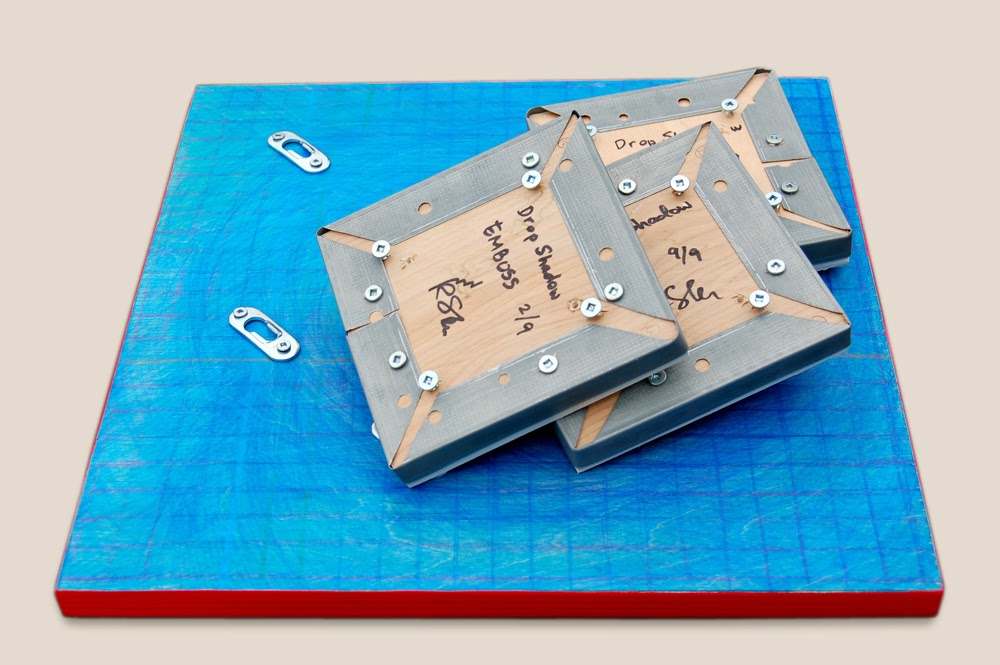
Then, in 2010 came my parents' 70th birthdays. It seemed like a great opportunity to take a look at what I've had and make something new out of it. This time, a square plywood board was selected to be the background and support for the whole composition. To make the small squares truly interactive, simple elements of hardware were employed. Making sure to work with an accurate template, I've installed screws at the back of each square so that one can insert each piece in any of the nine spots on the background board. I'm not sure my parents play with combinations of the various possibilities but they sure can, and that was my intention.
A little later I tried a down scaled version for a friend's wedding. Instead of a stained background I took a bunch of color pencils and worked on visually relating the pieces. Instead of nine squares floating above the surface I've selected three from the existing acrylics on plywood pieces.
Pressing the pencils on the background boards, there is a physical connection that forms between me and the surface. I enjoy the transparency of pencils where you can gradually add strokes and the color becomes more pronounced and still the color beneath shows itself. By contrast, acrylics tend to just cover the layer beneath. The difference between media supports my narrative of urban change: the effort of tweaking an established infrastructure involves finding the right balance between existing conditions and the boundaries of our imagination; between past, present and future.
My current state of the process is nearly ready with six pieces. They all use plywood boards as backgrounds and pencils in various degrees of application. There is a wide range of styles between them and still they seem to form a coherent family of objects. I am intrigued by how they will look when I'm done. Notice in the small works the similar pieces in blue. As my use of tools allows me to plan and anticipate the process, what I'm showing here is an approximately what they will be. On this, I will expand a bit later.

28.1.14

Open Media with the Design Nerds

"The question mark is our exclamation mark," I say as we stand in front of the room. "We have to keep on asking questions so that the challenges we generate provide us with insight to better understand the realities we are facing. Education through a variety of sources and venues allows us to become informed so that the decisions we make sustain us within the society we live."


A Design Nerds Jam starts with an introduction by a speaker or two who provide the framework of the event. The guest host on Saturday, 25th of January was Reilly Yeo, Managing Director of OpenMedia.ca.  

- - - - - - - - - - - - - - - - - - - - - - - - - - - - - - - - - - - - - - - - - - - - - - - - - - - - - - - - - - - - 
Browsing through the questions posted on the walls, my feeling is that they come with a predetermined agenda.
SHOULD INTERNET AND CELL PHONE PROVIDERS BE ABLE TO MAKE IT MORE EXPENSIVE TO ACCESS CONTENT SERVICES THAT COMPETE WITH THEIR OWN?
This is a strange question. If anyone in the room has a business to run, wouldn't they want to be able to charge for their services or products so that they make profit that supports their livelihood and that of any of their employees?
ARE THERE CERTAIN SERVICES THAT ARE BLOCKED, OR CERTAIN SHOWS YOU CAN’T WATCH BECAUSE YOU ARE NOT SUBSCRIBED TO A SPECIFIC TV BUNDLE?
When you subscribe to a certain service, you're offered certain programming. It's up to me to negotiate the terms of our engagement with the company we are buying our services from. I have disconnected cable years ago and haven't felt like I've missed anything.
MUCH OF CANADA’S MEDIA CONTENT, NOTABLY LIVE SPORTS, IS CONTROLLED BY THE BIG TELECOMMUNICATIONS COMPANIES. SHOULD THIS CONTENT BE MADE  AVAILABLE AT A COST-BASED RATE TO ALL TV AND ONLINE SERVICE PROVIDERS AND THEIR CUSTOMERS?
I see "NOTABLY LIVE SPORTS" and think: "OK, we want better access to media content for what purpose?!" Isn't live sports a venue where the masses escape from meaningful participation in social issues? Well, I find the way this question is framed somewhat ironic.
SHOULD TELECOM COMPANIES HAVE THE ABILITY TO DETERMINE OR RESTRICT ACCESS TO PUBLIC MEDIA OUTLETS AND OTHER COMPETING SERVICES?MOST CANADIAN TELEVISION COMES FROM CNADA’S BIG TELECOMMUNICATIONS COMPANIES (I.E. BELL, ROGERS, SHAW AND QUEBECOR). THE MAIN EXCEPTIONS ARE PUBLIC MEDIA OUTLETS LIKE THE CBC AND THE ABORIGINAL PEOPLES TELEVISION NETWORK. 
When TV services in Israel expanded into more than one channel, it was already evident that the American population was growing to be hooked on the crappy content they were provided with. I've always had a naive belief that people eventually grow out of distorted strangleholds of media companies. Education is key to better understanding, awareness and choice.
WHAT DIGITAL CONTENT SERVICES DO YOU SUBSCRIBE TO? I.E. CABLE TV, NETFLIX, SATELITE TV, THE ITUNES STORE, OR OTHERS
When the internet became easily available there was much talk about the revolution in content consumption. The interactive nature of this tool ignited the imagination of many thinkers. The reality we all live in is that not a lot of action is taken within the vast fields of opportunity. The general public is a random collection of individuals who are usually taking the path of least resistance.
IS HAVING PUBLIC MEDIA AND CULTURAL PROGRAMMING READILY AVAILABLE IMPORTANT TO YOU?
When I first unsubscribed from the cables, I wasn't sure it was the right move. As a designer, shouldn't I stay in touch with what's happening? It turned out to be a great move: not only was it right but it turned out to be a blessing: I've gained more time for things I'd been neglecting; my exposure to inspiring content has improved and there wasn't any noticeable change in my feeling of being connected.

It was only a few days after the event that the real challenge became clear to me: "what are the questions that I would have asked?" 
- - - - - - - - - - - - - - - - - - - - - - - - - - - - - - - - - - - - - - - - - - - - - - - - - - - - - - - - - - - - 
I came to this Jam to "explore how matters of digital access, choice and affordability affect our daily lives, and propose solutions that put people first." After the introduction session we are all presented with a variety of topics to choose from, brainstorm ideas and come back to introduce our conclusion in a two minutes presentation. As the five of us in the Wild Card group exchange thoughts around the table I'm happy with my choice. A heated discussion over a variety of topics starts almost without delay. 

Tom, the funeral services guy introduces himself just before me. He gives a very interesting account of the strangle hold the Big companies in his field have over small businesses. I find it fascinating to realize how every issue we raise ignites streams of consciousness that can take us all over the place: the enthusiasm of a speaker can be inspiration to some as much as intimidation to others; the information shared will always need to be verified; every word is a trigger to countless associations to other thoughts and ideas.

Jared, the product designer is joining me in doodling as he speaks. His drawings are much nicer than mine. I hope to see the images soon on the design nerds' pages as I haven't taken any photos apart from the notes on the walls. We kind of jot down reactions to things that are mentioned around our table or thoughts that come up in reaction to one another. 

Tara, the Communications PhD student also writes words and circles them with red lines. Julien, our facilitator realizes that our intellectual meandering is threatening the coherence of our presentation. What is our story? For me, this is it.

"The question mark is our exclamation mark," I say. "We have to keep on asking questions so that the challenges we generate provide us with insight to better understand the realities we are facing. Education through a variety of sources and venues allows us to become informed so that the decisions we make sustain us within the society we live."

I really enjoy the practice of coming up with a coherent message after only a brief exchange of ideas. Just before moving on to the main hall to deliver our summary, I've noticed in my peers' papers words and phrases pretty similar to mine. "The scale in which we operate determines the outreach of our actions. But when we consider the concept of accountability my question to myself is where am I accountable? Our demands from big corporations start in each of us as individual members of society. As soon as my own goal is beyond the scope of my resources, my reliance on others tilts the priorities of my decisions."

This is why my first doodle was the question "WHAT IS OUR STORY?"
- - - - - - - - - - - - - - - - - - - - - - - - - - - - - - - - - - - - - - - - - - - - - - - - - - - - - - - - - - - - 
I'm always impressed by the undertakings the Design Nerds engage in. My effort of participating keeps me trying to join. Being a design nerd myself, traps me in the reality of looking at everything from more than one direction and distance. So the questions naturally arise. When you start asking questions, the process of education is natural. My interaction with others requires accountability which will always tie me to the scale at which I can operate. The question mark is definitely my exclamation mark; and the other way around.

18.8.13

Talking about cars*

“So what is it about Vancouver that everyone’s talking about?”, my father's question from 2009 resonated in me as I was taking this picture. Downtown cities crammed with high-rises are a common sight in our world. Watching south from North Vancouver’s Waterfront Park you can definitely recognize it's Vancouver. However, to be honest, as a postcard image, it's just another big city. So what is it about Vancouver that everyone’s talking about? In my morning discussion with my wife we were talking about my future as urban designer. Am I actually contributing to our city's future?
One of my first incidents of planning for urban space was back in 2006. An invitation to participate in a public arts selection panel for the Steveston Community Center has introduced me to Doug Senft, one of three artists who had prepared a maquette for that eventHis Metal Cathedral from 1986 is a beautiful reflection on nature in and about the city. Still, our city is only as beautiful and meaningful as the people living in it and building it.
For our visit to the north shore we decided to take a walk starting from Lonsdale Quay and to let our steps lead us. Walking into the Waterfront Park, I was intrigued to see all these BMWs scattered around the lawn. My love affair with BMW started as a boy browsing through my grandmother’s National Geographic Magazine. Every month they used to have ads for BMW on one of the very first pages of each issue. I still admire what BMW are making but not so much as a drooling teenager anymore.
In 2009, after going to various places and experiencing some of Vancouver’s sights, my parents got over their flight inflicted back pains and jet lag. But it wasn’t until they had seen an acquaintance they’d known from a visit to Germany a few years earlier that the city made sense to them. Suddenly their whole visit turned into a story of success.

So what is it about a car club show that BMW lovers might talk about?

As Anat, Inbal and I were sitting on a bench enjoying the weather, the views and the hotdog, a passer by has asked me whether I was a BMW owner. Our first words drifted away from cars to let us learn that he had come from Acre. When he had realized our Israeli origins, our exchange shifted into an intriguing conversation. The whole visit to North Vancouver became a heart warming connection. Our city is only as beautiful and meaningful as the people living in it and caring for it.
- - - - - - - - - - - - - - - - - - - - - - - - - - - - - - - - - - - - - - - - - - - - - - - - - - - - - - - - - - -
* This is for Judi, whose recent remark about blogging was probably a good push for writing this one. Thank you.

12.7.13

The Art of Engagement

Here's a way to prepare for a TED talk: go to a PechaKucha!
The July 2013 Richmond event brought on stage ten people affiliated with creativity. I appreciate the effort of talking in front of an audience while twenty of your slides change every twenty seconds. I've done this last year and had fun. Having said that, it's hard work to tell a personal story and be relevant to your audience. Most of this year's presenters had good content. Most of them failed to engage me as an audience. Unfortunately I come with expectations.
Next week I will audition for a TEDx event. I'm always curious to see others present their work, ideas and insights. Preparing for my own talk turned my interest into a quest for reference. Look. Creative people. What is it that makes you want to describe anything about yourself in front of an audience? What does it mean to interest others in your work, your life, your ideas?
Our lives are full of exposure to images, imagery, imagination. When I come to see and hear someone talk about something, anything, can you please deliver a show other than what I can zap through the internet as soon as I type your name? But it's not only the availability of information. It's the engagement. You are the medium. You are the show. The message is there. If you aren't there to deliver it, why are you there?
Well, Diyan Achjadi had lovely images in her slides but her reading from her pages didn't do justice to her insights; Laura Bucci entered the stage in a promising march and talked to the screen instead of to us; OK, Nan Capogna tried to sell someone else's show which she curated: not a good choice; and then two other presenters challanged my expectations until the break: Sammy Chien, who was cute but too nerveous to stand and talk and Yayoi Hirano, whose work is evidently graceful and impressive but her presentation was none of that. The intermission presented a very welcome break for my nerves.
Should I leave? Do I stay? Hmm, if anyone is about to be better, they deserve an audience. Maybe I'm not the right audience. But it's not about me. It's not about you. It's about our connection and what makes it exist.
They all had content. Good content as such. Toni Latour introduced a compelling story and if, again, she could move a bit or leave the papers at home... Her story was focused, interesting and successfully put together though; Greg Masuda had a fascinating story which he managed to read with his eyes fixed to his smartphone screen...; 
At last Vjeko Sager brought a whiff of relief: his kind of off hand delivery of disregard and contempt complemented his edgy works on screen which provided evidence that it doesn't have to be so hard to light a fire. Jeff Chiba Stearns managed to keep the juices running with an amusing description of his family's history. In my momentum of disillusionment I wish he were somewhat more lively on stage; finally we reached Rick Tae who had good images and a nice flow of a story if a bit fluffy to my taste, but hey!
It's not about me. It's not about you. It's about our connection and how we make it work. Did this help me prepare for the TEDx audition? Maybe it is about me after July 18th. You might tell me about it.

20.4.13

Spellbound

“How do you spell whatever?!”
Prior to my interview with the selection panel for the West Richmond Community Center’s Art project five questions were sent to me for reference. They involved my ability to work with a variety of age groups, my process of developing collaborative processes and the challenges and opportunities I see in the proposed space. The questions seemed reasonable to me. They almost felt too easy. I knew I had to find a way to present the panel with "How do you spell whatever?"

This was my response to a youth from the community arts project in Vancouver I was involved in - Norquay Park 2010 Clean Water. When I had asked him what the story was in the tile he had been working on he answered in a single word: “Whatever”... In response to my "How do you spell whatever", he mumbled "Aam,... Double U, eighche, A, ... Whatever." From then on he seemed to be just a bit more engaged and interested. It was a moment that made me realize a point in community engagement: No one is there for you. As a facilitator my responsibility is to be with my audience. And at that exact moment I was totally with him. 

My entry into the City of Richmond’s public art platform started at around that time. Richmond’s public art planner, Eric Fiss, was coordinating a Pecha Kucha event. I had been looking for an opportunity to present the mosaic story and the waiting list for the Vancouver event looked hopelessly long. It still is. The Richmond event was cancelled that year but I stayed in touch with Eric and got onto the artists roster for public community arts. The way community arts projects are handled in Vancouver made me curious to see what things were like in Richmond.

The traffic to Richmond on the evening of my interview had been surprisingly light compared to previous experiences so I have arrived pretty early to City Hall. Eric seemed a bit concerned as if a possible encounter with the artist who was being interviewed before me might not be the best idea. For me it was no big deal. I found a spot to sit and prepare stuff for my turn. When the artist before me came out of the meeting room I handed her my card and introduced myself. I later found out that she, Jeanette Lee, was the one selected for this project.

Engagement in community arts is all about collaboration and the connections we make. When I stepped into the room where the panel had been waiting it was my first time to see them. However, our discussion seemed to pick up as if from some time in the past. The question from Norquay didn’t have to wait for too long to be mentioned. In my Pecha Kucha presentation it comes on the second slide. As I was preparing for the interview I had realized that my way of responding to the reference questions would be through a story. And the Norquay Mosaics story is still fresh as an illustration of my approach to dealing with community, be it kids, adults or seniors.

Community Arts is not about arts. It’s not even about community. It’s about our connections and what we make of them. Then our community is built. Then we make art.

So tell me now, what is your story, and how do you spell whatever?

21.3.13

See me and Julio down at the... PAC meeting

My first visit to a PAC meeting might be remembered by some for my proposal to call teachers by name… First name that is. I certainly remember the reaction of some to my proposal: vehement rejection.
When I was considering raising the issue it seemed to me almost like a non issue that maybe I shouldn't bother with. My vision of it was that people would just nod and say sure, why not. After all, we are in the 21st century.
It turns out I don’t know people that well. Do I know what PAC is? Is it Council or Committee... ? Well, it’s Council: “All parents/guardians of children in a school are members of the Parent Advisory Council” (from the School Board’s Handbook).
So here I am, almost three years as a parent of a child in school; still learning what this whole education system is all about; still trying to remember people’s names when I recognize their face. Anat and I try to alternate in attending PAC meetings so that the burden (and sometimes boredom) is shared.
Yes, you don’t have to be there to be a member. Before we know it, our daughter is eighteen and…, yeah, what century are we still in?

22.12.12

How do you get to 2013 from here?

Well, take a right where they're going to tear down the viaducts.
Go straight past where they're going to put in the hi-rize.
Take a left at what was going to be the new community center.
And keep going until you hit the place where they're thinking of building that cycle-in bank.
You can't miss it.
(Paraphrasing on Laurie Anderson’s Big Science - 1982)
The street grid here shows Kingsway between Victoria Dr. and Rupert St. in Vancouver, BC. The background image shows part of the planting around our sidewalk tree.

In the past year I've been involved in a variety of meetings and discussions relating to urban and other issues. My fascination with urban life gradually brought me to realize how much I enjoy dealing with the massive challenges that urban planning imposes. The coming year is going to be another step in my constant
 exploration, exposure, planning, building and connection with the subject matter I am so engaged in.

Best wishes for a graceful move from one year to another, from day to day, from one thought to the next. Some steps are bigger than others. All are important.

5.10.12

The challenges of consolidating discrepancies in the process of engagement


Can you listen to yourself through the ears and mind of someone else?
The title above is a phrase I've constructed as I was sharing my thoughts with the consultant at the bank. I enjoy the effort of articulating a complex idea in a very short sentence. With this one it feels like what came as a summary of thoughts in a conversation should be a starting point for a story that explains an issue.
The Process of Engagement 
A phone call from the bank started with her introducing herself as taking control over our investment file. She mentions her role as specializing in providing services to clients whose investments have been active for a while. One of the sentences, that grabs my attention, sounds like “from now on your investments will be taken care of personally”.
I’m not sure what the meaning of that might be and I do not bother to ask: On the phone I am always alert to the possibility that a call from someone I am not familiar with might be risky; I have no interest in volunteering personal information. So I keep my thoughts to myself. They relate to the fact that since we started our investment file, it has gone through quite a few hands, always with seemingly good reason, always with “your benefit in mind”. “From now on...” doesn't sound like what we've experienced so far.
I appreciate the bank’s reassuring disclosures about their best intentions. However, their good service is always certainly going to benefit the bank as well, if not more than what it would benefit us. With investment it is always a game of risk versus chances of gains. Whether we lose money or earn it, the bank takes its share.
We schedule a meeting and I let my new contact know that I will inform my wife, who might be able to join. If not, she would schedule another appointment after we set the stage for further action. Half an hour later I get a call from the same person asking to speak with Anat. I remind her of the previous call and we confirm the meeting already scheduled for the following week.
This of course raises my concern with the quality of service I am experiencing. Not only am I already uneasy with the scheduled appointment but now I get an illustration of someone on the other side not exactly in control of information they should have.
And so, a day before the meeting I see my bank’s name on the caller display. My thoughts go “Nice, she is making a reminder call”. But no, she is asking whether I remember we scheduled a meeting for five minutes before she had called. My thoughts race in circles trying to figure what, how and when did our conversation a week earlier lead to this mistake: was it me who put the wrong date in my calendar; was it she who is showing consistent incompetence?
We agree to meet the next day which for me was the time I had in my calendar anyway. When I do get to the bank, our interaction is absolutely productive: the consultant describes her position, apologizes for the misunderstanding and informs me of her interests in that meeting. She takes notes of my responses to her questions and I feel content with the degree of personal service this whole experience entails.
Could the above experience have been smoother?
My concern stays with the stage until our face to face engagement. I am curious how many clients find themselves in similar situations. How many clients does the bank miss because of those tiny streams of discomfort that arise in technology based communications? I’m not so much worried for that bank as I am trying to learn a lesson myself.
We think we are all used to the phone, a well established piece of technology. Even so, there are still endless examples of people messing up issues just because they've tried to settle something on the phone instead of in person. The variety of communication tools at our disposal these days is almost out of control. Between us, we still don’t possess the same degree of mastery over these tools. Beside the technical level of actually operating any of them there is also the social aspect of interaction: it could be that we have different cultural backgrounds; we might have differences in using the same language and we could simply be in different moods at the moment of exchange.
What leads to a meeting builds expectations that do not necessarily relate to the outcome. In the case with my bank the meeting turned out to be much better than what my concerns alarmed me with. In many other cases, things go the other way. The challenge is in the attention we give to what the other side might make of our effort to engage. It’s like we need to find a way to listen to ourselves through the ears and mind of others. Can we do that with everyone we interact? I’m sure we don’t.
So what is our challenge?
We want to engage. That leads us through a process that involves communication. The discrepancies consist of many variations in the way each of us understand the world, ourselves and each other. Bridging these gaps is what I call consolidating. No matter how we name this process it is a challenge.

21.4.11

stepping-stones

The block on Kingsway between Wales and Rhodes streets has light pedestrian traffic. As we are installing the last mosaic pieces in the two entries to the park the protective fence is still there. Norquay Park has been a construction zone since July of last year. The few people that pass by either slow down beside us or stop.
They are all curious as to when the park will be open again. They also notice the mosaic pieces and seem impressed with their beauty. Along the progress with installation we’ve gradually been able to get the sense of significance this project has in the upgraded park. The entry pieces have a good impact as gate decorations.

The history of Still Creek is one in many similar stories of urban industrialization, reflection and rehabilitation. Today the Vancouver part of the creek is still mostly hidden in underground pipes or behind chain link fences. From its designation as the most polluted stream in BC in the 1980s, much progress has been made and much more is required. Serious work has been taken to bring it back to a liveable natural element in urban space. The Norquay Park 2010 Clean Water Mosaic project is one stepping stone in a long educational journey.

Funding for our part of the journey came from the Vancouver Board of Parks and Recreation, the Vancouver Neighborhood Matching Fund and Collingwood Neighborhood House. The intention of this collaboration between budgetary resources is to facilitate community interaction. Participation in the building process of the park enhances the sense of ownership over the neighbourhood.

Members in the community were brought together to create a visual reminder for all to enjoy. Twenty pieces were created in this process and are now integrated in the concrete sections of the paths in the park. After entering either from its west or east entries you are welcome to explore the park and find the other mosaic pieces. All of them are a result of many hours shared by community members who participated in our workshops. It is our pleasure to thank them all, seniors, adults and youth for their contribution.

Installing our mosaics provided us with the opportunity to work closely with the architects and builders who were responsible for the function of the park. The result of their work is a fabulous space with a great sense of place.

The conclusion of this project brings me back to its starting point. In the research for mosaic making we met Liz Calvin and Bruce Walther. These two mosaic artists’ work can be seen in many places around and out of town. Without their generosity this project would have looked completely different. A sample of their collaboration can be seen in Downtown Vancouver where a set of eighteen pieces are placed.

Many more contacts were made throughout the process. Yoko and I are grateful to all who helped us get to this stage. Our own collaboration started with mutual interest in this experience and ends with excitement over the accomplishment. Just like the small pieces of a mosaic tile tell a story, the whole set of twenty expands this into space and time. This is a reflection on industrialization and rehabilitation.

19.3.11

are we there yet?

The park is slowly being completed. We’ve been away for the cold and wet winter. The forecast for excessive snow was mostly true for regions north of Vancouver. A few days after starting with the first piece though it did snow and from then on the weather kept playing between low temperatures and wet days.
A night walk in December. There wasn’t a lot of
snow this year but it was cold enough to prevent installation.
Yoko and I tried to stick to working together so that we learn from each other as much as possible. Until now it worked vey well. This week Yoko flied to Japan for a family visit. It is too early to conclude the degree of destruction following the earth quake a week ago. Nevertheless this is a moment in history that puts our lives into a grim perspective.
An aerial view of tsunami damage in the Tōhoku region.
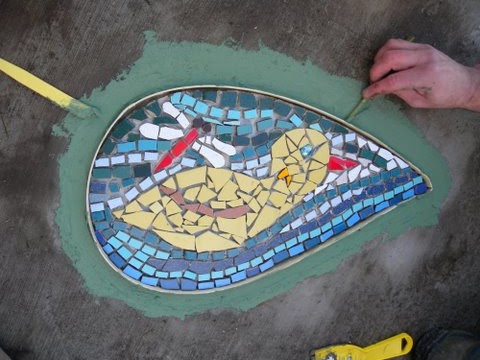
From the first tile installed in October of last year we saw that the stained mortar band needs to be applied differently. If any of it rubs out onto the path surrounding the recess we are bound to spend more time and effort cleaning the mess. The solution is quite easy in theory: apply the paste carefully. In reality it was relatively easy but still challenging. A combination of cold weather, wet concrete path and crouching down to work were found to be a nice workout.
Into a one inch wide gap the mortar is applied in small amounts to
gradually create our desired band.
There is no way we can rush things even though we want to. As we move into spring more days are available to work on installation. The world around us is shaking in multiple directions. I think it’s a matter of re-imagining the excitement from last year that will help us shift gears. This is still a celebration of life.
Even with this impressive display of process the
grouting stage is still ahead of us.

26.11.10

always longer than you expect

The concrete was hard enough to step and jump on three days after it was poured. What you don’t see at that stage is the process of curing it goes though that takes about a month. Within that time it’s better not to lay our mosaic tiles in their recesses. Waiting for the concrete slab to cure allows adhesion with the mortar for the mosaic tiles to build up properly.

The plywood board is easily extracted from the recess.
An unwelcome puddle of water is exposed underneath.
By the time we could start it was already the end of October. A day or two of rain, and we need to wait. A few days of sunshine and it becomes colder. Proper setting of our mortar is sensitive to moisture and low temperatures. With the first tile we had started laying we realized that the opportunity was slipping away. The rest of the job will have to wait until spring.
A peanut buttery feel to the mix feels good
and is a suitable consistency.
Each tile will have a stained concrete band that is our choice for transition between the mosaic image and its surrounding gray paving. In order to achieve a clean line we need to fine tune our method of applying the stained concrete into the gap.
We surround the mosaic tile with a strip of masking taped cardboard
to leave room for the grout between the tile and the concrete band.
When we grout this piece we will also have a chance to see what other techniques we have to implement. This is a technically easy stage but it needs the same attention to details as we’ve invested in the process up to now. Grouting can drastically alter the appearance of a mosaic tile. If that happens we’d like it to be for the better. This is why I always tell people and try to remember myself: It always takes longer than you expect.