Showing posts with label Design. Show all posts

4.9.17

Small Matters Matter

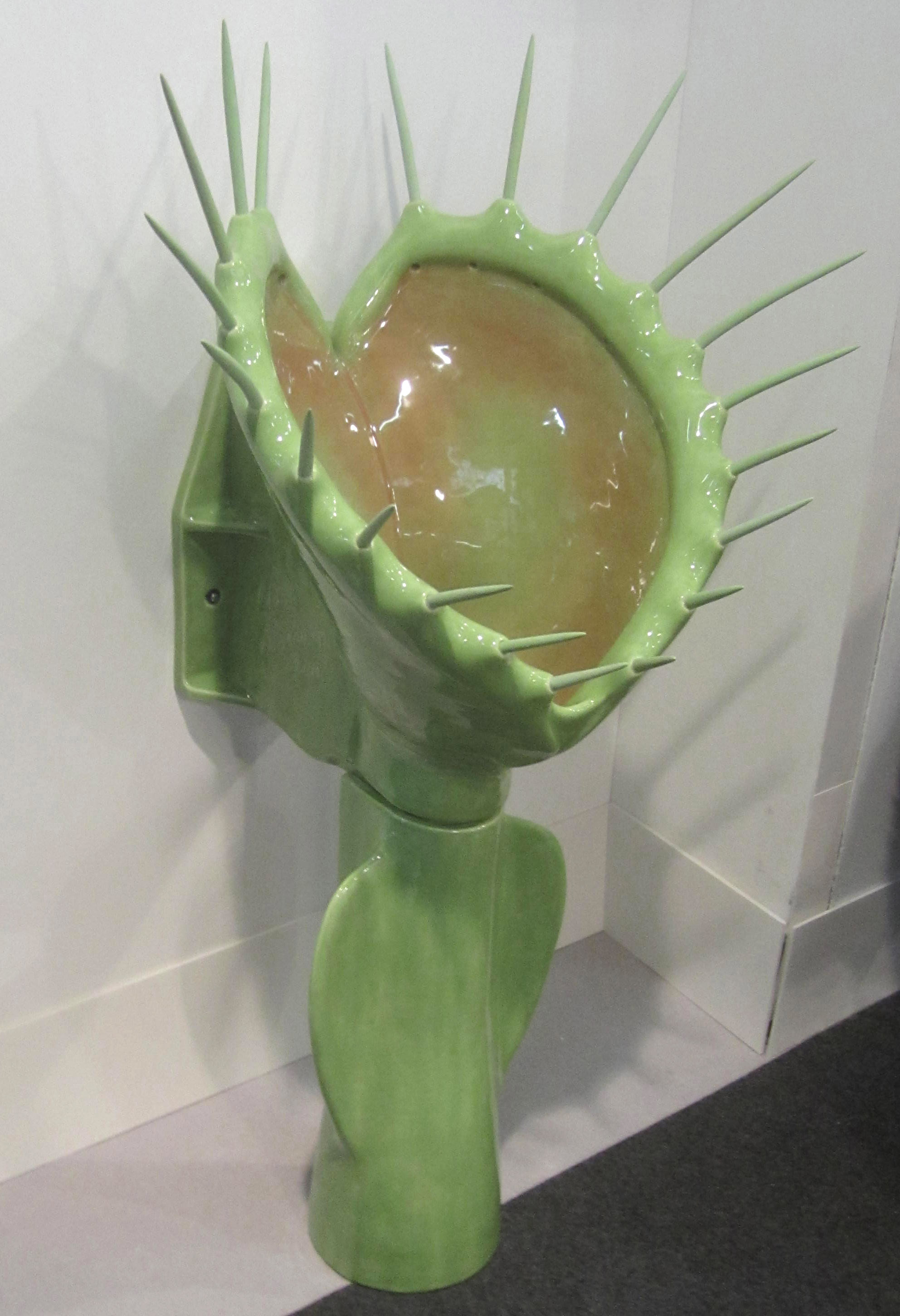
At home, 65 centimeters exist between my eyes and the surface in front of me when I stand to pee. In most public washrooms, urinals are attached to a blank, boringly surfaced wall. That wall is typically  spaced about 35 cm away. Sometimes there is a framed picture, many times an ad, hung up to attract us, the pee-standing population. If there is some depth in the image, a slight sense of relief accompanies the process of relieving my bladder. In rare occasions there is a ledge at chest height that adds a welcome sense of space. In even rarer installations, there is a small window.
I've been enjoying the freedom of pee-standing forever, really. However, at times I simply get tired of the small accidents or even the occasional harmless splatter. As clean as I have always been, the stray drops that escape me accumulate in hidden gaps and get on my nerves. For a few years I managed to stick to pee-sitting. A seemingly small sacrifice for the sake of bathroom wellbeing. But temptations are not restricted to erotic avenues. One of my fantasies is to install a urinal at home.
However, the one I really want is just way too expensive, at least for the time being. So I stick my stick through the zipper and enjoy my musings in front of the blinded window in our humble bathroom. This morning for instance, I was wondering about the pattern of light that formed on one of the slats facing me. Light waves generate intriguing projections thanks to a variety of phenomena. When I thought of taking a picture of the light pattern, it occurred to me that until I set up the tripod and attach my camera on to it, the sun will move and the pattern might vanish with it. Still, which of the four cell-phones at our disposal would be best for the task? Why not try all? So yes. By the time I got to the fourth device, the projection changed.
Thankfully, none of the phones dropped into the toilet.


22.3.14

The making of Drop Shadow - Artist Staement

Among the layers of creation, a statement is the artist's way of articulating the outcome for the viewer. Whether this explains the work or adds mystery, is a matter of choice. I find it intriguing to provide a statement that is both. The previous two posts (First Stages; Resurrection) mainly dealt with the timeline of working on 'Drop Shadow'. Apart from beauty, I want my work to provoke thought and nurture discussion. Open minded communication with my audience can generate new ideas and insights. The following is my statement for the show in July.
Our built environment is a result of generations of growth and interaction. In this body of work I'm reflecting on components of life and setting them in a pattern that supports new directions. We all come together on an individual journey and find the commons we need. The city is a body with endless faces. The way from which you look at it can change how you feel about and in it.
'Drop Shadow' is a process in which I contemplate the move between stages, the changes in time and scale, the balance between resource and allocation. From a young age I've been intrigued by the constant development of tools available to us. When I started using Photoshop I very quickly developed a variety of processes that allowed me to generate the features we needed for my team's projects. Then a tool called drop-shadow was introduced that in a single click created most of what my process had involved.
The city is our most complex tool and changing it seems to be on a larger scale than we can imagine. Within the arbitrary motions of fitting components together, a sense of order evolves. This sense of order is a source of both strength and weakness in all of us, individuals and societies. The need for change repeatedly shows itself. The effort to change is many times bigger than what we've thought or even hoped it would be.
'Drop Shadow' is merely a work of art. My work on creating it involves traditional arts materials such as acrylics and pencils. However, computer and various hand tools were a significant contribution to the results at hand. In 2003 its various components were constructed in a certain way. Revisiting them more than a decade later has allowed me to relate the small scale of revitalizing their existence to my current state of engagement with urban design. The effort of tweaking an established body of work involves finding the right balance between existing conditions and the boundaries of my imagination; between past, present and future.
My search is in how to turn this effort into play.

15.3.14

The making of Drop Shadow - Resurrection

My previous post (Drop Shadow - First Stages) ended with me leaving my art stored since 2005 for a few years.
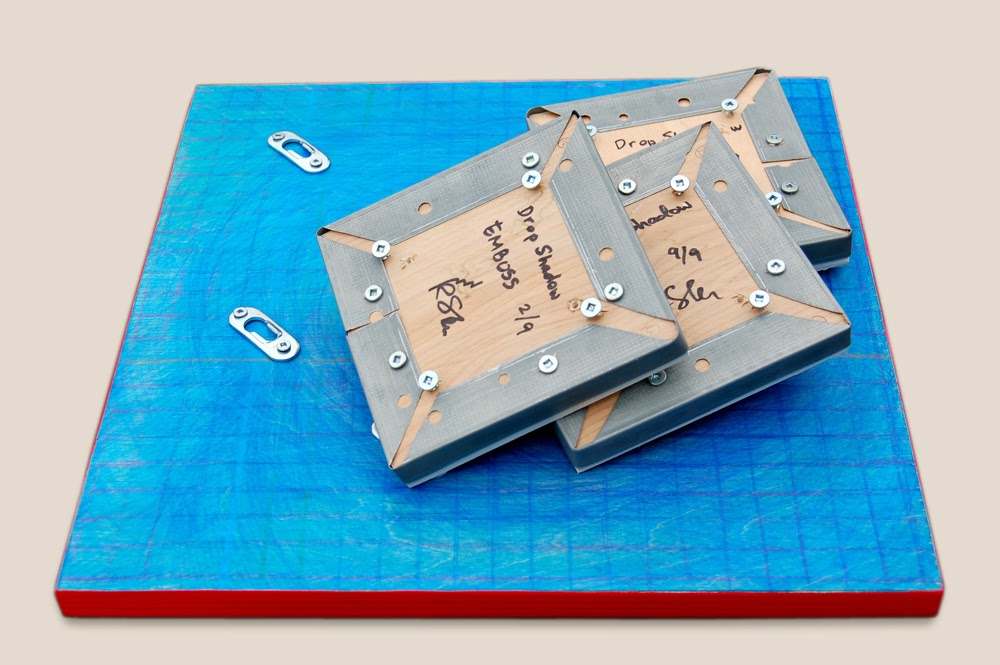
Then, in 2010 came my parents' 70th birthdays. It seemed like a great opportunity to take a look at what I've had and make something new out of it. This time, a square plywood board was selected to be the background and support for the whole composition. To make the small squares truly interactive, simple elements of hardware were employed. Making sure to work with an accurate template, I've installed screws at the back of each square so that one can insert each piece in any of the nine spots on the background board. I'm not sure my parents play with combinations of the various possibilities but they sure can, and that was my intention.
A little later I tried a down scaled version for a friend's wedding. Instead of a stained background I took a bunch of color pencils and worked on visually relating the pieces. Instead of nine squares floating above the surface I've selected three from the existing acrylics on plywood pieces.
Pressing the pencils on the background boards, there is a physical connection that forms between me and the surface. I enjoy the transparency of pencils where you can gradually add strokes and the color becomes more pronounced and still the color beneath shows itself. By contrast, acrylics tend to just cover the layer beneath. The difference between media supports my narrative of urban change: the effort of tweaking an established infrastructure involves finding the right balance between existing conditions and the boundaries of our imagination; between past, present and future.
My current state of the process is nearly ready with six pieces. They all use plywood boards as backgrounds and pencils in various degrees of application. There is a wide range of styles between them and still they seem to form a coherent family of objects. I am intrigued by how they will look when I'm done. Notice in the small works the similar pieces in blue. As my use of tools allows me to plan and anticipate the process, what I'm showing here is an approximately what they will be. On this, I will expand a bit later.

22.12.12

How do you get to 2013 from here?

Well, take a right where they're going to tear down the viaducts.
Go straight past where they're going to put in the hi-rize.
Take a left at what was going to be the new community center.
And keep going until you hit the place where they're thinking of building that cycle-in bank.
You can't miss it.
(Paraphrasing on Laurie Anderson’s Big Science - 1982)
The street grid here shows Kingsway between Victoria Dr. and Rupert St. in Vancouver, BC. The background image shows part of the planting around our sidewalk tree.

In the past year I've been involved in a variety of meetings and discussions relating to urban and other issues. My fascination with urban life gradually brought me to realize how much I enjoy dealing with the massive challenges that urban planning imposes. The coming year is going to be another step in my constant
 exploration, exposure, planning, building and connection with the subject matter I am so engaged in.

Best wishes for a graceful move from one year to another, from day to day, from one thought to the next. Some steps are bigger than others. All are important.

30.9.12

PKN - Norquay Mosaics in 20 slides at 20 seconds each

My first Pecha Kucha talk was delivered twice: in November 2010 I was the last in a line of speakers at the first ever Coquitlam BC PKN; in September 2012 the first ever Richmond BC PKN was held at the Cultural Center there and I was the eighth among ten. The Norquay Park Clean Water Mosaic was a Vancouver Neighborhood Matching Fund  project. This talk describes in 20 slides the issues related to the creative process we, Yoko Tomita and I facilitated in the Renfrew-Collingwood community back in 2010. Here it is in its revised and updated version: 
Halfway into a mosaic making session I’m delivering an enthusiastic speech about the fascinating process of telling a story through careful one by one laying of pieces onto the cement base. As part of my routine I ask one of the kids I am working with, “what is the story in your tile?”

“Whatever”, he responds in a typical juvenile bored expression.
“How do you spell whatever?” I ask him, still with the same breathless enthusiasm.
He starts with “aam, W. H. A…” and finally retreats to “whatever”.


At the time my daughter was six years old. I must have been influenced by the games I was playing with her. “How do you say it; How do you spell it” and so on.


Making mosaics was new to me. I haven’t really realized what I got myself into by joining this Neighborhood Matching Fund project. Working with the community is a challenge. In most cases it was fun.


Yoko Tomita is a community artist in the Vancouver East side. She is the one who actually prepared me to working with youth: they would say “Yoko, I’m bored” she warned me. “Hey, this is child labor…”. And they actually did.


For many of the artists out there community arts is a treacherous way of making a living. For me it was an opportunity to engage in design for urban space. 


My first encounter with design and production of large scale objects was in 2001, about a year before moving from Israel to Canada. I had an exhibition of eight lighting objects at the foyer of the Pavilion for Performing Arts in Tel Aviv.


For the mosaic project I had the fortune of meeting Bruce Walther and Liz Calvin, two professional and generous artists who have their mosaics installed in various locations around the lower mainland and even further away.


Our challenge was not only bored kids but many people’s low expectations that in many cases leads to lagging engagement. This drawing was made by a woman who initially said she could not draw. “Oh”, I said to her. “Can you draw a straight line?”; “Can you draw a circle?” “Looks like a drawing to me”.


No matter what skill level, it was a pleasant surprise to see people's creative process evolving as this pretty example shows.


The youth leader who started this one, occasionally asked for advice or direction. I would point to a simple pattern and half an hour later she’d come up with even better creations.


It wasn't always easy. No matter how patient Yoko would be, with the boy who started this, he would lose interest as soon as his design was covered by the broken tiles we worked with. But we needed more detail, we wanted to push the limits.


When I took the drawing home and played a bit with PhotoShop I wasn’t sure how the boy would react to someone else taking over his design. Miraculously, he loved it and continued working with a new sense of purpose.


It was always heartbreaking for people to realize that this was not the end. The woman who showed this to us thought it was perfect. We were looking for more detail. For us the task was simple: the gaps had to be even; every piece made a difference. Notice the chunky red border at the top and the yellow border around the dolphin.


One day she approached me just a few pieces before her mosaic was complete.  With the little English this woman had she managed to say, “It’s not beautiful”. “Ah,” I reassured her, “Whatever you manage to do is perfect. From there you can only improve.” 


The mosaic process was almost over when demolition of the old park started and we moved on to dealing with the landscape architect and contractors. It was mostly a friendly exchange of information. We were just a tiny component of the whole production but the coordination required some back and forthing that exposed a few challenges.


Even at the planning stage, the mosaics were supposed to go into the floor of the water spray feature. When the health authorities said that mosaics are not allowed in or near the water, I encouraged my colleagues with the realization that now the whole park could benefit from the art. The red dots show where the mosaics were proposed; the green marks show where they were eventually installed.


In the cold spring of 2011 we finally installed the pieces that were waiting in my basement throughout the winter. You need to wait for the concrete structure to cure before you can install the mosaics in the recesses that were made for them. During the winter it was too cold for the mortar to efficiently attach the tiles in place.

I think the achievement with the credit plate was managing to fit in all of the info we were expected to. But it was also the fact that we got a stone carved element with the absurdly low budget we had. The stone carver who made it for us was absolutely generous and committed when we explained the context of our project.

For me, Community Arts is not about art; it’s not about community. It’s about our connection. For this I’d like to thank you for reading this far and making it happen. To read even more, go to the Mosaic page of this blog.

16.6.12

green streets traffic circle

My method of gardening relies on heavy digging. I have no patience for weeding on my knees. I started by building a few scrap plywood planters to experiment with structure in the traffic circle. Unfortunately these were turned over by mysterious hands and some were even removed. It's interesting to realize that people actually have interest in what's going on inside of a traffic circle.


So, from this I decided to concentrate on the existing conditions of the location. When this circle was assigned to me it had great mulch covering its soil, an established colony of irises and a few other plants in reasonable shape. It didn't seem to have too many weeds but who knows what weeds are anyway. Any plant matter that grows without me interested in it is doomed. Which more accurately means that I become doomed to constantly chase it whenever its leaves are sent out of the ground.


As a first step, the irises had to make room for other varieties. Their rhizome type root system is impressive. They're actually not that hard to pull. But I had to dig a bit before pulling so that it's not only the knife shaped leaves that come out. There's an interesting process going on in my head as I make my way from one cluster to the next. I decided to take it easy and start with what seemed to be a small task: removing irises from only one quarter of the circle. It worked well and didn't take too long. But it was still quite a workout. I was happy to have made the decision to take it easy ahead of time. But the next day I was there to work on another quarter. Immediately I became impatient to finish the whole area. Piles of irises with their root systems accumulated in the middle of the ground. 


The weather was great, a partly cloudy, typical Vancouver, mid June. The soil was soft and moist. Removing the "debris" from the circle required some hauling and now the place is ready to continue its transformation. The irises selected to stay are planted in two rows at the perimeter, close to the concrete edge. A young rose bush is waiting to be cultivated into a healthier accent and some pieces of bergenia were also spared from extinction (thank you Green Streets people for your help with the name).


Our sidewalk tree base is my gardening lab. This is where I plant all sorts of plants to see how well they grow. We bought a few 4" pots and as small as they are I have divided them before planting to increase their spread. As it seems, all have rooted well. In the next little while, some of them will be transported to the traffic circle and left to do their part of the deal.


15.4.12

hate-love


I have to confess I almost hate gardening. But the reason for that is the exact same reason why I almost love it. You toil away doing whatever you think is required to keep your yard or planter in shape. Then nature does its part and does it no matter if it fits your plans or not. When it doesn’t, I feel powerless and futile in my efforts. When it does…, hey! We are a team!
This is how it looked when i started. A variety of five plants.
So basically I admire the ability of plant matter to regenerate no matter what you think of it. We label dandelions ‘weeds’ and consider Morning Glory to be a menace. The inspiration one can take from these two examples is incredibly valuable: persistence and perseverance. If you think what you’re doing is right, never despair. Of course the human body matter’s mind doesn’t aspire to be considered a weed. But that’s not the point.
Small pot plants were cut into smaller parts.
I love the smell of soil. When I trim the hedge there is a fantastic feeling of freshness in the air. The act of gardening is mostly boring but the rewards exist. You just need to reach the right balance between Labor and Love.
From this angle things already look lovely.

15.7.11

the-official-opening

The park has been open to the public for about a month now. The upgrade seems to be a huge success based on the amount of people clamoring its features. Despite the coldish summer many even dare the sprinkles of the water spray area.
An official opening event is scheduled for Wednesday July 20th 4:30 pm. I'm curious to see what that will look like.

21.4.11

stepping-stones

The block on Kingsway between Wales and Rhodes streets has light pedestrian traffic. As we are installing the last mosaic pieces in the two entries to the park the protective fence is still there. Norquay Park has been a construction zone since July of last year. The few people that pass by either slow down beside us or stop.
They are all curious as to when the park will be open again. They also notice the mosaic pieces and seem impressed with their beauty. Along the progress with installation we’ve gradually been able to get the sense of significance this project has in the upgraded park. The entry pieces have a good impact as gate decorations.

The history of Still Creek is one in many similar stories of urban industrialization, reflection and rehabilitation. Today the Vancouver part of the creek is still mostly hidden in underground pipes or behind chain link fences. From its designation as the most polluted stream in BC in the 1980s, much progress has been made and much more is required. Serious work has been taken to bring it back to a liveable natural element in urban space. The Norquay Park 2010 Clean Water Mosaic project is one stepping stone in a long educational journey.

Funding for our part of the journey came from the Vancouver Board of Parks and Recreation, the Vancouver Neighborhood Matching Fund and Collingwood Neighborhood House. The intention of this collaboration between budgetary resources is to facilitate community interaction. Participation in the building process of the park enhances the sense of ownership over the neighbourhood.

Members in the community were brought together to create a visual reminder for all to enjoy. Twenty pieces were created in this process and are now integrated in the concrete sections of the paths in the park. After entering either from its west or east entries you are welcome to explore the park and find the other mosaic pieces. All of them are a result of many hours shared by community members who participated in our workshops. It is our pleasure to thank them all, seniors, adults and youth for their contribution.

Installing our mosaics provided us with the opportunity to work closely with the architects and builders who were responsible for the function of the park. The result of their work is a fabulous space with a great sense of place.

The conclusion of this project brings me back to its starting point. In the research for mosaic making we met Liz Calvin and Bruce Walther. These two mosaic artists’ work can be seen in many places around and out of town. Without their generosity this project would have looked completely different. A sample of their collaboration can be seen in Downtown Vancouver where a set of eighteen pieces are placed.

Many more contacts were made throughout the process. Yoko and I are grateful to all who helped us get to this stage. Our own collaboration started with mutual interest in this experience and ends with excitement over the accomplishment. Just like the small pieces of a mosaic tile tell a story, the whole set of twenty expands this into space and time. This is a reflection on industrialization and rehabilitation.

1.4.11

engagement

I was halfway through a mosaic laying workshop discussing the fascinating aspects of creating a story through one by one laying of tiles on the concrete surface. As part of my routine I turned to one of the kids and asked him: “what’s the story in your tile?” His response illustrated exactly what Yoko had described as the challenge of working with youth: “whatever…” he said with the most lifeless look on his face.
They’re bored; they’re all over the place; they always want to do something other than what you were committed to deliver. “How do you spell whatever?!” I asked him with surprising breathless enthusiasm. In retrospect I couldn’t really explain where my outburst came from. His response was “aahm, doubleyoo, ‘H’, ‘A’…, whatever…”. So I had to conclude with “Good Job! I almost got you there!”.

Putting this experience in writing reminds me that face to face communications lives in a different universe than that of letters and text. In the written space, texting, typing or messaging have a life of their own. Whoever the recipient might be, my words arrive at the other side without facial expressions and no sounds. I can send an innocent “What’s up?” to my sister and hear the explosions from the other side of the world in a matter of minutes. Or never hear from her ever again.

Sometimes every breath we take is loaded with food for interpretations. When I was a teenager I had realized that no matter what I do or say there is always someone who will be upset. My conclusion was to do whatever felt right to me. If any explanations will be needed afterwards, so be it. You have to trust your own intentions.

Communications can be an adventure. There are people who prefer to avoid confrontation. I can envy them for their choice of calm and composure. Most of the time my patience is that of an educator. Occasionally though I feel like it is that of a rebel: why should I wait till tomorrow for the action that could have been taken yesterday?! But people need their own time to join a "revolution". Put the wrong pressure and something will break. Fixing what went wrong then takes place instead of any sense of progress. Without prior intentions I become a rescue expedition to outer space.

The mosaic workshops were mostly grounded in and around community centers. No extraterrestrial adventures here. The boy who got the attention he needed continued to work on his tile with a new sense of commitment. Whatever he texted to his friends afterwards I have no idea…