Showing posts with label Technology. Show all posts

11.1.16

Pendulum


In fact, maybe we are, after a phase of adjustment, situated in a new reality. Packs of commuters, pedestrians and community at large are holding a device of some sort in their hand. With it one speaks, another is messaging; one device is used to read books and on the other, articles are composed.
Like many innovations that capture our initial reservations, the electronic communications device too, in its many incarnations, attracts a variety of calls of dismissal and reproach. Whether I am among the users of the most cutting edge device or one of the many onlookers, our inclination to mock a new phenomenon feels natural. However, without much delay I become one of the many first users of a technology. I might still have a tinge of unease by succumbing to the trend but embrace the wonders of the novelty or even its limits.
Once more I am on the bus, thinking of the typical grievances that used to be or still are directed towards "the addicted" to technology. As time passes by, those who spend their time device-less look increasingly idle, like bums: "like, don't they have anything more important to do than just sit there, without doing anything? Ha! Riding a bus!"

Pendulum (Hebrew)


בעצם, אולי אנחנו מצויים אחרי תקופה של הסתגלות, במציאות חדשה. קבוצות רצופות של נוסעי תחבורה ציבורית, הולכי רגל ושאר חברי קהילה, מחזיקים בידם מכשיר כלשהו. עם המכשיר הזה אחד מדבר, אחרת מתכתבת; מכשיר אחד משמש לקריאת ספרים ובמכשיר אחר מחברים מאמרים.
כמו הרבה חידושים שתופסים אותנו מגיבים אליהם בהסתייגות ראשונית, גם אביזר התקשורת האלקטרוני על תצורותיו השונות זוכה למגוון קריאות ביטול ותוכחה. בין אם אני ממשתמשי המכשיר התורן או מאלה המבחינים בו מהצד, הנטייה לפתוח במסרים ביקורתיים על ההשלכות השליליות של התופעה מרגישה טבעית. לא עובר זמן רב בדרך כלל וגם אני בין המשתמשים הטריים בטכנולוגיה. אולי אני ממשיך לחוש באי הנחת מהכניעה לסחף אבל מגלה את נפלאות החידוש או אפילו את מגבלותיו.
ושוב אני נוסע באוטובוס וחושב על הטרוניות הראשוניות שהופנו, או עדיין מופנות כלפי "המכורים" לטכנולוגיה. ככל שהזמן עובר, המעבירים את זמנם ללא מכשיר ביד נראים יותר ויותר כמו חסרי מעש, בטלנים: "מה, אין להם משהו חשוב יותר מלשבת כך סתם, מבלי לעשות כלום? נוסעים באוטובוס!"

27.8.14

Fresh Roots Dig It

In our daughter's School's exploration of adding value to the educational experience, we've had a discussion with Fresh Roots.


On their website they say that they "transform underutilized spaces into thriving gathering places through urban agriculture. More than growing a garden, we grow community."


A quick visit to one of their locations in Vancouver allowed me to get an impression of what that transformation could look like.


In Norquay School, there is a nice play area, a few planting beds and vast gravel surfaces where kids roam in breaks and after school hours.


What my crappy phone-camera managed to capture is a compelling proposition for at least some of our school's yard.


Some of the photos are not that bad actually and of course that's not the point of teaming up with Fresh Roots.


Urban societies today are in a fascinating crossroads of defining many of their habits, including the act of farming their own produce.


Exposing kids to the possibilities at school age seems like a healthy way of keeping them connected to their source of life and hands on understanding of what sustainability could mean.


Farming is a labor intensive engagement. The friendly people at Fresh Roots may encourage more of us to reclaim the fun that is also part of it.


This Back Yard farming operation is located at the Vancouver Technical Secondary.

29.3.14

Drop Shadow - In The Making

I met Michael Shandrick at a design thinking event back in 2011. This whole series of documentation was inspired by a conversation I've had with him a short while ago. We were discussing processes. In response to his description of a script he was engaged in writing, I've asked him about the possibility of him posting the story. He seemed pretty intrigued by the idea. As we were exchanging more thoughts I've realized the same idea could apply to me. This is the fourth post following First StagesResurrection and Statement.
Just a minute or two before our walking tour of Vancouver in the Design Thinking unConference

As soon as I embark on the act of executing my thoughts, the process itself is a form of result. However, it is also an exploration. You could even see it as an adventure, where not all the answers are known. The creative process can be planned in detail yet reality imposes hurdles in many forms. Time and money are the most basic of them. Proper planning helps in balancing the many components that the process entails as it unfolds. However, people get sick, accidents happen, new ideas come up. You can't anticipate everything.
The beauty of a process exists in any of its stages.

'Drop Shadow' as a work of art is an analogy to this process. When I had started working on it, the plywood squares I was painting on, represented pixels of the digital world. Technically, I've placed them together as one surface and occasionally shuffled them to add a new layer of paint. That has generated a degree of arbitrariness to the composition. A pixel is like that. It is a sort of canvas that accommodates whatever info is directed in its way. When all the pixels together form an image that makes sense to us, communication exists.
Scale is a fascinating feature of space.

As my world expanded into the urban realm, my interest in reflecting that in my art inspired me to look at "my pixels" with a new sense of purpose. For me, a city is the most complex product of human society. Its most challenging complexity is the fact that we are one of its components - its most important one. Without the city our lives would be something else. Without us, it won't exist, or at least slowly degrade into oblivion (have a look at this).
Reflections happen with smooth surfaces, within computer programs and in your head.

In this process my camera and computer were used as painting accessories. Taking photos of the acrylic squares had allowed me to manipulate the image before continuing to add paint. The desktop monitor enabled an enhanced flexibility in viewing the work and experimenting. Planning and execution progressed very quickly following decisions made over a compelling variety of options. Plywood, as a building material, allowed me to cut existing pieces and further play with their layout.
The side of a building in construction where the concrete pouring "imperfections" are still evident. 

This layering of processes is what I find compelling in everything I do. Whether it is an idea or an object, a present reality or a vision for the future; when I look at them as raw material, my options of action are wide open. The story is the action that connects everything together. Each story sheds a light of its own on our existence.  Light and shadow play equal roles in our sense of space. If for no other reason, naming my project 'Drop Shadow' sounds almost inevitable.
- - - - - - - - - - - - - - - - - 
This post was actually posted on August 28 2014. I had meant to publish it on the date that appears here but simply lost  track of my list of drafted files. Interestingly, in Blogger you can control the publishing date to reflect your interests.

28.1.14

Open Media with the Design Nerds

"The question mark is our exclamation mark," I say as we stand in front of the room. "We have to keep on asking questions so that the challenges we generate provide us with insight to better understand the realities we are facing. Education through a variety of sources and venues allows us to become informed so that the decisions we make sustain us within the society we live."


A Design Nerds Jam starts with an introduction by a speaker or two who provide the framework of the event. The guest host on Saturday, 25th of January was Reilly Yeo, Managing Director of OpenMedia.ca.  

- - - - - - - - - - - - - - - - - - - - - - - - - - - - - - - - - - - - - - - - - - - - - - - - - - - - - - - - - - - - 
Browsing through the questions posted on the walls, my feeling is that they come with a predetermined agenda.
SHOULD INTERNET AND CELL PHONE PROVIDERS BE ABLE TO MAKE IT MORE EXPENSIVE TO ACCESS CONTENT SERVICES THAT COMPETE WITH THEIR OWN?
This is a strange question. If anyone in the room has a business to run, wouldn't they want to be able to charge for their services or products so that they make profit that supports their livelihood and that of any of their employees?
ARE THERE CERTAIN SERVICES THAT ARE BLOCKED, OR CERTAIN SHOWS YOU CAN’T WATCH BECAUSE YOU ARE NOT SUBSCRIBED TO A SPECIFIC TV BUNDLE?
When you subscribe to a certain service, you're offered certain programming. It's up to me to negotiate the terms of our engagement with the company we are buying our services from. I have disconnected cable years ago and haven't felt like I've missed anything.
MUCH OF CANADA’S MEDIA CONTENT, NOTABLY LIVE SPORTS, IS CONTROLLED BY THE BIG TELECOMMUNICATIONS COMPANIES. SHOULD THIS CONTENT BE MADE  AVAILABLE AT A COST-BASED RATE TO ALL TV AND ONLINE SERVICE PROVIDERS AND THEIR CUSTOMERS?
I see "NOTABLY LIVE SPORTS" and think: "OK, we want better access to media content for what purpose?!" Isn't live sports a venue where the masses escape from meaningful participation in social issues? Well, I find the way this question is framed somewhat ironic.
SHOULD TELECOM COMPANIES HAVE THE ABILITY TO DETERMINE OR RESTRICT ACCESS TO PUBLIC MEDIA OUTLETS AND OTHER COMPETING SERVICES?MOST CANADIAN TELEVISION COMES FROM CNADA’S BIG TELECOMMUNICATIONS COMPANIES (I.E. BELL, ROGERS, SHAW AND QUEBECOR). THE MAIN EXCEPTIONS ARE PUBLIC MEDIA OUTLETS LIKE THE CBC AND THE ABORIGINAL PEOPLES TELEVISION NETWORK. 
When TV services in Israel expanded into more than one channel, it was already evident that the American population was growing to be hooked on the crappy content they were provided with. I've always had a naive belief that people eventually grow out of distorted strangleholds of media companies. Education is key to better understanding, awareness and choice.
WHAT DIGITAL CONTENT SERVICES DO YOU SUBSCRIBE TO? I.E. CABLE TV, NETFLIX, SATELITE TV, THE ITUNES STORE, OR OTHERS
When the internet became easily available there was much talk about the revolution in content consumption. The interactive nature of this tool ignited the imagination of many thinkers. The reality we all live in is that not a lot of action is taken within the vast fields of opportunity. The general public is a random collection of individuals who are usually taking the path of least resistance.
IS HAVING PUBLIC MEDIA AND CULTURAL PROGRAMMING READILY AVAILABLE IMPORTANT TO YOU?
When I first unsubscribed from the cables, I wasn't sure it was the right move. As a designer, shouldn't I stay in touch with what's happening? It turned out to be a great move: not only was it right but it turned out to be a blessing: I've gained more time for things I'd been neglecting; my exposure to inspiring content has improved and there wasn't any noticeable change in my feeling of being connected.

It was only a few days after the event that the real challenge became clear to me: "what are the questions that I would have asked?" 
- - - - - - - - - - - - - - - - - - - - - - - - - - - - - - - - - - - - - - - - - - - - - - - - - - - - - - - - - - - - 
I came to this Jam to "explore how matters of digital access, choice and affordability affect our daily lives, and propose solutions that put people first." After the introduction session we are all presented with a variety of topics to choose from, brainstorm ideas and come back to introduce our conclusion in a two minutes presentation. As the five of us in the Wild Card group exchange thoughts around the table I'm happy with my choice. A heated discussion over a variety of topics starts almost without delay. 

Tom, the funeral services guy introduces himself just before me. He gives a very interesting account of the strangle hold the Big companies in his field have over small businesses. I find it fascinating to realize how every issue we raise ignites streams of consciousness that can take us all over the place: the enthusiasm of a speaker can be inspiration to some as much as intimidation to others; the information shared will always need to be verified; every word is a trigger to countless associations to other thoughts and ideas.

Jared, the product designer is joining me in doodling as he speaks. His drawings are much nicer than mine. I hope to see the images soon on the design nerds' pages as I haven't taken any photos apart from the notes on the walls. We kind of jot down reactions to things that are mentioned around our table or thoughts that come up in reaction to one another. 

Tara, the Communications PhD student also writes words and circles them with red lines. Julien, our facilitator realizes that our intellectual meandering is threatening the coherence of our presentation. What is our story? For me, this is it.

"The question mark is our exclamation mark," I say. "We have to keep on asking questions so that the challenges we generate provide us with insight to better understand the realities we are facing. Education through a variety of sources and venues allows us to become informed so that the decisions we make sustain us within the society we live."

I really enjoy the practice of coming up with a coherent message after only a brief exchange of ideas. Just before moving on to the main hall to deliver our summary, I've noticed in my peers' papers words and phrases pretty similar to mine. "The scale in which we operate determines the outreach of our actions. But when we consider the concept of accountability my question to myself is where am I accountable? Our demands from big corporations start in each of us as individual members of society. As soon as my own goal is beyond the scope of my resources, my reliance on others tilts the priorities of my decisions."

This is why my first doodle was the question "WHAT IS OUR STORY?"
- - - - - - - - - - - - - - - - - - - - - - - - - - - - - - - - - - - - - - - - - - - - - - - - - - - - - - - - - - - - 
I'm always impressed by the undertakings the Design Nerds engage in. My effort of participating keeps me trying to join. Being a design nerd myself, traps me in the reality of looking at everything from more than one direction and distance. So the questions naturally arise. When you start asking questions, the process of education is natural. My interaction with others requires accountability which will always tie me to the scale at which I can operate. The question mark is definitely my exclamation mark; and the other way around.

5.10.12

The challenges of consolidating discrepancies in the process of engagement


Can you listen to yourself through the ears and mind of someone else?
The title above is a phrase I've constructed as I was sharing my thoughts with the consultant at the bank. I enjoy the effort of articulating a complex idea in a very short sentence. With this one it feels like what came as a summary of thoughts in a conversation should be a starting point for a story that explains an issue.
The Process of Engagement 
A phone call from the bank started with her introducing herself as taking control over our investment file. She mentions her role as specializing in providing services to clients whose investments have been active for a while. One of the sentences, that grabs my attention, sounds like “from now on your investments will be taken care of personally”.
I’m not sure what the meaning of that might be and I do not bother to ask: On the phone I am always alert to the possibility that a call from someone I am not familiar with might be risky; I have no interest in volunteering personal information. So I keep my thoughts to myself. They relate to the fact that since we started our investment file, it has gone through quite a few hands, always with seemingly good reason, always with “your benefit in mind”. “From now on...” doesn't sound like what we've experienced so far.
I appreciate the bank’s reassuring disclosures about their best intentions. However, their good service is always certainly going to benefit the bank as well, if not more than what it would benefit us. With investment it is always a game of risk versus chances of gains. Whether we lose money or earn it, the bank takes its share.
We schedule a meeting and I let my new contact know that I will inform my wife, who might be able to join. If not, she would schedule another appointment after we set the stage for further action. Half an hour later I get a call from the same person asking to speak with Anat. I remind her of the previous call and we confirm the meeting already scheduled for the following week.
This of course raises my concern with the quality of service I am experiencing. Not only am I already uneasy with the scheduled appointment but now I get an illustration of someone on the other side not exactly in control of information they should have.
And so, a day before the meeting I see my bank’s name on the caller display. My thoughts go “Nice, she is making a reminder call”. But no, she is asking whether I remember we scheduled a meeting for five minutes before she had called. My thoughts race in circles trying to figure what, how and when did our conversation a week earlier lead to this mistake: was it me who put the wrong date in my calendar; was it she who is showing consistent incompetence?
We agree to meet the next day which for me was the time I had in my calendar anyway. When I do get to the bank, our interaction is absolutely productive: the consultant describes her position, apologizes for the misunderstanding and informs me of her interests in that meeting. She takes notes of my responses to her questions and I feel content with the degree of personal service this whole experience entails.
Could the above experience have been smoother?
My concern stays with the stage until our face to face engagement. I am curious how many clients find themselves in similar situations. How many clients does the bank miss because of those tiny streams of discomfort that arise in technology based communications? I’m not so much worried for that bank as I am trying to learn a lesson myself.
We think we are all used to the phone, a well established piece of technology. Even so, there are still endless examples of people messing up issues just because they've tried to settle something on the phone instead of in person. The variety of communication tools at our disposal these days is almost out of control. Between us, we still don’t possess the same degree of mastery over these tools. Beside the technical level of actually operating any of them there is also the social aspect of interaction: it could be that we have different cultural backgrounds; we might have differences in using the same language and we could simply be in different moods at the moment of exchange.
What leads to a meeting builds expectations that do not necessarily relate to the outcome. In the case with my bank the meeting turned out to be much better than what my concerns alarmed me with. In many other cases, things go the other way. The challenge is in the attention we give to what the other side might make of our effort to engage. It’s like we need to find a way to listen to ourselves through the ears and mind of others. Can we do that with everyone we interact? I’m sure we don’t.
So what is our challenge?
We want to engage. That leads us through a process that involves communication. The discrepancies consist of many variations in the way each of us understand the world, ourselves and each other. Bridging these gaps is what I call consolidating. No matter how we name this process it is a challenge.

21.4.11

stepping-stones

The block on Kingsway between Wales and Rhodes streets has light pedestrian traffic. As we are installing the last mosaic pieces in the two entries to the park the protective fence is still there. Norquay Park has been a construction zone since July of last year. The few people that pass by either slow down beside us or stop.
They are all curious as to when the park will be open again. They also notice the mosaic pieces and seem impressed with their beauty. Along the progress with installation we’ve gradually been able to get the sense of significance this project has in the upgraded park. The entry pieces have a good impact as gate decorations.

The history of Still Creek is one in many similar stories of urban industrialization, reflection and rehabilitation. Today the Vancouver part of the creek is still mostly hidden in underground pipes or behind chain link fences. From its designation as the most polluted stream in BC in the 1980s, much progress has been made and much more is required. Serious work has been taken to bring it back to a liveable natural element in urban space. The Norquay Park 2010 Clean Water Mosaic project is one stepping stone in a long educational journey.

Funding for our part of the journey came from the Vancouver Board of Parks and Recreation, the Vancouver Neighborhood Matching Fund and Collingwood Neighborhood House. The intention of this collaboration between budgetary resources is to facilitate community interaction. Participation in the building process of the park enhances the sense of ownership over the neighbourhood.

Members in the community were brought together to create a visual reminder for all to enjoy. Twenty pieces were created in this process and are now integrated in the concrete sections of the paths in the park. After entering either from its west or east entries you are welcome to explore the park and find the other mosaic pieces. All of them are a result of many hours shared by community members who participated in our workshops. It is our pleasure to thank them all, seniors, adults and youth for their contribution.

Installing our mosaics provided us with the opportunity to work closely with the architects and builders who were responsible for the function of the park. The result of their work is a fabulous space with a great sense of place.

The conclusion of this project brings me back to its starting point. In the research for mosaic making we met Liz Calvin and Bruce Walther. These two mosaic artists’ work can be seen in many places around and out of town. Without their generosity this project would have looked completely different. A sample of their collaboration can be seen in Downtown Vancouver where a set of eighteen pieces are placed.

Many more contacts were made throughout the process. Yoko and I are grateful to all who helped us get to this stage. Our own collaboration started with mutual interest in this experience and ends with excitement over the accomplishment. Just like the small pieces of a mosaic tile tell a story, the whole set of twenty expands this into space and time. This is a reflection on industrialization and rehabilitation.

26.11.10

always longer than you expect

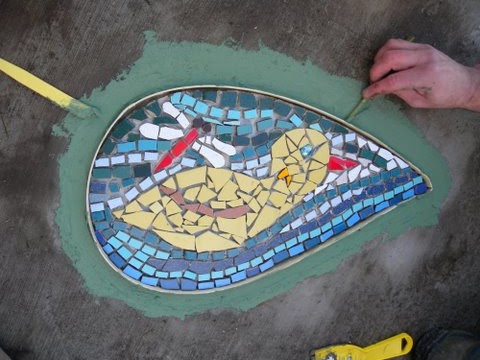
The concrete was hard enough to step and jump on three days after it was poured. What you don’t see at that stage is the process of curing it goes though that takes about a month. Within that time it’s better not to lay our mosaic tiles in their recesses. Waiting for the concrete slab to cure allows adhesion with the mortar for the mosaic tiles to build up properly.

The plywood board is easily extracted from the recess.
An unwelcome puddle of water is exposed underneath.
By the time we could start it was already the end of October. A day or two of rain, and we need to wait. A few days of sunshine and it becomes colder. Proper setting of our mortar is sensitive to moisture and low temperatures. With the first tile we had started laying we realized that the opportunity was slipping away. The rest of the job will have to wait until spring.
A peanut buttery feel to the mix feels good
and is a suitable consistency.
Each tile will have a stained concrete band that is our choice for transition between the mosaic image and its surrounding gray paving. In order to achieve a clean line we need to fine tune our method of applying the stained concrete into the gap.
We surround the mosaic tile with a strip of masking taped cardboard
to leave room for the grout between the tile and the concrete band.
When we grout this piece we will also have a chance to see what other techniques we have to implement. This is a technically easy stage but it needs the same attention to details as we’ve invested in the process up to now. Grouting can drastically alter the appearance of a mosaic tile. If that happens we’d like it to be for the better. This is why I always tell people and try to remember myself: It always takes longer than you expect.

28.8.10

commitment

My perception of the urban environment as a tool for the use of human society brought me to engage with this project. Eighteen water drop shaped pieces are planned for the pathways and two circular mosaic pieces will mark the entry to the park. The collaboration between planning parties is the driving force behind proper urban management. The result can turn into great living conditions.
How does this relate to making mosaics with the public? When we work on laying each small piece of broken ceramic onto the surface of our concrete base, a personal story unfolds. That story will be viewed by other people who visit the park. They will have a chance to go through a journey into their imagination while walking along the pathways. Already I've had the opportunity to notice the many interpretations some of our finished pieces excite.
The light gray areas mark the surfaces where the mosaic tiles
will be placed. Click the image to zoom in
and see the placements for the mosaic tiles.
The architects have a job to do in designing this park. The builders are in charge of putting it in place. When construction is done, it is the public that will be there to live with the results. Having members of the community participate in putting a piece of their lives into the park is a neat way of tying the ends. Our taxes go into paying for this development. Our hands are still there to be part of building it. It's like baking your own cake instead of buying it in the grocery store.
These forms will be sunk flush into the concrete surface.
The resulting recesses will house the mosaic tiles.
As simple as making mosaics can be, the fact that they are going to be part of public space requires a degree of coordination that I find intriguing. Each party has a role to perform. By working together the process promotes an opportunity to make the most out of collaboration. Having a community arts project as part of this maintains a balance between the professional and the personal.
making sense of it all.

24.7.10

leather based concrete

This week marked a shift in the process of creating mosaics with our community. Technically, we learned how to lay tiles in a way that is both simple and insightful. Socially, this method allows us to better engage with our public. It all started with what looked like a brief encounter with two local mosaic artists, Liz Calvin and Bruce Walther. They are both separately making mosaic pieces and have collaborated in a Downtown Vancouver project.


Concrete on mesh can be cut with sissors

Colored concrete is a world of exploration

Soon to be seen in Norquay Park, Vancouver BC

Both were friendly on the phone and provided valuable information that seemed quite a lot and sufficient for any good start of mosaic tile creation. This was a few weeks ago when Yoko and I were experimenting with methods to teach at our workshops. After quickly meeting with Bruce at the New Westminster Fraser Festival I went on to meet Liz in her studio.

My own joy of sharing information comes from practical realization that this is one of the stepping stones for our shared success as a society. What I've experienced in my meeting with Liz was something like a hurricane of generosity. Not only did she share information but she also provided us with tiles, materials and tools that are probably equal to doubling our budget for this part of the project. Not enough thanks can be expressed for such an attitude.

Meanwhile, in our workshops we gradually feel the growing interest among our visitors, who step into the room and around the tables with curiosity. They start with struggling to fit broken tiles side by side. As Yoko and I guide them through the process, their results begin to show nice little expressions of art. Some of them already show the glimmer of enthusiasm at the side of their eyes. They end their session with an eagerness do to more. I'm looking forward to the tiles we are about to create in the next little while.

12.7.10

what people will understand


The design process takes us through steps of exploring options before we start fabricating. We'd like to check grout color, both within the tile and surrounding it; seeing the proportion of a tile on site can give a sense of its impact; understanding what to expect is also helpful when working in a team with a wide variety of skill levels. The Norquay Park mosaic project is a Matching Fund operation. Anyone from the community is invited to participate in workshops designed to facilitate the fabrication of mosaic tiles. Yoko and I will later on install them on site.
The color of grout greatly affects the way a mosaic looks. In this example the exact same design of tiles is completely transformed when illustrated with three different shades of grout.
It's also useful to get a sense of how a piece might look as its surroundings age. A quick test can let us make decisions relating to priorities ranging from choice of tiles to selection of colors. Three sidewalks of different degrees of wear were shot for this spread. The image of the tile was gently manipulated to illustrate a similar process of aging.
As we are making progress with the workshops, it's useful to continue exploring some of the techniques we will be using with the public. Some would step into work without hesitation. Others will express difficulties with unexpected issues. "I'm too lazy today" I've heard on the first session. Another one can't draw. The fact that they come to this workshop by their own choice puts things in an interesting perspective. The challenge in education is in what others will understand, not what they don't.
Other tests are made on the way. Some are merely illustrations done on the computer. But it's always working with the real materials when results start to give you a tangible sense of what things will actually look like. Even then, the tools we have on the computer help in saving time, money, and resources.
Then it's time to interact with our artists - the kids and other men and women from the community. They come to have fun, but are about to create a legacy for their own neighborhood.

13.2.10

time is money

The concept of time has always interested me. The way we use it, the devices we create to measure time, document it and display it are a product of years of development.
Cartier
In 1748 Benjamin Franklin published a letter of advice to a young tradesman. It is intriguing to see the words that became one of the most used phrases related to business appear at the very beginning of that letter. I’m sure this is not the only reason his figure adorns the US$100 bill. Nevertheless, the concept is worth appreciating.
Tag-Heuer
The research that went into getting this information was not paid for. For my second Toastmasters speech I wanted to talk about wrist watches. Time is Money seemed to me like an appropriate opening, especially for the group I am meeting with, mostly employees of PHN, a Canadian investment management firm.
Tudor
The main body of my research concentrated on the watches though. Today, a wristwatch is considered as much of a status symbol as a device to tell time. Clock and watch makers have always taken it as a challenge to introduce new engineering advances into movements. Not all of them necessary for daily time keeping. This is how we end up with mechanical watches that provide an accurate display of time of sunset, phase of the moon and so on. Features responsible for the display of info other than hours, minutes, and seconds are referred to as complications.
Panerai
Components of the wristwatch can be numerous: The common hands for showing the hour, minute and second; Other hands in watches with complications; the dial; divisions of the hour; case; winder/button; wrist band. Each of these makes a difference when it comes to designing a timepiece. You might get confused when looking for a watch. When in a shop showing hundreds of watches, concentrate on one feature at a time. Go over the watches and focus your attention on the minutes hands. Then, look at how the hour 12 is represented. After that, sweep through the winders. With this exercise you can now approach your next browsing in open eyes and possibly make a selection that satisfies you.
Xetum
In an age when cell phones and digital accessories display time accurately and reliably, the mechanical wristwatch has slowly become less of an object of function and more a piece of modern culture. Go into any of the sites of watch making companies and you’d be amazed by the amount of attention given to the experience of browsing through the variety of products on offer. If you think no one buys those things anymore, think again. It took some time for the manufacture of watches to become relatively affordable for the masses. Never the less, whether cheap or expensive, for many, one of life’s more exciting rites of passage is a child getting their first wrist watch. It is also one of the most advanced pieces of technology people had before electronic gadgets evolved.
Ebel
Money facilitates our journey through time. In order to gain that money – controlled use of time is required. Throughout history humanity strived to perfect time keeping devices. A wrist watch on your hand is still one of the most convenient. It shows your understanding and appreciation of time, money and culture.