Showing posts with label Culture. Show all posts

18.8.22

ריצת ניקיון

אפשר להתייחס להצטברות הלכלוך ברחובות בדומה לעלים הנושרים מהעצים. חלק מהזבל אפילו לא מכוון: נייר עף ברוח; עטיפות שונות אכן נשמטות בטעות; ציפורים אוספות אשפה ממקום אחד ומשליכות אותה במקום אחר... אבל הזנחה מעשה ידי אדם נוטה לעודד הזנחה.

בספרו של מלקולם גלדוול: Tipping Point הוא דן בתהליך. אני בטוח שיש עוד המון מחקרים שמצביעים על אותה מסקנה: הזנחה מעשי ידי אדם מסכנת את החברה עד כדי מפגעים פליליים של ממש. מלקולם גלדוול, מסתבר, מקיים שגרת ריצות ארוכות. פרט שולי, אבל נוח לדרבון, בניסיון שלי לשמר שגרה דומה.

אחרי הפסקה ארוכה, התחלתי שוב עם כמה ריצות קצרות בשכונה, עד החזרה לשגרת החמשה קילומטר שלי. חלק מהשגרה הזו הוא הליכת צינון ושחרור שרירים בשבילי הפארק, סביב מגרש המשחקים ומגרש הכדורסל. זה המקום שבו ראיתי הבוקר מספרי ציפורניים, מלבד הכוסות החד פעמיות האופייניות ואריזות המזון הפזורות פה ושם. 

אני חי עם ענת ינאי בפרוור של וונקובר, העיר הגדולה במערב קנדה. משהו בדמות המכשיר החד במרחב הציבורי גרם לי לפעולה מיידית. בהזדמנויות שונות בעבר חזרתי לפארק קצת מאוחר יותר -לעשות ניקיון זריז. אני לא מתנדב בנפשי, אבל מדי פעם זה מרגיש בסדר לעשות משהו בשביל החברה.

דמותו של גיורא קפצה מיד בדמיוני. ביולי השנה, הייתי עם ענת וענבל בתנו, בביקור משפחתי בישראל. בילדותי היינו מבקרים בבית השיטה, שם חיה בת דודה של אמי. הביקור בקיבוץ תמיד הרגיש עבורי כמו בריחה במנהרת הזמן למקום קטן וחברותי. כמעט תמיד גרתי בעיר. הרגשתי לגמרי בבית באלמוניות שהעיר מספקת. ישראל היא מדינה קטנטנה והזרות העירונית אף פעם לא הפריעה לי להתחבר עם זרים. 

אמנם גם על עין השופט עוברים שינויים כמו בכל מקום אחר, אבל הוא עדיין חממה קהילתית לעומת הניכור הפרוורי אליו אני רגיל כל כך. הקיבוצים של היום הופכים בהדרגה למגוון קהילות שאינן שונות מדי מפרוורים עירוניים. יישוב חקלאי כמו עין השופט נמצא אולי רבע שעה נהיגה מיוקנעם, העיר הקרובה. מה זה אם לא פרוור?

ואכן, גיורא יוצא כל בוקר לטיול רגלי בשכונה (הקיבוץ). כשאנחנו אצלם, אני תמיד נהנה להצטרף אליו. האוויר הצח, השקט של הבוקר והפעילות - כולם נהדרים כחלק מהחופש שלי. אמרתי לגיורא (בחיבה) שאם הוא היה בעיר, הוא בטח היה מוכר כאותו זקן תימהוני שאוסף את הזבל של כולם. במציאות של ההתיישבות האנושית, לא משנה היכן אתה נמצא, מעט מאוד אנשים טורחים לנקות אחרי אחרים. זה פשוט לא עובד ככה.

אם כבר, כשהבלגן יוצא משליטה, אנשים יוצרים קבוצות התנדבות שמתאספות לעשות משהו. שם אחד שנמצא בשימוש בימים אלה הוא מסיבת ניקיון (Clean Up Party). יש אנשים שמקימים קבוצות ללא מטרות רווח וחלק פשוט נעשים פעילי שכונות. 

ביום כדור הארץ, מתקיים אירוע עולמי הקורא לאנשים להתאסף כיחידה (https://bit.ly/3PrCZmq). זה לא רעיון רע. מה שמסקרן אותי הוא שברמה האישית, אדם מוצא את עצמו מתמודד עם מחסומים מיידיים לפעולה מיידית, כלומר לאסוף אחרי אחרים בעצמך. זה פשוט לא ריאלי. אתה יכול לבלות את כל חייך באיסוף הזה וזה לעולם לא ייגמר. אתה עלול לספוג לעג מהמשפחה והחברים. ובאמת, יש לך דברים אחרים לטפל בהם.

    יבול של הליכת בוקר- יולי 9 2022

גיורא יודע את זה. והוא ממשיך לאסוף את כל מה שהוא מצליח בטיולי הבוקר שלו. כשהצטרפתי אליו, אפילו הבאתי שקית מהבית כדי להקל על איסוף האשפה שלנו. תיארתי לי שניתקל ביותר פריטים ביחד מאשר כשהוא לבדו. גיורא אמר לי שהוא מתכנן לקדם את הרעיון של מתנדבים שיקיימו תורנויות ניקיון. 

ככל שהחברה שלנו גדלה, אנו יוצרים מערכות שנועדו לשרת את הצרכים המשותפים שלנו. צרכים אלה ממשיכים להתפתח ככל שהמערכות התומכות בהם מתבססות ואז מתיישנות. האופן שבו אנו מתמודדים עם השינויים הללו משפיע על איכות החיים שלנו. ככל שהקהילה קטנה יותר, כך קל יותר לזהות את האתגרים ולטפל בהם. אבל גם בקהילה קטנה, רוב הקשיים נובעים מהאנשים המעורבים. לא כל כך בגלל אשמתו של מישהו מסוים. יותר בזכות נקודות המבט והאינטרסים השונים של המעורבים. בהתייעצויות, ההבדלים עלולים להסתיים בעימות או להיפתר לטובת כולם. אבל תהליכים דורשים זמן. 

ועד שיעבור הזמן, תמשיכו ודאי לראות את גיורא מרים בקבוק פה ועטיפה אבודה שם.

תודה גיורא וכמובן שאר פעילי הניקיון העלומים.


19.3.22

מוזיקה היא משמעת

יחידת מגורים הופכת לבית ברגע שאני מתקין בה את מערכת הסאונד שלי. אפילו דירה ליד רחוב רועש יכולה להיות מוגנת על ידי מערכת סטריאו נכונה והמוזיקה הנכונה. נכון, אני נהנה ממוזיקה. אבל היא גם מקור משמעותי בחיי למשמעת.

ספתליב, סבתא שלי, גרה במרכז העיר ירושלים. אהבתי לבלות בדירה שלה, להקשיב לתקליטים על פטיפון ה Akai שלה. אצלנו, משק בית עמוס בשני הורים שתלטנים וארבעתנו, הילדים, לא היו יותר מדי הזדמנויות לשמוע תקליטים, שלא לדבר על ליהנות מהם. וההורים שלי ממילא לא טרחו להשקיע במערכת סאונד ראויה. לכן, כאשר הוזמנתי על ידי סבתא להחנות את האוסף שלי בסלון שלה, עשיתי את זה ומאותו יום לא הבטתי לאחור.

In the court of the crimson king

פרט מעטיפת התקליט של קינג קרימזון, In the court of the crimson king

בין המדפים המציגים קריסטלים ופריטים יקרי ערך אחרים, שניים הוקדשו לרמקולים מרשימים. סבתא שלי לא הייתה חובבת אודיו גדולה. גם אני לא. אבל היא הייתה אדם ממושמע, וידעה מה היא רוצה. היא הזמינה יועץ אודיו לביקור שבעקבותיו קיבלה המלצות. כמעט אף פעם לא הקשבתי למוזיקה הקלאסית בתקליטיה שלה. אבל הסאונד היה מרהיב.

'ליב' היה הקיצור האהוב עלינו לשמה האמיתי - ליביה. בכינוי 'ספתליב' השתמשנו בינינו. החלונות הקדמיים של דירתה פנו לאחד הרחובות העמוסים במרכז העיר. כאשר היו סגורים, הם סיפקו בידוד סביר מהרעש שבחוץ. הודות לרעש הזה, יכולתי להאזין לתקליטים שלי מבלי לדאוג שמי מהשכנים יתלונן. וכשסבתא סיימה את היום בחנות שבבעלותה, היא אפילו אהבה כמה מהלהקות להן האזנתי.

"רק תחליש קצת את המוזיקה," היא הייתה מבקשת. "שהשכנים לא יבואו."

מאוחר יותר, כשהייתי סטודנט בתל אביב, הדירה שלי הייתה ממוקמת ליד אחד הרחובות הרועשים בעיר. לא בזכות הניסיון שלי עם "אולם המוזיקה" של סבתא. זה מה שיכולתי להרשות לעצמי. גם יחידות המדפים שלי לא היו באיכות גבוהה כמו אלה שבאולם המוזיקה. אבל הם תמכו ברמקולים באיכות שאהבתי. בכל ביקור של אחי, אפילו יותר מה - M&Ms, הוא ממש העריך את האפשרות להאזין איתי למוזיקה. 

מני, כשמו היום, נהג לבקר אותי פעם בשבוע למשרה חלקית שהייתה לו בעסק מקומי. בכל פעם שהגיע לסלון שלי, הוא מתח במהירות את ידו לצנצנת הקרמיקה שלי, שם שמרתי את ה - M&Ms. היה לה מכסה והיא הכילה בדיוק את חבילת חצי הקילו שרכשתי פעם בכמה חודשים. חצי קילו הספיק לי בדרך כלל לחודש.

"אני לא מאמין שיש כאן משהו עדיין," הוא הפטיר בהתפעלות.

"טוב, נו, אני לוקח רק את הכמות לאותו יום ואוכל אותם מהצלחת."

או

"אתה מכיר אותי, אני הנכד של ספתליב," אמרתי.

השנתיים שהפרידו בינינו מאז לידתי, הפכו ככל שגדלנו לחסרות משמעות. ובכל זאת, על פי רוב, בילדותנו, הייתי אני זה שמביט בו בהערצה. שנינו שמענו מסבתא בנפרד את סיפור הבוטנים. אבל נראה לי שאצלי הסיפור נתפס. במשך שנים, היה לי אצלה ביקור שבועי. האם אני בנאדם ממושמע יותר?
ספתליב אכן הייתה אדם ממושמע. כעשרים שנה ניהלה לבדה את חייה וחנותה במרכז העיר לפני שנפטרה. בשנות העשרים לחייה, סבתא הגיעה לירושלים של טרום הקמת המדינה. בעידודו של אביה עברה לארץ ישראל מצ'כוסלובקיה, לפני שהנאצים השתלטו עליה ב-1938.

המלחמה באוקראינה של 2022 היא תזכורת קודרת לאופן שבו נדרשת משמעת בהתמודדות עם רודני העולם. האם אנחנו מתקרבים למלחמת עולם במלוא מובן המילה, או שהטרגדיה הזו תישאר סיוט לאלה המושפעים ממנה ישירות? אפשר היה לחשוב שמגפת הקורונה של 2019 החזירה לכולנו מידה סבירה של רוגע ואחריות, אבל מי אנחנו במובן הזה? מי אני? אנחנו רק מקשיבים למוזיקה שלנו וצורכים את ה M&Ms שלנו או כל מזון נוחות אחר לצורך העניין.

יום אחד סיפרה לי ספתליב על מפגש משפחתי מהתקופה הראשונה בירושלים. היא הייתה קצת ביישנית, לא מכירה לגמרי את כל קרובי המשפחה והאורחים. היא מצאה מקום שקט מול שולחן הקפה בסלון. מכל הפינוקים שהונחו על השולחן (לא היו יותר מדי), קערת הבוטנים פיתתה אותה ביותר. בילדותה בוטנים היו החטיף האהוב עליה. הקלויים שהוגשו במפגש המשפחתי ההוא היו מדהימים. היא לקחה חופן ולעסה אותם בהיסח דעת מנומס.

"אז, את אוהבת בוטנים," חייך אליה בן משפחה במבט מאשר.

עדיין יכולתי לשמוע את הבושה הבוערת בה, יותר מארבעים שנה אחרי, כשהיא סיפרה לי את הסיפור הזה. היא אכלה את כל תכולת הקערה.

"מאותו יום," היא אמרה, "לא נגעתי יותר בבוטנים!"

אם אני זוכר נכון את התגובה שלי באותו הזמן, זה היה משהו כמו, "וואו! אני מניח שהם לא היו מוטרדים מזה כמוך." כמה שנים לאחר מכן הבנתי שאני נושא בתוכי עומס דומה למדי של בושה.

הייתה לי ההזדמנות המפוקפקת לצפות בסרטון בו נראה מה שקורה לכלב שנחשף לגז עצבים. הסרטון הזה היה חלק מאימון שהייתי צריך לעבור בזמן שירותי הצבאי בישראל. בסוף העינויים, הכלב שכב מת בשלולית הצואה של עצמו. אם ידע הוא כוח, אז סוג כזה של ידע גרם לבטן שלי לשקשק כמו מכונת כביסה. אז כן, אולי יש לי בטן חזקה כי לא הקאתי. אבל בזמנו, הידע הזה לא הרגיש מעצים בכלל.

ואז, ב-1991 במלחמת עיראק, הייתי מתוסכל מההצלחה של סדאם חוסיין בטרלול החברה הישראלית. אף אחד לא באמת ידע אם היו לו טילים כימיים. אפילו אמינות איומיו לשגר אותם הוטלה בספק. אז כבר גרתי באותה דירה בה אחי נהנה מאוחר יותר מה M&Ms שלי. כולם סביבי היו באובססיה סביב המלחמה. הדחף שלי היה לפטור את כל זה בביטול. התחושה שאנחנו בובות במשחק שלאף אחד מאיתנו אין עליו שליטה הייתה בלתי נסבלת. האמנתי, כמו רבים בתקשורת, שטילים לא יינחתו בישראל.

דבר מזה לא היה חשוב. התורים למסכות אב"כ היו בחדשות. לא רק שהם היו ארוכים להחריד, הם גם חשפו את הצדדים המכוערים בחברה. היו אנשים שנאבקו זה בזה. אחרים התנהגו בבריונות כלפי מתנדבים ואנשי צוות שניסו להעביר לכולם את האספקה המידלדלת. סירבתי להזמין מסכת אב"כ.

מידע מוטה, דיסאינפורמציה, הונאה וטקטיקה, כולם בשימוש אפילו בעתות שלום. במשברים ובזמן מלחמה, חוסר הוודאות שהם מקדמים הופך למציאות הקשה. אנשים שונאים אי ודאות. אני שונא תורים.

אחד הטילים העיראקיים הראשונים פגע בחנות לא רחוק הרבה יותר מ-500 מטרים מהדירה שלי. ובכן, טעיתי. ועכשיו עמדתי למות מגז עצבים. עדיין הייתי מתוסכל מכל ההיסטריה שהתעמולה הזו הכניסה לחיינו. עם זאת, הייתי מודאג יותר מכך שהגוף שלי יימצא בשלולית הצואה של עצמי, בדיוק כמו הכלב ההוא בסרטון מהתקופה שלי בצבא.

אפילו הייתי משועשע להתרשם כמה מהבושה של סבתא שלי הכלתי בתוכי. הצורך שלנו בשליטה מוחלטת הוא חסר תוחלת. עם זאת, השעה הייתה 2 או 4 לפנות בוקר. נותרו כמה שעות לפני שיכולתי לעשות משהו מועיל. קמתי מהמיטה. הלכתי לשירותים ושחררתי את כל מה שהצלחתי לדחוף החוצה. כשסיימתי, חזרתי למיטה ועסקתי במחשבות ובתוכניות בציפייה לנשום את המולקולות הראשונות של גז העצבים.

לפני מרץ 2020, כשהמגפה הגיעה לחופינו, הציפייה ללא נודע הרגישה דומה לימים שלפני מתקפת הטילים העיראקיים. לא היה באמת משהו שיכולנו לעשות חוץ מלהישמע לכמה הנחיות ולחכות.

פרט מעטיפת התקליט של קינג קרימזון, Discipline

זמן רב קודם, היה למשק הבית הקטן שלי נגן CD פשוט. בימי הסגר, הוא התחיל לטעות בקריאת חלק מהסי.דים שאנחנו מנגנים. ניקוי מהיר של עדשת הלייזר פתר את העניין. עם זאת, אמרתי לאשתי ולבתי שכדי לשדרג את חווית ההאזנה שלנו, אולי כדאי שנחפש ציוד טוב יותר. מהיום שהמערכת הקומפקטית החדשה הונחה על המדף, לא הבטנו לאחור.

1.5.16

Gotta b. kiddn'


The infinitely complex undertaking that threadless is taking - to provide a platform of engagement for a massive audience - fascinates me. They started with attracting people through competitions and now we have the Artist Shop to try out.
Yes, this is Hebrew
Stumbling upon a t-shirt prints shop in Tel Aviv, in the later years of the twentieth century started my journey of turning threads of inspiration into wearables. The English version of the one on the left is shown at the top, the image in the center comes from a book by Halbritter; the shirt on the right is my expression of frustration over the introduction of caps to Tetra Pak cartons ("Return the cap to the bottle!").

At the time when printed t-shirts became a prominent item in the American culture, I was a bit dismissive of people making billboards of themselves. Then, in the early nineteen nineties my brother's designs for transfer technology exposed me to the broader side of this engagement. After moving to Canada in 2002 I walked into a place that made prints on t-shirts. I was appalled to realize how expensive making one would be, maybe three times the amount it cost me in Israel. However, the idea of finding ways and venues to continue my habit of turning ideas into objects stayed.

Not available on threadless as a t-shirt anymore

Then, in 2010 my sister sent me an orange shirt with a lovely design of a fox. This was the first time I became aware of the company named threadless. Still, the price seemed appalling to me. But why worry, here is a venue where my ideas can join a stream of like-minded people, and possibly even be purchased around the world. My first submission was kindly rejected, making me feel like, why bother…

My first submission on threadless
OK, I appreciate the way things are handled here. The concept of putting your stuff out and gathering feedback, directly and indirectly, is at the core of the design process. Moving ideas from concept to reality on the threadless platform is fun and friendly. The Artist Shop is a welcome addition to the package. I'm happy to have been able to witness its initial stages of development. It's exciting to follow a process like this (the development of an interactive, functional mechanism) and also participate in its making. Occasionally I send feedback to the threadless team. They are open to ideas and have even implemented successfully some of mine.
Some of my submissions this year, 2016
Sharing insights with unknown people for unguaranteed prospects is not easy for me. Every day requires a set of choices to be made: "Do I post a design? Should I send this feedback or keep it to myself? Is this going to be a t-shirt or a tote bag? How much more garbage does the world need?" An intangible sense of worth is constantly challenged. I solve this by trusting myself, trusting my own intentions. Whatever inspires me I try my best to keep alive and kicking.

1.1.16

Bus Ride Reading (Ignorance is bliss - The Hebrew Version)

ב 2009 כשהורי ביקרו אותנו כאן בוונקובר, יצא לי להבין בהפתעה קלה משהו, שהטריד את יוחנן בתור אבא לילדים שגדלו בבית דובר עברית. באחד מטיולי הבוקר הוא ציין את תחושת היתרון שיש לנו בהשוואה אליו, שגדל אצל הורים דוברי שפות זרות. בשיתוף הזה מצידו, היה משהו מעורר מחשבה. זו אמירה שמכילה רבדים של תחושות כמו תסכול, קנאה והערכה. לפעמים אנחנו עיוורים למכלול המציאות בה אנחנו חלק, עד שמי שאיתנו חולק מה שאצלו. את יכולת ההבעה והכתיבה אני ממילא מנסה לשפר ולזקק בלי קשר. אבל היכולת הזו מיועדת גם לקהל, שבלעדיו אין לה הרבה תכלית.
אולי פרט אירוני במחשבות העולות תוך כתיבת הדברים שכאן, הוא שאף פעם לא הבחנתי אצל אבא במגבלה ביכולת ההבעה. אבל השיחה שבה הוא הצליח להביע את ההכרה שלו באותה מגבלה, ממשיכה להעסיק אותי במפגשים עם אנשים אחרים. אלה שאני מעריך את יכולת ההבעה שלהם כטובה משלי, מהם אני מנסה ללמוד. אלה שיכולת ההבעה שלהם אולי פחותה, איתם אני מנסה להקפיד, מצד אחד על סבלנות ומצד שני על תמיכה. סבלנות בהקשבה ותמיכה במאמץ לנסות.
לקראת יום השלושים לפטירת יוחנן שטרן, הייתי עסוק בכתיבת החיבור בהמשך תוך נסיעה בתחבורה ציבורית. הקשר לפתיחה שלמעלה אולי לא מיידי אם כי טבעי עבורי במכלול החוויות העוברות עלי.
קריאה בתחבורה ציבורית (בורות היא אושר)
במה אנחנו מחפשים תעסוקה? אני קורא ספר בשם 'קריאת רשות' ('קריאה בלתי נחוצה' בתרגום לאנגלית) שאת שם המחברת אולי יום אחד אצליח לזכור ולהגות. השאלה שלמעלה מעסיקה אותי בזמן הקריאה ואחריה. אני תוהה מה מוצא חן בעיני בשורות אותן אני קורא ומה גורם לי להירתע.
בהמשך אני קורא פיסות מידע על ויסלבה שימבורסקה. הבירור הזריז הזה מחזיר אותי ל'קאמפר' הראשונות שקניתי.
ברחובות מילנו 1999, עברתי ליד חלון ראווה שבו הוצג זוג נעלים שגרם לי לעצור. כאילו מצאתי משהו שכל החיים חיפשתי. הן היו יפות באופן לא מובחן כמעט. היופי שלהן הכיל שלוה, נינוחות, ביטחון עצמי. אפשר היה לעבור לידן מבלי להרגיש בכלל. ובכל זאת הן כאילו חיכו לי. כשמדדתי, הנוחות שלהן הפתיעה רק על רקע נסיון העבר, בו מה שנראה נוח מסתבר בדרך כלל כפחות אם בכלל.
הכתיבה של שימבורסקה, המתורגמת לאנגלית, מרגישה מוכרת, בכל זאת זרה, אולי בגלל התרגום, אולי בגלל התחביר. היא "נשמעת" קצת כמו עולה חדש מרוסיה שנמצא בישראל כבר הרבה שנים. השפה רהוטה וקולחת עם מהמורה קלה פה ושם בנגינה. כשאני מדבר אנגלית, מדי פעם חסרות לי מלים. אני ממציא ביטויים שמסבירים את מה שאני מתכוון בצירופים שחדשים לחברה מסביבי. מעמדת הקורא, אני מתרשם שהשפה של שימבורסקה מעוררת בי התרשמות דומה אולי לזו של השומעים אותי במקום בו אני נמצא. מהמקום בו אני נמצא, אני מתחבר חזרה לויסלבה.
כשחזרתי מאיטליה עם הקאמפר החדשות, הסתבר לי שזה מותג ספרדי חם בשוק האפנה האירופאי, כולל ישראל. תהיתי איך הייתי מתייחס לנעליים בחלון אם הייתי יודע על כך מראש. לא מפריע לי להסתובב עם מותג. מפריע לי לקנות אותו רק בגלל שהוא זה. עודד, שקרא לי בעברית חיבור אחד מתוך הספר, חסך ממני את הפרט הלא רלוונטי של פרס הנובל בו זכתה שימבורסקה. כשפניתי לקנות את הספר חשבתי לעצמי, האם אני קונה אותו בגלל שאני מושפע מהמפגש עם עודד או כיוון שמשהו בטקסט היה באמת חזק מספיק עבורי.
אחת השאלות ששאלו את ויסלבה, משוררת פולנית ידועה, שנפטרה בת 89 ב 2012, היתה למה לא פרסמה יותר שירים. התשובה שלה מחזירה אותי לקרוא את החיבורים שלה, "הבלתי נחוצים": "יש כבר סל מיחזור אצלי בחדר".


28.12.15

Bus Ride Reading (Ignorance is bliss)

In 2009, my parents visited us here in Vancouver. Somewhat unexpectedly I realized an issue that had bothered Yohanan, my dad, for years. In one of our morning walks he mentioned the advantage we’d had over him. Being Israeli born to immigrant parents, he always felt that his exposure to language was compromised. He expressed awareness to the fact that we, his children, grew up in a Hebrew speaking household. That confession provoked layers of thought in me. I could sense the frustration in him, the envy as well as appreciation and respect. We are sometimes blind to the complex reality we live in until the person with us shares their own. My drive to improve and distil my own process of expression and writing is already established. However, my skills are deemed futile without an audience.
As I am writing these words, the irony in my dad’s state of mind has not escaped me. I have never considered his level of expression as missing much. But our chat in which he managed to express his awareness to that perceived fault, keeps me alert in my encounters with other people. From those I appreciate the level of expression as superior to mine I try to learn. With the ones whose level might be lower I try to be careful, on the one hand with patience and on the other - support; being patient in listening and supportive of the effort to try.
This memory came back to me as the thirty days from my dad's passing away (on 21 November 2015) approached. I was just about to complete a piece of commentary following a few days of commuting on bus to work. The link between the opening above and my commentary seems natural to me if not immediately obvious.
Bus Ride Reading (Ignorance is bliss)
What do we occupy ourselves with? I am reading a book, named ‘Non-required Reading’ (initially introduced to me in Hebrew as ‘Optional Reading’). One day I might remember its author’s name and manage to pronounce it. The question above rolls in my head as I am reading and beyond. I wonder what it is that attracts me to it and what turns me off.
Later I read snippets of information about Wislawa Szymborska. This quick exploration throws me back to the first ‘Campers’ I have purchased.
In the streets of Milan, 1999, I passed by a window where a pair of shoes made me stop. It was as if I found something I had been looking for my whole life. They were beautiful in an almost unnoticeable way. And yet they were waiting for me. When I tried them on, their comfort was only surprising in light of past experiences, where what looks comfortable turns out to be less so or even not at all.
Szymborska’s writing, translated into English, feels familiar yet still foreign. Maybe because of the translation, maybe due to its syntax. She “sounds” a bit like a new comer from Russia who’s already been away from homeland for many years. The language is fluent and flawless with a screech here and there in its music. When I speak English, occasionally my vocabulary fails me. I invent expressions that explain my ideas in combinations that are new to my listeners. From the reader’s point of view, my impression of Szymborska’s language is probably similar to that of my audience, in the place where I am. From where I am, I re-connect with Wislawa.
When I returned from Italy to Israel with my new Campers, I realized that they had been a hot Spanish brand in the European fashion world including that of Israel. I was wondering how I would have treated the shoes had I known about that in advance. Not that I am worried about being dressed in a brand name. I am simply averse to buying a brand name just because of it. Oded, my friend who introduced ‘optional reading’ to me, read one of the book’s pieces in Hebrew. He had spared me the irrelevant knowledge of Scymborska’s being a Nobel prize for literature winner. Still, when I considered buying the book I asked myself whether I was buying it just because of my meeting with Oded or thanks truly to the strength of the book’s text.
Wislawa, who died at 89 in 2012, was a well known Polish poet. She was asked once how come she hadn’t published more poems. Her response draws me back to her “non-required” essays: “My room already has a recycling bin.”

3.8.15

Is the 'Grouse Grind' a reflection of Vancouver Culture?

If my first impression of the Grouse Grind was of a touristy experience, it still held a charm that allowed me to occasionally go back and enjoy it. The intensely corporate context of the site is still physically challenging and socially compelling.

In 2003 I took a photo that managed to capture the magic of that year's climb. The first time we took our daughter with us in 2006, she bravely slept most of the way up, sitting on my shoulders, her head resting firmly on mine.

In 2009 my parents visited us from Israel for the first time. Our relatives from Portland joined us to spend some family time with them. We all went out to enjoy the place, most of the pack taking the cable car. Phyllis, my relative's wife and I took what turned out to be the bonding experience of walking up the hill.

A few years later, my in-laws were seriously injured by a car on a visit to Germany. This happened just a month before we were scheduled to have a family vacation in Israel. The timing was such, that sticking to plan was the most helpful choice. They were helped back home by Anat's brothers. We kept on with preparing the now slightly changed context of our visit. Just two weeks before flying to Israel, we took Inbal for her first on-foot Grouse Grind. Inbal, then nine years old asked me after completing the course: "do you think grandpa would manage the climb?" "Sure." I responded. "Even grandma could." Inbal, in surprise: "You think so?" "Of course." I continued. "She might not want to, but she definitely could."

It is an atypical warm summer in Vancouver this year. Still, nothing compared with other regions in the world. Again, in a few months we are scheduled for a visit in Israel. Anat's parents are planning their vacation in Tanzania a few days from now. Inbal's second climb to the Grouse was an uneventful, enjoyable weekend experience.

However, my impression is that the place has become even more touristy; even more corporate. The socially compelling side of the physical challenge looks to me now a bit like an anthropological observation opportunity. I enjoyed walking along a family whose daughter, younger than Inbal, patiently waited for her parents, guiding her even younger sibling. The effort makes for talking to be minimal, but the occasional exchange with others gives a curious sense of community.

While my leisurely pace is still that of a fit person, the many competitive climbers make me think of the diversity of participants in this venue. In the past I was amused to think that although walking up the path is not for everyone, it could sometimes feel like you're in the middle of a downtown sidewalk. I was reminded of that thought while braving one of the narrower sections of stairs, close to the top.

Some people were a step or two in front of me, a few behind me. Not a lot of room for passing or letting others pass. You just wait patiently for the next widening of the path to make your move. If at any point someone lets you through, a quick thank you is all that is exchanged. Then the breath and steps of a quicker climber were getting closer until I hear from behind an impatient "excuse me". There isn't a lot of room to move sideways so I continue climbing. When she asks again and passes the pack I am with I'm not sure whether I'm amused or irritated. As a newly minted Canadian I probably should have said "Sorry". Being who I am I'm happy to have avoided a confrontational "Excuse me!"

24.4.15

The U-turn guy

As the car suddenly swerved towards me, I realized the guy driving it hadn't noticed me.

Cycling south on Shoken Street, a median separated road, between Salame Street and Glilot Way, used to be a typical morning commute for me. The street rises and descends in both directions. My apartment was located in the low rent but lively South of Tel Aviv. The ride was a seven kilometer stretch to the design school in the adjacent city of Holon.


There wasn't much time, neither a lot else to do but kick my way to safety. I lifted my left foot straight into the back right door of the car. This stabilized my violent change of direction. At the same time the driver got a clear signal that something wrong was happening.

His U-turn maneuver was a legal one. His neglect to notice me - the cyclist with the right of way - probably was not.


However, as soon as he heard the crashing sound of my shoe bending the metal of his car, his head turned and he saw me. He stopped. But I was still pedaling uphill, a few inches away from the right side of the car that had almost killed me. I was partly startled, partly happy everything was OK and mostly annoyed by the disruption.


When the man saw that I continued my ride, he accelerated beside me and cut me again to make me stop. At that moment the last thing I wanted was to be bothered with him. I changed course and kept going uphill, this time to the left of the car. But now he jumped out and latched onto my handlebar.


Driver: "You kicked my car!"

Cyclist: "You almost killed me..., what d'you want?"
"No, come with me. You kicked my car!"
"Nothing happened. Let go of my bike."
"No! You come with me first."
"You almost killed me. Nothing happened to your car. Let go of my bike and I'll show you."
"No! If I let go you'll run away again."
"You almost killed me. Let go of my bike first."

At that moment a passer by was beside us. He told the driver that he saw him almost run over me. The look on the driver's face changed in realization into a gaze of fear. He let go of my bike and I joined him to look at the spot where I'd kicked his back door.


The crashing sound of my kick was that of sheet metal bending in and out again. As much as I was focused on surviving an emergency, seeing that was amusing. My confrontation with the driver gradually added to my sense of comedy.


"You see? Nothing happened. Have a good day."

Driver: "You,... you speak like someone with a ring in his ear!"

I smiled and continued with my ride.

- - - - - - - - - - - - - - - - - - - - - - - - - - - - - - -
Walking and biking in the city has its merits as well as its challenges. All journeys have a story. It is either immediately evident or only reveals its beauty years later when you pull it out of your memory. I was reminded of the story above, from 1990, as I brushed against a moving car here in Vancouver last year. I was crawling with the traffic down Main Street when the car to my left tried to pull right into 6th Avenue. As soon as the driver noticed this, he slammed the brakes. We quickly and peacefully parted ways as nothing happened to any of us.


27.8.14

Fresh Roots Dig It

In our daughter's School's exploration of adding value to the educational experience, we've had a discussion with Fresh Roots.


On their website they say that they "transform underutilized spaces into thriving gathering places through urban agriculture. More than growing a garden, we grow community."


A quick visit to one of their locations in Vancouver allowed me to get an impression of what that transformation could look like.


In Norquay School, there is a nice play area, a few planting beds and vast gravel surfaces where kids roam in breaks and after school hours.


What my crappy phone-camera managed to capture is a compelling proposition for at least some of our school's yard.


Some of the photos are not that bad actually and of course that's not the point of teaming up with Fresh Roots.


Urban societies today are in a fascinating crossroads of defining many of their habits, including the act of farming their own produce.


Exposing kids to the possibilities at school age seems like a healthy way of keeping them connected to their source of life and hands on understanding of what sustainability could mean.


Farming is a labor intensive engagement. The friendly people at Fresh Roots may encourage more of us to reclaim the fun that is also part of it.


This Back Yard farming operation is located at the Vancouver Technical Secondary.

29.3.14

Drop Shadow - In The Making

I met Michael Shandrick at a design thinking event back in 2011. This whole series of documentation was inspired by a conversation I've had with him a short while ago. We were discussing processes. In response to his description of a script he was engaged in writing, I've asked him about the possibility of him posting the story. He seemed pretty intrigued by the idea. As we were exchanging more thoughts I've realized the same idea could apply to me. This is the fourth post following First StagesResurrection and Statement.
Just a minute or two before our walking tour of Vancouver in the Design Thinking unConference

As soon as I embark on the act of executing my thoughts, the process itself is a form of result. However, it is also an exploration. You could even see it as an adventure, where not all the answers are known. The creative process can be planned in detail yet reality imposes hurdles in many forms. Time and money are the most basic of them. Proper planning helps in balancing the many components that the process entails as it unfolds. However, people get sick, accidents happen, new ideas come up. You can't anticipate everything.
The beauty of a process exists in any of its stages.

'Drop Shadow' as a work of art is an analogy to this process. When I had started working on it, the plywood squares I was painting on, represented pixels of the digital world. Technically, I've placed them together as one surface and occasionally shuffled them to add a new layer of paint. That has generated a degree of arbitrariness to the composition. A pixel is like that. It is a sort of canvas that accommodates whatever info is directed in its way. When all the pixels together form an image that makes sense to us, communication exists.
Scale is a fascinating feature of space.

As my world expanded into the urban realm, my interest in reflecting that in my art inspired me to look at "my pixels" with a new sense of purpose. For me, a city is the most complex product of human society. Its most challenging complexity is the fact that we are one of its components - its most important one. Without the city our lives would be something else. Without us, it won't exist, or at least slowly degrade into oblivion (have a look at this).
Reflections happen with smooth surfaces, within computer programs and in your head.

In this process my camera and computer were used as painting accessories. Taking photos of the acrylic squares had allowed me to manipulate the image before continuing to add paint. The desktop monitor enabled an enhanced flexibility in viewing the work and experimenting. Planning and execution progressed very quickly following decisions made over a compelling variety of options. Plywood, as a building material, allowed me to cut existing pieces and further play with their layout.
The side of a building in construction where the concrete pouring "imperfections" are still evident. 

This layering of processes is what I find compelling in everything I do. Whether it is an idea or an object, a present reality or a vision for the future; when I look at them as raw material, my options of action are wide open. The story is the action that connects everything together. Each story sheds a light of its own on our existence.  Light and shadow play equal roles in our sense of space. If for no other reason, naming my project 'Drop Shadow' sounds almost inevitable.
- - - - - - - - - - - - - - - - - 
This post was actually posted on August 28 2014. I had meant to publish it on the date that appears here but simply lost  track of my list of drafted files. Interestingly, in Blogger you can control the publishing date to reflect your interests.

22.3.14

The making of Drop Shadow - Artist Staement

Among the layers of creation, a statement is the artist's way of articulating the outcome for the viewer. Whether this explains the work or adds mystery, is a matter of choice. I find it intriguing to provide a statement that is both. The previous two posts (First StagesResurrection) mainly dealt with the timeline of working on 'Drop Shadow'. Apart from beauty, I want my work to provoke thought and nurture discussion. Open minded communication with my audience can generate new ideas and insights. The following is my statement for the show in July.
Our built environment is a result of generations of growth and interaction. In this body of work I'm reflecting on components of life and setting them in a pattern that supports new directions. We all come together on an individual journey and find the commons we need. The city is a body with endless faces. The way from which you look at it can change how you feel about and in it.
'Drop Shadow' is a process in which I contemplate the move between stages, the changes in time and scale, the balance between resource and allocation. From a young age I've been intrigued by the constant development of tools available to us. When I started using Photoshop I very quickly developed a variety of processes that allowed me to generate the features we needed for my team's projects. Then a tool called drop-shadow was introduced that in a single click created most of what my process had involved.
The city is our most complex tool and changing it seems to be on a larger scale than we can imagine. Within the arbitrary motions of fitting components together, a sense of order evolves. This sense of order is a source of both strength and weakness in all of us, individuals and societies. The need for change repeatedly shows itself. The effort to change is many times bigger than what we've thought or even hoped it would be.
'Drop Shadow' is merely a work of art. My work on creating it involves traditional arts materials such as acrylics and pencils. However, computer and various hand tools were a significant contribution to the results at hand. In 2003 its various components were constructed in a certain way. Revisiting them more than a decade later has allowed me to relate the small scale of revitalizing their existence to my current state of engagement with urban design. The effort of tweaking an established body of work involves finding the right balance between existing conditions and the boundaries of my imagination; between past, present and future.
My search is in how to turn this effort into play.

15.3.14

The making of Drop Shadow - Resurrection

My previous post (Drop Shadow - First Stages) ended with me leaving my art stored since 2005 for a few years.
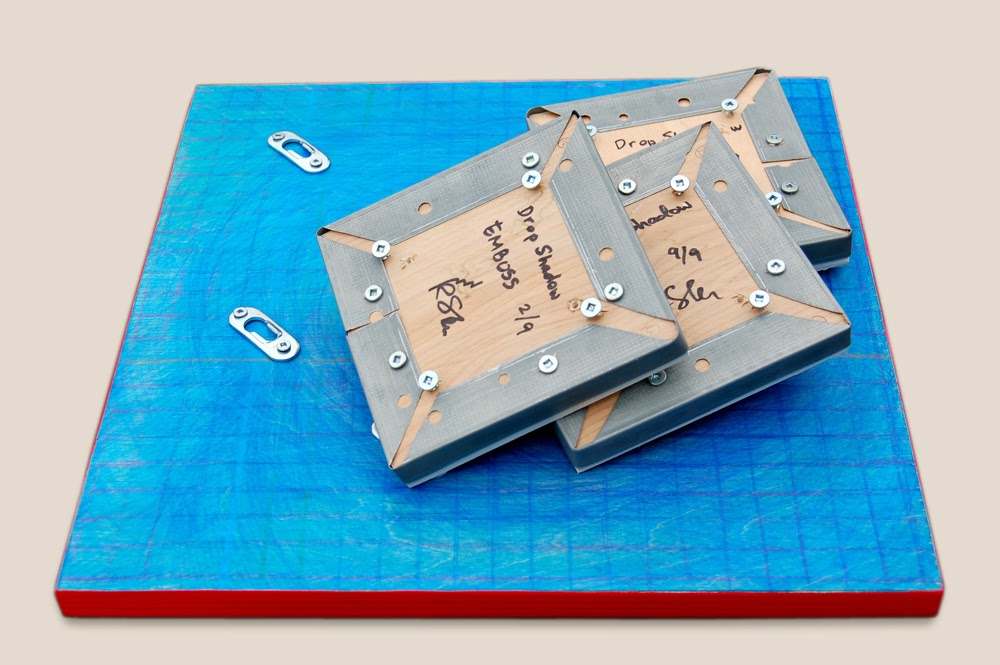
Then, in 2010 came my parents' 70th birthdays. It seemed like a great opportunity to take a look at what I've had and make something new out of it. This time, a square plywood board was selected to be the background and support for the whole composition. To make the small squares truly interactive, simple elements of hardware were employed. Making sure to work with an accurate template, I've installed screws at the back of each square so that one can insert each piece in any of the nine spots on the background board. I'm not sure my parents play with combinations of the various possibilities but they sure can, and that was my intention.
A little later I tried a down scaled version for a friend's wedding. Instead of a stained background I took a bunch of color pencils and worked on visually relating the pieces. Instead of nine squares floating above the surface I've selected three from the existing acrylics on plywood pieces.
Pressing the pencils on the background boards, there is a physical connection that forms between me and the surface. I enjoy the transparency of pencils where you can gradually add strokes and the color becomes more pronounced and still the color beneath shows itself. By contrast, acrylics tend to just cover the layer beneath. The difference between media supports my narrative of urban change: the effort of tweaking an established infrastructure involves finding the right balance between existing conditions and the boundaries of our imagination; between past, present and future.
My current state of the process is nearly ready with six pieces. They all use plywood boards as backgrounds and pencils in various degrees of application. There is a wide range of styles between them and still they seem to form a coherent family of objects. I am intrigued by how they will look when I'm done. Notice in the small works the similar pieces in blue. As my use of tools allows me to plan and anticipate the process, what I'm showing here is an approximately what they will be. On this, I will expand a bit later.

8.3.14

The making of Drop Shadow - First Stages

In July of 2014, my acrylics will be displayed in Bean Around The World coffee shop on Main street in Vancouver. Following a process of restructuring and re-purposing a set of pieces that were stored in my basement, the show I call Drop Shadow will go through what might be considered a resurrection.
After moving from Israel to Canada in 2002 I decided to explore in more detail the process of painting and dealing with artistic expression. My first encounter with canvas and acrylics had happened just a year or so before. That explosion of color and emotions had stayed with my friends Yoav and Michal. In Canada, instead of canvas, plywood, which was readily available to me, was selected as my surface of choice. Another item from the past has been, in general terms, the three dimensional nature of the result. I am used to looking for the relationships between elements in space. Some of my previous dealings with acrylics involved found objects that I had attached to the surface as part of the composition.
Metal and wooden frames; wire and mesh hanging systems
My process has yielded two types of framing: metal and wood. The frames, being part of the composition, were used as the structure that holds the plywood pieces suspended in the air. Here too, I came up with two versions:  wires intersecting each other to form a 3 x 3 grid and a mesh stretched between the members of the frame.
Conceptually I considered the plywood pieces to be placed in any of the locations available within the composition and any orientation. Eventually they were attached rigidly to the mesh or grid from behind. I didn't worry with this too much but knew I would come back to that issue sometime later.
Ground floor in Cuppa Joe coffee shop (2003)
Eight items hung on the walls of Cuppa Joe on 4th Avenue West for the month of April 2003. A gallery in Gastown was next to host my art. Unfortunately it shut down just before my turn came up for display. In August of the same year one of my pieces was juried into a group show on Granville Island. After that I was already busy developing my ceramic designs so the art stayed mostly in storage until September 2004.
Wave participated in the juried show Painting On The Edge
When my ceramic pieces were displayed for sale in a gallery in Steveston, Tamaka, the owner invited me to have my acrylics there as well. She had called me to pick up my paintings after about a year of moving around the walls of the gallery without a buyer. A day after that call, a woman from Germany came by and paid Tamaka for one item to be shipped abroad. Suddenly I could use the term "sold internationally". However, I was focused more on my design interests and kept my art stored for another few years.
Daubs was the first to be sold.
In the next post I will go through the process of reviving Drop Shadow: Resurrection.