Showing posts with label Language. Show all posts

29.3.14

Drop Shadow - In The Making

I met Michael Shandrick at a design thinking event back in 2011. This whole series of documentation was inspired by a conversation I've had with him a short while ago. We were discussing processes. In response to his description of a script he was engaged in writing, I've asked him about the possibility of him posting the story. He seemed pretty intrigued by the idea. As we were exchanging more thoughts I've realized the same idea could apply to me. This is the fourth post following First StagesResurrection and Statement.
Just a minute or two before our walking tour of Vancouver in the Design Thinking unConference

As soon as I embark on the act of executing my thoughts, the process itself is a form of result. However, it is also an exploration. You could even see it as an adventure, where not all the answers are known. The creative process can be planned in detail yet reality imposes hurdles in many forms. Time and money are the most basic of them. Proper planning helps in balancing the many components that the process entails as it unfolds. However, people get sick, accidents happen, new ideas come up. You can't anticipate everything.
The beauty of a process exists in any of its stages.

'Drop Shadow' as a work of art is an analogy to this process. When I had started working on it, the plywood squares I was painting on, represented pixels of the digital world. Technically, I've placed them together as one surface and occasionally shuffled them to add a new layer of paint. That has generated a degree of arbitrariness to the composition. A pixel is like that. It is a sort of canvas that accommodates whatever info is directed in its way. When all the pixels together form an image that makes sense to us, communication exists.
Scale is a fascinating feature of space.

As my world expanded into the urban realm, my interest in reflecting that in my art inspired me to look at "my pixels" with a new sense of purpose. For me, a city is the most complex product of human society. Its most challenging complexity is the fact that we are one of its components - its most important one. Without the city our lives would be something else. Without us, it won't exist, or at least slowly degrade into oblivion (have a look at this).
Reflections happen with smooth surfaces, within computer programs and in your head.

In this process my camera and computer were used as painting accessories. Taking photos of the acrylic squares had allowed me to manipulate the image before continuing to add paint. The desktop monitor enabled an enhanced flexibility in viewing the work and experimenting. Planning and execution progressed very quickly following decisions made over a compelling variety of options. Plywood, as a building material, allowed me to cut existing pieces and further play with their layout.
The side of a building in construction where the concrete pouring "imperfections" are still evident. 

This layering of processes is what I find compelling in everything I do. Whether it is an idea or an object, a present reality or a vision for the future; when I look at them as raw material, my options of action are wide open. The story is the action that connects everything together. Each story sheds a light of its own on our existence.  Light and shadow play equal roles in our sense of space. If for no other reason, naming my project 'Drop Shadow' sounds almost inevitable.
- - - - - - - - - - - - - - - - - 
This post was actually posted on August 28 2014. I had meant to publish it on the date that appears here but simply lost  track of my list of drafted files. Interestingly, in Blogger you can control the publishing date to reflect your interests.

12.7.13

The Art of Engagement

Here's a way to prepare for a TED talk: go to a PechaKucha!
The July 2013 Richmond event brought on stage ten people affiliated with creativity. I appreciate the effort of talking in front of an audience while twenty of your slides change every twenty seconds. I've done this last year and had fun. Having said that, it's hard work to tell a personal story and be relevant to your audience. Most of this year's presenters had good content. Most of them failed to engage me as an audience. Unfortunately I come with expectations.
Next week I will audition for a TEDx event. I'm always curious to see others present their work, ideas and insights. Preparing for my own talk turned my interest into a quest for reference. Look. Creative people. What is it that makes you want to describe anything about yourself in front of an audience? What does it mean to interest others in your work, your life, your ideas?
Our lives are full of exposure to images, imagery, imagination. When I come to see and hear someone talk about something, anything, can you please deliver a show other than what I can zap through the internet as soon as I type your name? But it's not only the availability of information. It's the engagement. You are the medium. You are the show. The message is there. If you aren't there to deliver it, why are you there?
Well, Diyan Achjadi had lovely images in her slides but her reading from her pages didn't do justice to her insights; Laura Bucci entered the stage in a promising march and talked to the screen instead of to us; OK, Nan Capogna tried to sell someone else's show which she curated: not a good choice; and then two other presenters challanged my expectations until the break: Sammy Chien, who was cute but too nerveous to stand and talk and Yayoi Hirano, whose work is evidently graceful and impressive but her presentation was none of that. The intermission presented a very welcome break for my nerves.
Should I leave? Do I stay? Hmm, if anyone is about to be better, they deserve an audience. Maybe I'm not the right audience. But it's not about me. It's not about you. It's about our connection and what makes it exist.
They all had content. Good content as such. Toni Latour introduced a compelling story and if, again, she could move a bit or leave the papers at home... Her story was focused, interesting and successfully put together though; Greg Masuda had a fascinating story which he managed to read with his eyes fixed to his smartphone screen...; 
At last Vjeko Sager brought a whiff of relief: his kind of off hand delivery of disregard and contempt complemented his edgy works on screen which provided evidence that it doesn't have to be so hard to light a fire. Jeff Chiba Stearns managed to keep the juices running with an amusing description of his family's history. In my momentum of disillusionment I wish he were somewhat more lively on stage; finally we reached Rick Tae who had good images and a nice flow of a story if a bit fluffy to my taste, but hey!
It's not about me. It's not about you. It's about our connection and how we make it work. Did this help me prepare for the TEDx audition? Maybe it is about me after July 18th. You might tell me about it.

20.4.13

Spellbound

“How do you spell whatever?!”
Prior to my interview with the selection panel for the West Richmond Community Center’s Art project five questions were sent to me for reference. They involved my ability to work with a variety of age groups, my process of developing collaborative processes and the challenges and opportunities I see in the proposed space. The questions seemed reasonable to me. They almost felt too easy. I knew I had to find a way to present the panel with "How do you spell whatever?"

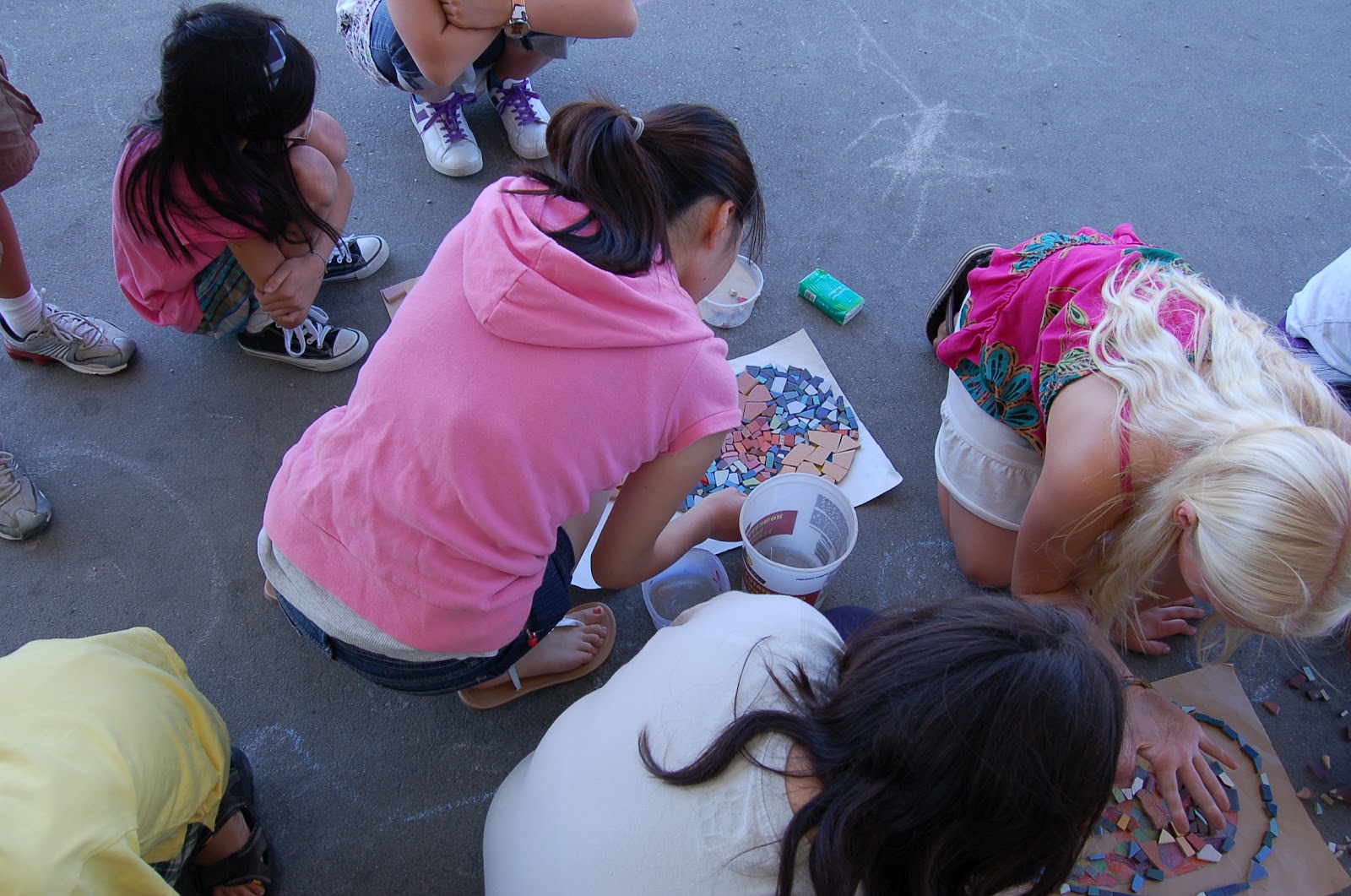
This was my response to a youth from the community arts project in Vancouver I was involved in - Norquay Park 2010 Clean Water. When I had asked him what the story was in the tile he had been working on he answered in a single word: “Whatever”... In response to my "How do you spell whatever", he mumbled "Aam,... Double U, eighche, A, ... Whatever." From then on he seemed to be just a bit more engaged and interested. It was a moment that made me realize a point in community engagement: No one is there for you. As a facilitator my responsibility is to be with my audience. And at that exact moment I was totally with him. 

My entry into the City of Richmond’s public art platform started at around that time. Richmond’s public art planner, Eric Fiss, was coordinating a Pecha Kucha event. I had been looking for an opportunity to present the mosaic story and the waiting list for the Vancouver event looked hopelessly long. It still is. The Richmond event was cancelled that year but I stayed in touch with Eric and got onto the artists roster for public community arts. The way community arts projects are handled in Vancouver made me curious to see what things were like in Richmond.

The traffic to Richmond on the evening of my interview had been surprisingly light compared to previous experiences so I have arrived pretty early to City Hall. Eric seemed a bit concerned as if a possible encounter with the artist who was being interviewed before me might not be the best idea. For me it was no big deal. I found a spot to sit and prepare stuff for my turn. When the artist before me came out of the meeting room I handed her my card and introduced myself. I later found out that she, Jeanette Lee, was the one selected for this project.

Engagement in community arts is all about collaboration and the connections we make. When I stepped into the room where the panel had been waiting it was my first time to see them. However, our discussion seemed to pick up as if from some time in the past. The question from Norquay didn’t have to wait for too long to be mentioned. In my Pecha Kucha presentation it comes on the second slide. As I was preparing for the interview I had realized that my way of responding to the reference questions would be through a story. And the Norquay Mosaics story is still fresh as an illustration of my approach to dealing with community, be it kids, adults or seniors.

Community Arts is not about arts. It’s not even about community. It’s about our connections and what we make of them. Then our community is built. Then we make art.

So tell me now, what is your story, and how do you spell whatever?

17.3.13

How are we doing, you may ask.


Fine tuning a message is like mixing colors to reach the perfect hue. The industry would always market the latest offering as the best ever. Then next year a new variant will show up, again, as the ultimate solution.
Strength Based Learning (SBL) is a fine title for an educational concept.
For me, an underlying tension exists between our intentions and the resulting messages we try to promote. My interaction with my daughter involves many expressions of behavior. Some of them are more pleasant than others. As she acquires the communication tools through exposure and practice, our interaction becomes more complex, challenging and rewarding. What is it in what we do that helps her in life and what might it be that undermines her progress? These questions are hard pressed to provide answers when dealing with other adults.
Many times I brought home exams marked at 97 points out of 100. My grandmother used to ask me “Why not a hundred?” She always did it with a smile that showed her content. But the message stayed: anything but perfect is not good enough. This search for balance between aspirations and reality is a life long endeavour. Everyone has a version of it that is made of infinite bits of beliefs and behaviours that make any of us what we are. Social interaction is a journey full of collaborations and confrontations. Throughout life I absorb ideas as well as reject others. In raising my kid I hope to expose her to experiences that lead her to socially healthy independence.
What is the state of social health in our world, our city, our neighbourhood? My daughter is an avid reader, so it seams we’ve done well so far. In the context of SBL we are commended as well as encouraged to go for more. But more might not necessarily mean more of the same. In the meeting with Faye Brownlie I found myself saying that our kids don’t need us that much. When adults try to discuss methods of promoting success of their kids I tend to cringe a bit. The intentions are all positive and worthy.
Children grow into their family and almost simultaneously out of it. We have a varying degree of control over their lives. My hope is to see my daughter confidently take control over her own life. She might share her perception of our efforts in the future. At the moment her ability and interest in doing so are limited.
Until we get her feedback if at all, we are busy mixing the colors in search of the perfect hue.

14.3.13

Strength Based Learning

In January this year Norquay School Principal Tricia Rooney shared with parents at the PAC meeting the concept of Strength Based Learning. On Tuesday, March 12, Faye Brownlie, a literacy and learning expert shared insights with a few parents and teachers at the school library. Teachers and Staff of Norquay Elementary in Vancouver have been introduced to Faye and the principles of Strength Based Learning by Tricia some time before. Faye Brownlie’s talk provided an intriguing window of thought into issues relating to the education of our children.

The focus of Strength Based Learning is in promoting the natural ability of anyone to succeed. For better or lesser reasons, our interest in promoting our kids’ success is always challenged. In society we then face a reality that not all of us are performing to the extent of our ability.
A child’s entry into adult world hinges on their ability to communicate in support of the society we all rely on. Play, learning and practice expose us as kids to a process that eventually becomes who and how strong we are. As adults we continue to play, learn and practice. As parents we hope to pass the better parts of our strength to our children.

Reading and writing are the core tools that enable us to connect in society. How to promote literacy in the early stages of life is where Strength Based Learning has a lot of insights to offer. Faye’s work around BC and elsewhere is an ongoing effort of keeping us connected to the simple truth that any of us is successful.
Norquay PAC shared the costs of inviting Faye to talk on this occasion. In appreciation to this and Tricia’s enthusiasm as an educator, I will continue to contemplate more at the topic and post new thoughts as they surface.

5.10.12

The challenges of consolidating discrepancies in the process of engagement


Can you listen to yourself through the ears and mind of someone else?
The title above is a phrase I've constructed as I was sharing my thoughts with the consultant at the bank. I enjoy the effort of articulating a complex idea in a very short sentence. With this one it feels like what came as a summary of thoughts in a conversation should be a starting point for a story that explains an issue.
The Process of Engagement 
A phone call from the bank started with her introducing herself as taking control over our investment file. She mentions her role as specializing in providing services to clients whose investments have been active for a while. One of the sentences, that grabs my attention, sounds like “from now on your investments will be taken care of personally”.
I’m not sure what the meaning of that might be and I do not bother to ask: On the phone I am always alert to the possibility that a call from someone I am not familiar with might be risky; I have no interest in volunteering personal information. So I keep my thoughts to myself. They relate to the fact that since we started our investment file, it has gone through quite a few hands, always with seemingly good reason, always with “your benefit in mind”. “From now on...” doesn't sound like what we've experienced so far.
I appreciate the bank’s reassuring disclosures about their best intentions. However, their good service is always certainly going to benefit the bank as well, if not more than what it would benefit us. With investment it is always a game of risk versus chances of gains. Whether we lose money or earn it, the bank takes its share.
We schedule a meeting and I let my new contact know that I will inform my wife, who might be able to join. If not, she would schedule another appointment after we set the stage for further action. Half an hour later I get a call from the same person asking to speak with Anat. I remind her of the previous call and we confirm the meeting already scheduled for the following week.
This of course raises my concern with the quality of service I am experiencing. Not only am I already uneasy with the scheduled appointment but now I get an illustration of someone on the other side not exactly in control of information they should have.
And so, a day before the meeting I see my bank’s name on the caller display. My thoughts go “Nice, she is making a reminder call”. But no, she is asking whether I remember we scheduled a meeting for five minutes before she had called. My thoughts race in circles trying to figure what, how and when did our conversation a week earlier lead to this mistake: was it me who put the wrong date in my calendar; was it she who is showing consistent incompetence?
We agree to meet the next day which for me was the time I had in my calendar anyway. When I do get to the bank, our interaction is absolutely productive: the consultant describes her position, apologizes for the misunderstanding and informs me of her interests in that meeting. She takes notes of my responses to her questions and I feel content with the degree of personal service this whole experience entails.
Could the above experience have been smoother?
My concern stays with the stage until our face to face engagement. I am curious how many clients find themselves in similar situations. How many clients does the bank miss because of those tiny streams of discomfort that arise in technology based communications? I’m not so much worried for that bank as I am trying to learn a lesson myself.
We think we are all used to the phone, a well established piece of technology. Even so, there are still endless examples of people messing up issues just because they've tried to settle something on the phone instead of in person. The variety of communication tools at our disposal these days is almost out of control. Between us, we still don’t possess the same degree of mastery over these tools. Beside the technical level of actually operating any of them there is also the social aspect of interaction: it could be that we have different cultural backgrounds; we might have differences in using the same language and we could simply be in different moods at the moment of exchange.
What leads to a meeting builds expectations that do not necessarily relate to the outcome. In the case with my bank the meeting turned out to be much better than what my concerns alarmed me with. In many other cases, things go the other way. The challenge is in the attention we give to what the other side might make of our effort to engage. It’s like we need to find a way to listen to ourselves through the ears and mind of others. Can we do that with everyone we interact? I’m sure we don’t.
So what is our challenge?
We want to engage. That leads us through a process that involves communication. The discrepancies consist of many variations in the way each of us understand the world, ourselves and each other. Bridging these gaps is what I call consolidating. No matter how we name this process it is a challenge.

21.4.11

stepping-stones

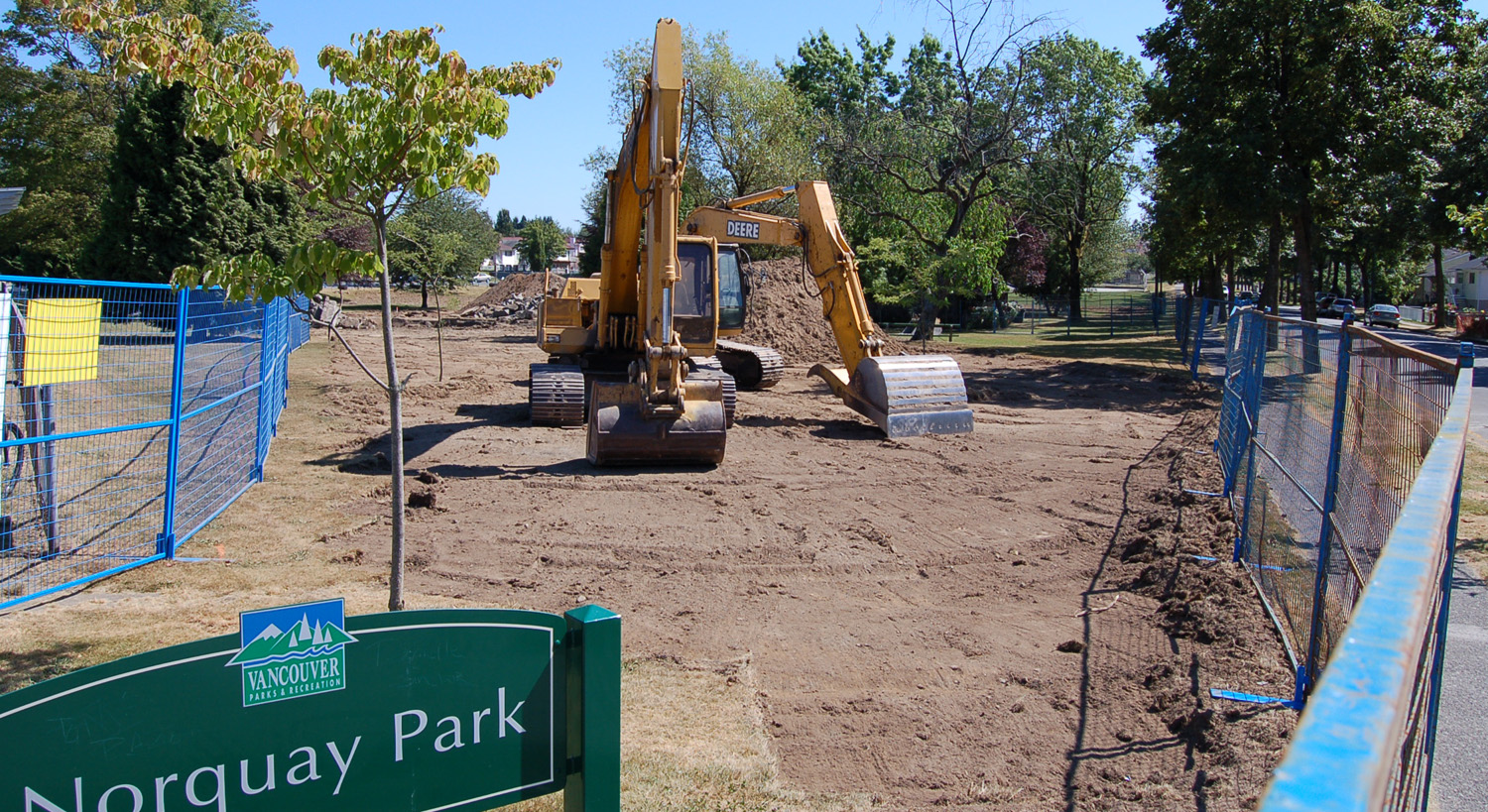
The block on Kingsway between Wales and Rhodes streets has light pedestrian traffic. As we are installing the last mosaic pieces in the two entries to the park the protective fence is still there. Norquay Park has been a construction zone since July of last year. The few people that pass by either slow down beside us or stop.
They are all curious as to when the park will be open again. They also notice the mosaic pieces and seem impressed with their beauty. Along the progress with installation we’ve gradually been able to get the sense of significance this project has in the upgraded park. The entry pieces have a good impact as gate decorations.

The history of Still Creek is one in many similar stories of urban industrialization, reflection and rehabilitation. Today the Vancouver part of the creek is still mostly hidden in underground pipes or behind chain link fences. From its designation as the most polluted stream in BC in the 1980s, much progress has been made and much more is required. Serious work has been taken to bring it back to a liveable natural element in urban space. The Norquay Park 2010 Clean Water Mosaic project is one stepping stone in a long educational journey.

Funding for our part of the journey came from the Vancouver Board of Parks and Recreation, the Vancouver Neighborhood Matching Fund and Collingwood Neighborhood House. The intention of this collaboration between budgetary resources is to facilitate community interaction. Participation in the building process of the park enhances the sense of ownership over the neighbourhood.

Members in the community were brought together to create a visual reminder for all to enjoy. Twenty pieces were created in this process and are now integrated in the concrete sections of the paths in the park. After entering either from its west or east entries you are welcome to explore the park and find the other mosaic pieces. All of them are a result of many hours shared by community members who participated in our workshops. It is our pleasure to thank them all, seniors, adults and youth for their contribution.

Installing our mosaics provided us with the opportunity to work closely with the architects and builders who were responsible for the function of the park. The result of their work is a fabulous space with a great sense of place.

The conclusion of this project brings me back to its starting point. In the research for mosaic making we met Liz Calvin and Bruce Walther. These two mosaic artists’ work can be seen in many places around and out of town. Without their generosity this project would have looked completely different. A sample of their collaboration can be seen in Downtown Vancouver where a set of eighteen pieces are placed.

Many more contacts were made throughout the process. Yoko and I are grateful to all who helped us get to this stage. Our own collaboration started with mutual interest in this experience and ends with excitement over the accomplishment. Just like the small pieces of a mosaic tile tell a story, the whole set of twenty expands this into space and time. This is a reflection on industrialization and rehabilitation.

19.3.11

are we there yet?

The park is slowly being completed. We’ve been away for the cold and wet winter. The forecast for excessive snow was mostly true for regions north of Vancouver. A few days after starting with the first piece though it did snow and from then on the weather kept playing between low temperatures and wet days.
A night walk in December. There wasn’t a lot of
snow this year but it was cold enough to prevent installation.
Yoko and I tried to stick to working together so that we learn from each other as much as possible. Until now it worked vey well. This week Yoko flied to Japan for a family visit. It is too early to conclude the degree of destruction following the earth quake a week ago. Nevertheless this is a moment in history that puts our lives into a grim perspective.
An aerial view of tsunami damage in the Tōhoku region.
From the first tile installed in October of last year we saw that the stained mortar band needs to be applied differently. If any of it rubs out onto the path surrounding the recess we are bound to spend more time and effort cleaning the mess. The solution is quite easy in theory: apply the paste carefully. In reality it was relatively easy but still challenging. A combination of cold weather, wet concrete path and crouching down to work were found to be a nice workout.
Into a one inch wide gap the mortar is applied in small amounts to
gradually create our desired band.
There is no way we can rush things even though we want to. As we move into spring more days are available to work on installation. The world around us is shaking in multiple directions. I think it’s a matter of re-imagining the excitement from last year that will help us shift gears. This is still a celebration of life.
Even with this impressive display of process the
grouting stage is still ahead of us.

30.10.10

weather or not

Looking back at the process we went through I see that I can now afford to be a bit more personal. This month felt like a marathon. Giora and Irit, Anat's parents, my in-laws, were with us for two weeks on a visit from Israel. I was interested in reaching the final mosaic making session with as many of the tiles we needed finished. There was also an application package I was working on that needed to be sent. I had two weekends of this month dedicated to the Urban Design classes in SFU. In normal conditions this would have been busy but manageable. Even the weekend in Silverdale, near Seattle was a welcome break from routine.
Great sunny days on the weekend in Silverdale
At the end of that weekend we drove back to Vancouver to start the week. Anat's parents stayed in Washington for a few more days before joining us and leaving back to Israel. I had a few last touches on the mosaic pieces to make them ready for installation. The whole visit was turning into a great familial update with Inbal, our daughter, getting a lot of attention from her gramps.
Inbal enjoying the play, Saba enjoying his grand daughter
and the Richmond ice rink
On the first day of gramps enjoying the scenery of Mount Rainier, Irit broke her knee cap . This is one of those minor injuries that change your life in an instant and not for the better. In normal conditions she would have been operated in Washington and started rehabilitation. Being visitors in Canada with a flight back to Israel scheduled just a few days later introduced a whole set of considerations into the matter.
A short while before the accident as shot by Giora
As soon as Saba and Savta (Grandpa and Grandma) were back in Vancouver we started preparing for their flight to Israel. Rehabilitation is the most intensive component of treatment for this type of injury. An operation can be delayed for a few days without harm. Tickets needed to be changed, insurance issues were resolved and an operation had to be scheduled as soon as they landed in Israel.
Inspired by the occasion
At dinner of their last evening with us we raised glasses of wine for the admirable way Giora has managed the faxes, emails and phone calls. I complained that my desire to help wasn't fulfilled. To be honest, my in-law's independence allowed me to continue my daily activities with very little if any disruptions. No one wishes to enhance their lives with accidents and hardship. Still, whatever happens to you is part of your life. A day after landing in Israel Irit's knee cap was restructured. A day later she started walking again.
A short while before the concrete was poured
Our mosaics are waiting for a few days without rain to be laid and grouted. Vancouver weather is part of our life...

3.10.10

the best you can

Urban design might sound like a field that deals with inanimate components of the city: spaces, buildings, roads and other built environments. One of the reasons I've joined the certificate program in SFU is my perception of the urban as an extension of the human, physically and socially. I'm happy to find the SFU Urban Design program delivering an approach that runs along a similar line.
The plywood board is later taken away and leaves a recess
where the tile will be installed
The mosaic workshops are wrapping up to their final days of fabricating pieces. Soon we will start installing them in Norquay Park. Most of the concrete that will house our tiles has recently been poured. Each mosaic piece, as an inanimate illustration of water related creatures, is also a reflection of a person or people who created it. We've had school kids, teenagers, adults and seniors participating in this project. I've had the fortune of following some of them go through an inspiring creative process.
The story behind each tile is personal as well as artistic
There are many ways to work on the things you are currently busy with. There is only one way that I can consider to be right: doing the best you can. This is a decision that is inherently an attitude. As soon as you reach that decision, your work is pretty easy. From there you can only improve.
Some of the more compelling results come from challenges
like this somewhat messy start
Guiding people to embrace this attitude is a challenge I wasn't fully aware of getting into before joining this project. I am now looking at our finished mosaics and can't wait to see them in place. Whether it was an hour that some spent with us or a few months that others labored, each brought a piece of their own life into this. The story of each tile starts with an image anyone can see and extends to the world of the people who created it.
Grouting will probably bring this tile
to an even better expression of art.
Urban design deals with the built world and is concerned with us, living its story.

13.8.10

community-art

When we will look at the process we are going through these days in twenty years, what we will see is a result. The beauty of a fine process is that it can be seen in a result you enjoy looking at many years later. Our ingredients for this are planning, right team and leadership. From how things look up to now we are on the right track.
This week the two first mosaic pieces were completed. Finishing a high quality 1 square foot tile requires more than a two hour workshop session that we schedule weekly for our groups. Instead of waiting with each tile to be completed by the same person who started it, we moved some of them between groups to add pieces to the partially laid surface. This helped in two fronts: finishing tiles quickly without haste and generating a true sense of communal collaboration. 
We got to a point where one of our biggest challenges is people getting excited and engaged. Usually they just put too little mortar on a tile or lay them so that nothing seems to resemble the intended image. Add genuine interest and you can end up with a bunch of small disasters that no one knows exactly what to do with. This is where leadership comes in handy. We have great leaders helping us in guiding youth in one group. The group of adults seems to understand the need to consult our guidance. Our own leadership is then a matter of balancing between keeping a sense of interest in the work and sensitivity to each person contributing their time and energy to this project.
The demolition of the park that started a short while ago is now transitioning into pockets of construction. By the end of this month we might even see some concrete paths being poured. In those paths we will have recesses to accommodate our tiles. Although there's still a lot of work ahead of us, completion feels very close. 

2.8.10

learning is one thing. implementing is another.


Facilitating a Matching Fund workshop is a constant process of learning. Whoever joins us for an hour or a few sessions has unique skills, expectations and interests. For us that means we need to be many things to many people. How to do this changes from day to day. 
Yoko on the left with
the Renfrew Community Center youth group
Yoko and I are working as a team since we met less than two months ago. I'm really happy with how well we get along. Each of us learns from the other and we both manage to review our process and make decisions following each discussion. Whatever we go through in a workshop generates insights into the steps ahead. This is how we find ways of transferring our knowledge and experience to our audience.
Placing tile fragments on paper is a quick way
to feel the process of mosaic creation
The differences between kids and adults are noticeable in terms of ability to concentrate, understanding of language and amount of energy. What I've noticed as similarities is a generality that I'm taking as fact and nothing more. It is an impression that is followed by change that brings me at the end of a process to re-assess my own perception: Most of our visitors start with hardly any ability to imagine what they'd like to create. Through our guidance and leadership a gradual change is taking place in front of our eyes.
One person creates a design. Another lays tiles.
Some of our results are thoroughly collaborative
We need that change to happen if we want to generate results that reflect our capabilities. There is no question in our own ability to produce mosaic tiles that people can appreciate. The challenge is in helping our audience succeed in making similar, high quality results we would like to see in the renovated Norquay Park. In itself, this aspiration raises questions over issues relating to art, quality, and authority. It also raises questions over how far we can go within the structure of the Matching Fund.
From a crude freestyle laying start,
we moved on to fine details and attentive focus
To judge by where we are at in this collaboration, we have gone very far. We intend to continue improving on that.