5.10.12

The challenges of consolidating discrepancies in the process of engagement


Can you listen to yourself through the ears and mind of someone else?
The title above is a phrase I've constructed as I was sharing my thoughts with the consultant at the bank. I enjoy the effort of articulating a complex idea in a very short sentence. With this one it feels like what came as a summary of thoughts in a conversation should be a starting point for a story that explains an issue.
The Process of Engagement 
A phone call from the bank started with her introducing herself as taking control over our investment file. She mentions her role as specializing in providing services to clients whose investments have been active for a while. One of the sentences, that grabs my attention, sounds like “from now on your investments will be taken care of personally”.
I’m not sure what the meaning of that might be and I do not bother to ask: On the phone I am always alert to the possibility that a call from someone I am not familiar with might be risky; I have no interest in volunteering personal information. So I keep my thoughts to myself. They relate to the fact that since we started our investment file, it has gone through quite a few hands, always with seemingly good reason, always with “your benefit in mind”. “From now on...” doesn't sound like what we've experienced so far.
I appreciate the bank’s reassuring disclosures about their best intentions. However, their good service is always certainly going to benefit the bank as well, if not more than what it would benefit us. With investment it is always a game of risk versus chances of gains. Whether we lose money or earn it, the bank takes its share.
We schedule a meeting and I let my new contact know that I will inform my wife, who might be able to join. If not, she would schedule another appointment after we set the stage for further action. Half an hour later I get a call from the same person asking to speak with Anat. I remind her of the previous call and we confirm the meeting already scheduled for the following week.
This of course raises my concern with the quality of service I am experiencing. Not only am I already uneasy with the scheduled appointment but now I get an illustration of someone on the other side not exactly in control of information they should have.
And so, a day before the meeting I see my bank’s name on the caller display. My thoughts go “Nice, she is making a reminder call”. But no, she is asking whether I remember we scheduled a meeting for five minutes before she had called. My thoughts race in circles trying to figure what, how and when did our conversation a week earlier lead to this mistake: was it me who put the wrong date in my calendar; was it she who is showing consistent incompetence?
We agree to meet the next day which for me was the time I had in my calendar anyway. When I do get to the bank, our interaction is absolutely productive: the consultant describes her position, apologizes for the misunderstanding and informs me of her interests in that meeting. She takes notes of my responses to her questions and I feel content with the degree of personal service this whole experience entails.
Could the above experience have been smoother?
My concern stays with the stage until our face to face engagement. I am curious how many clients find themselves in similar situations. How many clients does the bank miss because of those tiny streams of discomfort that arise in technology based communications? I’m not so much worried for that bank as I am trying to learn a lesson myself.
We think we are all used to the phone, a well established piece of technology. Even so, there are still endless examples of people messing up issues just because they've tried to settle something on the phone instead of in person. The variety of communication tools at our disposal these days is almost out of control. Between us, we still don’t possess the same degree of mastery over these tools. Beside the technical level of actually operating any of them there is also the social aspect of interaction: it could be that we have different cultural backgrounds; we might have differences in using the same language and we could simply be in different moods at the moment of exchange.
What leads to a meeting builds expectations that do not necessarily relate to the outcome. In the case with my bank the meeting turned out to be much better than what my concerns alarmed me with. In many other cases, things go the other way. The challenge is in the attention we give to what the other side might make of our effort to engage. It’s like we need to find a way to listen to ourselves through the ears and mind of others. Can we do that with everyone we interact? I’m sure we don’t.
So what is our challenge?
We want to engage. That leads us through a process that involves communication. The discrepancies consist of many variations in the way each of us understand the world, ourselves and each other. Bridging these gaps is what I call consolidating. No matter how we name this process it is a challenge.

30.9.12

PKN - Norquay Mosaics in 20 slides at 20 seconds each

My first Pecha Kucha talk was delivered twice: in November 2010 I was the last in a line of speakers at the first ever Coquitlam BC PKN; in September 2012 the first ever Richmond BC PKN was held at the Cultural Center there and I was the eighth among ten. The Norquay Park Clean Water Mosaic was a Vancouver Neighborhood Matching Fund  project. This talk describes in 20 slides the issues related to the creative process we, Yoko Tomita and I facilitated in the Renfrew-Collingwood community back in 2010. Here it is in its revised and updated version: 
Halfway into a mosaic making session I’m delivering an enthusiastic speech about the fascinating process of telling a story through careful one by one laying of pieces onto the cement base. As part of my routine I ask one of the kids I am working with, “what is the story in your tile?”

“Whatever”, he responds in a typical juvenile bored expression.
“How do you spell whatever?” I ask him, still with the same breathless enthusiasm.
He starts with “aam, W. H. A…” and finally retreats to “whatever”.


At the time my daughter was six years old. I must have been influenced by the games I was playing with her. “How do you say it; How do you spell it” and so on.


Making mosaics was new to me. I haven’t really realized what I got myself into by joining this Neighborhood Matching Fund project. Working with the community is a challenge. In most cases it was fun.


Yoko Tomita is a community artist in the Vancouver East side. She is the one who actually prepared me to working with youth: they would say “Yoko, I’m bored” she warned me. “Hey, this is child labor…”. And they actually did.


For many of the artists out there community arts is a treacherous way of making a living. For me it was an opportunity to engage in design for urban space. 


My first encounter with design and production of large scale objects was in 2001, about a year before moving from Israel to Canada. I had an exhibition of eight lighting objects at the foyer of the Pavilion for Performing Arts in Tel Aviv.


For the mosaic project I had the fortune of meeting Bruce Walther and Liz Calvin, two professional and generous artists who have their mosaics installed in various locations around the lower mainland and even further away.


Our challenge was not only bored kids but many people’s low expectations that in many cases leads to lagging engagement. This drawing was made by a woman who initially said she could not draw. “Oh”, I said to her. “Can you draw a straight line?”; “Can you draw a circle?” “Looks like a drawing to me”.


No matter what skill level, it was a pleasant surprise to see people's creative process evolving as this pretty example shows.


The youth leader who started this one, occasionally asked for advice or direction. I would point to a simple pattern and half an hour later she’d come up with even better creations.


It wasn't always easy. No matter how patient Yoko would be, with the boy who started this, he would lose interest as soon as his design was covered by the broken tiles we worked with. But we needed more detail, we wanted to push the limits.


When I took the drawing home and played a bit with PhotoShop I wasn’t sure how the boy would react to someone else taking over his design. Miraculously, he loved it and continued working with a new sense of purpose.


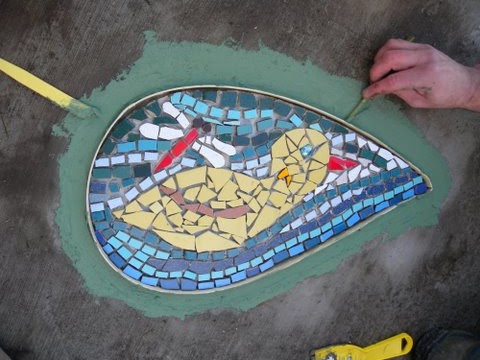
It was always heartbreaking for people to realize that this was not the end. The woman who showed this to us thought it was perfect. We were looking for more detail. For us the task was simple: the gaps had to be even; every piece made a difference. Notice the chunky red border at the top and the yellow border around the dolphin.


One day she approached me just a few pieces before her mosaic was complete.  With the little English this woman had she managed to say, “It’s not beautiful”. “Ah,” I reassured her, “Whatever you manage to do is perfect. From there you can only improve.” 


The mosaic process was almost over when demolition of the old park started and we moved on to dealing with the landscape architect and contractors. It was mostly a friendly exchange of information. We were just a tiny component of the whole production but the coordination required some back and forthing that exposed a few challenges.


Even at the planning stage, the mosaics were supposed to go into the floor of the water spray feature. When the health authorities said that mosaics are not allowed in or near the water, I encouraged my colleagues with the realization that now the whole park could benefit from the art. The red dots show where the mosaics were proposed; the green marks show where they were eventually installed.


In the cold spring of 2011 we finally installed the pieces that were waiting in my basement throughout the winter. You need to wait for the concrete structure to cure before you can install the mosaics in the recesses that were made for them. During the winter it was too cold for the mortar to efficiently attach the tiles in place.

I think the achievement with the credit plate was managing to fit in all of the info we were expected to. But it was also the fact that we got a stone carved element with the absurdly low budget we had. The stone carver who made it for us was absolutely generous and committed when we explained the context of our project.

For me, Community Arts is not about art; it’s not about community. It’s about our connection. For this I’d like to thank you for reading this far and making it happen. To read even more, go to the Mosaic page of this blog.

16.6.12

green streets traffic circle

My method of gardening relies on heavy digging. I have no patience for weeding on my knees. I started by building a few scrap plywood planters to experiment with structure in the traffic circle. Unfortunately these were turned over by mysterious hands and some were even removed. It's interesting to realize that people actually have interest in what's going on inside of a traffic circle.


So, from this I decided to concentrate on the existing conditions of the location. When this circle was assigned to me it had great mulch covering its soil, an established colony of irises and a few other plants in reasonable shape. It didn't seem to have too many weeds but who knows what weeds are anyway. Any plant matter that grows without me interested in it is doomed. Which more accurately means that I become doomed to constantly chase it whenever its leaves are sent out of the ground.


As a first step, the irises had to make room for other varieties. Their rhizome type root system is impressive. They're actually not that hard to pull. But I had to dig a bit before pulling so that it's not only the knife shaped leaves that come out. There's an interesting process going on in my head as I make my way from one cluster to the next. I decided to take it easy and start with what seemed to be a small task: removing irises from only one quarter of the circle. It worked well and didn't take too long. But it was still quite a workout. I was happy to have made the decision to take it easy ahead of time. But the next day I was there to work on another quarter. Immediately I became impatient to finish the whole area. Piles of irises with their root systems accumulated in the middle of the ground. 


The weather was great, a partly cloudy, typical Vancouver, mid June. The soil was soft and moist. Removing the "debris" from the circle required some hauling and now the place is ready to continue its transformation. The irises selected to stay are planted in two rows at the perimeter, close to the concrete edge. A young rose bush is waiting to be cultivated into a healthier accent and some pieces of bergenia were also spared from extinction (thank you Green Streets people for your help with the name).


Our sidewalk tree base is my gardening lab. This is where I plant all sorts of plants to see how well they grow. We bought a few 4" pots and as small as they are I have divided them before planting to increase their spread. As it seems, all have rooted well. In the next little while, some of them will be transported to the traffic circle and left to do their part of the deal.


15.4.12

hate-love


I have to confess I almost hate gardening. But the reason for that is the exact same reason why I almost love it. You toil away doing whatever you think is required to keep your yard or planter in shape. Then nature does its part and does it no matter if it fits your plans or not. When it doesn’t, I feel powerless and futile in my efforts. When it does…, hey! We are a team!
This is how it looked when i started. A variety of five plants.
So basically I admire the ability of plant matter to regenerate no matter what you think of it. We label dandelions ‘weeds’ and consider Morning Glory to be a menace. The inspiration one can take from these two examples is incredibly valuable: persistence and perseverance. If you think what you’re doing is right, never despair. Of course the human body matter’s mind doesn’t aspire to be considered a weed. But that’s not the point.
Small pot plants were cut into smaller parts.
I love the smell of soil. When I trim the hedge there is a fantastic feeling of freshness in the air. The act of gardening is mostly boring but the rewards exist. You just need to reach the right balance between Labor and Love.
From this angle things already look lovely.

2.2.12

wedstock


On the first Wednesday of February The Flame marked three years of presence in the Cottage Bistro on Main Street in Vancouver, BC. I had the fortune of telling my story as the fifth in a line up of eight other entertaining storytellers.
Without further ado, what follows are the words roughly as I spoke them:


I was walking my dog in Tel Aviv one morning and started hearing female yelling coming out of an apartment. When I was just across the street from their window I suddenly heard: “I’M NOT WEARING THAT DRESS TO MY WEDDING!”.
“This actually happens” I thought.
My story is about two Jewish weddings: one that I didn't know I’ve inspired and one that I didn't know I had.
My elder brother was planning his wedding in 1991. He banned any discussion within the family until three months before the event. This worked pretty well until exactly… three months before the event. As soon as my parents heard about his plan to have an unorthodox ceremony my mother cried out “What will grandma say!?”.
And indeed our grandma, took my brother for a serious talk. A talk that made him approach me for advice. I felt for him for this stupid mess, but I said “You should have known our family better”.
I thought he could still let them understand his point. After all it was his life and his choice. But he backed off and a few weeks later I was asked to pick up the Rabbi on my way to the wedding.  
So here I am, dressed up in this happy looking coverall leading the Rabbi down the stairs to the pool where the ceremony was about to begin. The Rabbi, dressed in a simple black suite, was ready to do his business and bring happiness to another Jewish family.
Six months later I realized what a shocking sight we must have been. As I was sitting at my parents’ place my mother brought it up. The minute she saw me from the pool below she knew she would not say a word. “After all, thanks to you he was getting married”.   
“Thanks to me!? It’s because of you!” I said. “People can live together without all of this nonsense.” “So you’re not going to get married?” she asked, tears welling up her eyes. “Of course not!” I exclaimed. Obviously she wasn’t prepared for that but it must have helped her not to expect anything when I moved away from Israel ten years later to live my girlfriend.   
Anat was introduced to me by a friend when I was living in Tel Aviv. She said good things about Anat, but also explained: “You know, she always gets involved with the wrong guys”. Anat was doing her PHD in Jerusalem. Tel Aviv is only 60 km away so we got in touch but it kind of didn’t pick up.  
And also, there was this guy in Jerusalem that got involved with Anat just before we had a chance to meet again. I was thinking, “OK, who’s the wrong guy now?”
By the time that relationship dissolved Anat was negotiating a post doc research position in Vancouver, BC. So we agreed to stay in touch just to keep options open.
Open in a way that I soon met another dog owner in one of my walks. Very quickly I realized she was only interested in getting pregnant. Unfortunately I was nothing more than a walking sperm bank for her. It didn’t last long… There goes the wrong guy again.
My emails with Anat gradually warmed to the point that when that guy from Jerusalem happened to visit Anat in Vancouver, she didn’t consider it fair to hide it from me.
That year I wanted to buy a digital camera. It was vastly more expensive in Israel than anywhere else. I knew that Anat was planning a home visit some months ahead. So after asking her if she could bring it with her I purchased my first digital camera on the web to be shipped to Vancouver. I was getting really excited.
As soon as I laid my hands on the camera I went for a weekend to test it with that dog owner slash sperm hunter. By then we were not dating anymore..., I think. When I got back from the weekend, Anat and I finally picked up from where we started a year earlier.
When it was time for Anat to return to Vancouver I decided to take a two months break to check things up. In that time I had a chance to explore Vancouver and see what opportunities might come up for me there.
It takes time to get used to Vancouver. As I was approaching the edge of sidewalks I noticed cars were slowing down. “What’s wrong with them” I was fuming, “Can’t they see I’m waiting for them to pass?!”
So very quickly I realized that this was probably the place I always wanted to live in. I don’t know, maybe I was in love.
I went back to Israel to pack everything I had and returned to Vancouver after a-n-o-t-h-e-r v-e-r-y l-o-n-g  two months. We knew that of all things (!) one of the quickest ways for me to get a work permit was to get married. Because we had a good feeling that our marriage could even last, the idea of going through the civil ceremony right after landing here didn’t look hasty to us. Well, maybe we were in love.
We found a lovely marriage commissioner two blocks away from us. At the time we were living across the street from CuppaJoe on west 4th avenue. The manager was happy to let us do the ceremony on the second floor.
We decided to ask Lori, our favourite barista if she’d like to be our witness. When we went there it was Rob’s shift. He didn’t realize we were that close. He said we looked to him like old friends. So he became our first witness. The next day I only started to talk with Lori before she said “YES” with a big smile.
On our wedding day, we thought it would be a good idea to call our families in Israel and let them know… Well, they all sounded so happy and congratulated us. Anat’s brother even managed to arrange for flowers to be sent to us from North Vancouver.
As we were moving stuff around in the coffee shop, I noticed a familiar face outside the door. We didn’t bother to invite anyone to our wedding but in Anat’s lab they knew about it.
So, here we were, joined by about eight scientists, all dressed up for a wedding in ties and fancy dresses. Without giving it much thought, our charming little ceremony turned into a celebration.
After years of knowing what kind of wedding I wasn’t going to have I suddenly got exactly what I felt it should be: an intimately personal event that is symbolically public.
Our marriage commissioner then thanked us for letting her do her first Jewish wedding.


15.7.11

the-official-opening

The park has been open to the public for about a month now. The upgrade seems to be a huge success based on the amount of people clamoring its features. Despite the coldish summer many even dare the sprinkles of the water spray area.
An official opening event is scheduled for Wednesday July 20th 4:30 pm. I'm curious to see what that will look like.

21.4.11

stepping-stones

The block on Kingsway between Wales and Rhodes streets has light pedestrian traffic. As we are installing the last mosaic pieces in the two entries to the park the protective fence is still there. Norquay Park has been a construction zone since July of last year. The few people that pass by either slow down beside us or stop.
They are all curious as to when the park will be open again. They also notice the mosaic pieces and seem impressed with their beauty. Along the progress with installation we’ve gradually been able to get the sense of significance this project has in the upgraded park. The entry pieces have a good impact as gate decorations.

The history of Still Creek is one in many similar stories of urban industrialization, reflection and rehabilitation. Today the Vancouver part of the creek is still mostly hidden in underground pipes or behind chain link fences. From its designation as the most polluted stream in BC in the 1980s, much progress has been made and much more is required. Serious work has been taken to bring it back to a liveable natural element in urban space. The Norquay Park 2010 Clean Water Mosaic project is one stepping stone in a long educational journey.

Funding for our part of the journey came from the Vancouver Board of Parks and Recreation, the Vancouver Neighborhood Matching Fund and Collingwood Neighborhood House. The intention of this collaboration between budgetary resources is to facilitate community interaction. Participation in the building process of the park enhances the sense of ownership over the neighbourhood.

Members in the community were brought together to create a visual reminder for all to enjoy. Twenty pieces were created in this process and are now integrated in the concrete sections of the paths in the park. After entering either from its west or east entries you are welcome to explore the park and find the other mosaic pieces. All of them are a result of many hours shared by community members who participated in our workshops. It is our pleasure to thank them all, seniors, adults and youth for their contribution.

Installing our mosaics provided us with the opportunity to work closely with the architects and builders who were responsible for the function of the park. The result of their work is a fabulous space with a great sense of place.

The conclusion of this project brings me back to its starting point. In the research for mosaic making we met Liz Calvin and Bruce Walther. These two mosaic artists’ work can be seen in many places around and out of town. Without their generosity this project would have looked completely different. A sample of their collaboration can be seen in Downtown Vancouver where a set of eighteen pieces are placed.

Many more contacts were made throughout the process. Yoko and I are grateful to all who helped us get to this stage. Our own collaboration started with mutual interest in this experience and ends with excitement over the accomplishment. Just like the small pieces of a mosaic tile tell a story, the whole set of twenty expands this into space and time. This is a reflection on industrialization and rehabilitation.

1.4.11

engagement

I was halfway through a mosaic laying workshop discussing the fascinating aspects of creating a story through one by one laying of tiles on the concrete surface. As part of my routine I turned to one of the kids and asked him: “what’s the story in your tile?” His response illustrated exactly what Yoko had described as the challenge of working with youth: “whatever…” he said with the most lifeless look on his face.
They’re bored; they’re all over the place; they always want to do something other than what you were committed to deliver. “How do you spell whatever?!” I asked him with surprising breathless enthusiasm. In retrospect I couldn’t really explain where my outburst came from. His response was “aahm, doubleyoo, ‘H’, ‘A’…, whatever…”. So I had to conclude with “Good Job! I almost got you there!”.

Putting this experience in writing reminds me that face to face communications lives in a different universe than that of letters and text. In the written space, texting, typing or messaging have a life of their own. Whoever the recipient might be, my words arrive at the other side without facial expressions and no sounds. I can send an innocent “What’s up?” to my sister and hear the explosions from the other side of the world in a matter of minutes. Or never hear from her ever again.

Sometimes every breath we take is loaded with food for interpretations. When I was a teenager I had realized that no matter what I do or say there is always someone who will be upset. My conclusion was to do whatever felt right to me. If any explanations will be needed afterwards, so be it. You have to trust your own intentions.

Communications can be an adventure. There are people who prefer to avoid confrontation. I can envy them for their choice of calm and composure. Most of the time my patience is that of an educator. Occasionally though I feel like it is that of a rebel: why should I wait till tomorrow for the action that could have been taken yesterday?! But people need their own time to join a "revolution". Put the wrong pressure and something will break. Fixing what went wrong then takes place instead of any sense of progress. Without prior intentions I become a rescue expedition to outer space.

The mosaic workshops were mostly grounded in and around community centers. No extraterrestrial adventures here. The boy who got the attention he needed continued to work on his tile with a new sense of commitment. Whatever he texted to his friends afterwards I have no idea…

19.3.11

are we there yet?

The park is slowly being completed. We’ve been away for the cold and wet winter. The forecast for excessive snow was mostly true for regions north of Vancouver. A few days after starting with the first piece though it did snow and from then on the weather kept playing between low temperatures and wet days.
A night walk in December. There wasn’t a lot of
snow this year but it was cold enough to prevent installation.
Yoko and I tried to stick to working together so that we learn from each other as much as possible. Until now it worked vey well. This week Yoko flied to Japan for a family visit. It is too early to conclude the degree of destruction following the earth quake a week ago. Nevertheless this is a moment in history that puts our lives into a grim perspective.
An aerial view of tsunami damage in the Tōhoku region.
From the first tile installed in October of last year we saw that the stained mortar band needs to be applied differently. If any of it rubs out onto the path surrounding the recess we are bound to spend more time and effort cleaning the mess. The solution is quite easy in theory: apply the paste carefully. In reality it was relatively easy but still challenging. A combination of cold weather, wet concrete path and crouching down to work were found to be a nice workout.
Into a one inch wide gap the mortar is applied in small amounts to
gradually create our desired band.
There is no way we can rush things even though we want to. As we move into spring more days are available to work on installation. The world around us is shaking in multiple directions. I think it’s a matter of re-imagining the excitement from last year that will help us shift gears. This is still a celebration of life.
Even with this impressive display of process the
grouting stage is still ahead of us.

26.11.10

always longer than you expect

The concrete was hard enough to step and jump on three days after it was poured. What you don’t see at that stage is the process of curing it goes though that takes about a month. Within that time it’s better not to lay our mosaic tiles in their recesses. Waiting for the concrete slab to cure allows adhesion with the mortar for the mosaic tiles to build up properly.

The plywood board is easily extracted from the recess.
An unwelcome puddle of water is exposed underneath.
By the time we could start it was already the end of October. A day or two of rain, and we need to wait. A few days of sunshine and it becomes colder. Proper setting of our mortar is sensitive to moisture and low temperatures. With the first tile we had started laying we realized that the opportunity was slipping away. The rest of the job will have to wait until spring.
A peanut buttery feel to the mix feels good
and is a suitable consistency.
Each tile will have a stained concrete band that is our choice for transition between the mosaic image and its surrounding gray paving. In order to achieve a clean line we need to fine tune our method of applying the stained concrete into the gap.
We surround the mosaic tile with a strip of masking taped cardboard
to leave room for the grout between the tile and the concrete band.
When we grout this piece we will also have a chance to see what other techniques we have to implement. This is a technically easy stage but it needs the same attention to details as we’ve invested in the process up to now. Grouting can drastically alter the appearance of a mosaic tile. If that happens we’d like it to be for the better. This is why I always tell people and try to remember myself: It always takes longer than you expect.

30.10.10

weather or not

Looking back at the process we went through I see that I can now afford to be a bit more personal. This month felt like a marathon. Giora and Irit, Anat's parents, my in-laws, were with us for two weeks on a visit from Israel. I was interested in reaching the final mosaic making session with as many of the tiles we needed finished. There was also an application package I was working on that needed to be sent. I had two weekends of this month dedicated to the Urban Design classes in SFU. In normal conditions this would have been busy but manageable. Even the weekend in Silverdale, near Seattle was a welcome break from routine.
Great sunny days on the weekend in Silverdale
At the end of that weekend we drove back to Vancouver to start the week. Anat's parents stayed in Washington for a few more days before joining us and leaving back to Israel. I had a few last touches on the mosaic pieces to make them ready for installation. The whole visit was turning into a great familial update with Inbal, our daughter, getting a lot of attention from her gramps.
Inbal enjoying the play, Saba enjoying his grand daughter
and the Richmond ice rink
On the first day of gramps enjoying the scenery of Mount Rainier, Irit broke her knee cap . This is one of those minor injuries that change your life in an instant and not for the better. In normal conditions she would have been operated in Washington and started rehabilitation. Being visitors in Canada with a flight back to Israel scheduled just a few days later introduced a whole set of considerations into the matter.
A short while before the accident as shot by Giora
As soon as Saba and Savta (Grandpa and Grandma) were back in Vancouver we started preparing for their flight to Israel. Rehabilitation is the most intensive component of treatment for this type of injury. An operation can be delayed for a few days without harm. Tickets needed to be changed, insurance issues were resolved and an operation had to be scheduled as soon as they landed in Israel.
Inspired by the occasion
At dinner of their last evening with us we raised glasses of wine for the admirable way Giora has managed the faxes, emails and phone calls. I complained that my desire to help wasn't fulfilled. To be honest, my in-law's independence allowed me to continue my daily activities with very little if any disruptions. No one wishes to enhance their lives with accidents and hardship. Still, whatever happens to you is part of your life. A day after landing in Israel Irit's knee cap was restructured. A day later she started walking again.
A short while before the concrete was poured
Our mosaics are waiting for a few days without rain to be laid and grouted. Vancouver weather is part of our life...